I’ve known Maya since my first session of Not Back to School Camp in 1999. It was her last year as a camper and I had the good fortune to be able to be heading in the same direction as her after camp. We drove to California together and exchanged life stories. She charmed me with her friendliness and her feistiness. When I asked her why she had purple hair, she said, “I like the way it makes people smile.”

My good fortune has continued. I am so grateful to have made a lifelong friend in Maya, that she married my brother Damian, that she has chosen to live near my family in Joshua Tree, that she created my first nephew, Oliver, and that she has made herself such a strong, kind, smart, beautiful woman.

Happy birthday, Maya! I love you.

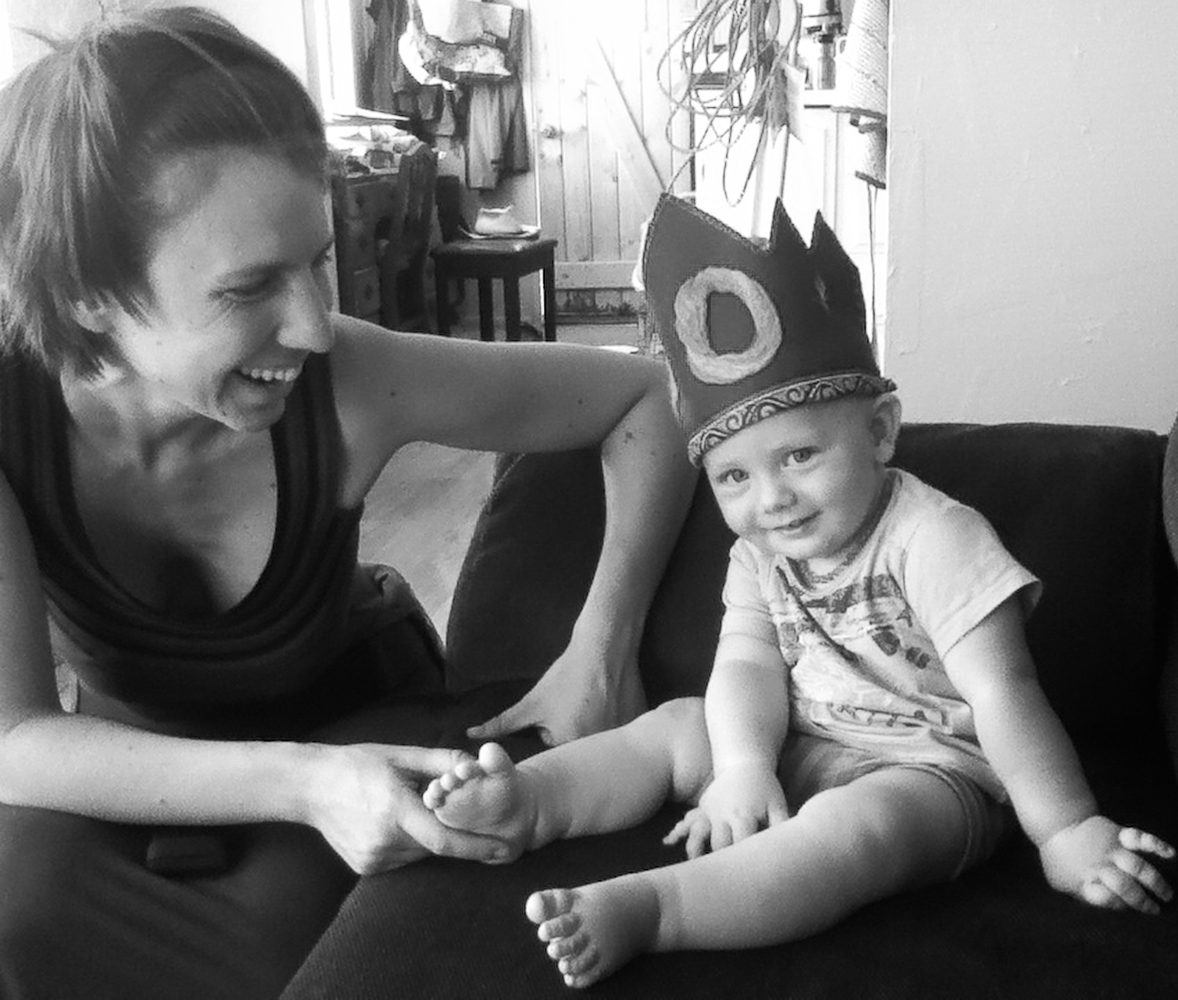
Maya, with Ollie on his Birthday, 2012

Maya, Ollie, Damian, 2012

On a challenge from the blog 400 Days ’til 40 I did a quick-and-dirty calculation of our carbon footprint for a year here in California. I just used the top hit on Google for “carbon footprint calculator” and made my best estimates for all the values they asked for:

1. I live in California, USA, in a household of two.

2. I use no natural gas, heating oil, coal, LPG, and no net electricity by virtue of a solar array, thanks to an investment by my father. Reanna and I cook with propane, and a little research is leading me to believe we will go through approximately 50 gallons in a year, maybe less. Our share of the firewood that my parents burn for heat in the evenings is about .4 of a cord. My share of all this contributes .08 metric tons of CO2 per year.

3. I fly to Portland and to Albany every year to work at Not Back to School Camp. That contributes .95 metric tons of CO2. Something like a quarter of a ton for each leg. Pricey!

4. Car travel is the biggest polluter at 5.05 metric tons of CO2. This amount probably varies quite a bit each year and is way up from my Eugene, OR lifestyle. This estimate includes a few trips to town each week, a dozen trips to the LA area, and one long road trip to Canada. That’s a bit less than 2 tons for each of those kinds of commutes.

5. I use a significant amount of bus and train travel on my business (and some other) trips as well, adding about .12 metric tons of CO2.

6. The second biggest polluter is a group of “lifestyle” choices. 1.21 tons for eating animal products, 1 ton for owning one car, .5 tons for eating only “mostly” local produce, .61 tons for buying stuff with packaging, .17 tons for buying “some” new equipment, .41 for throwing some stuff away, 1 ton for sometimes going out to movies and restaurants, and .4 tons for having a bank account. Total = 4.21 metric tons of CO2. (The highest value possible here was 24.53 tons.)

Here is the summary they gave me:

  • Your footprint is 10.41 metric tons per year
  • The average footprint for people in United States is 20.40 metric tons
  • The average for the industrial nations is about 11 metric tons
  • The average worldwide carbon footprint is about 4 metric tons
  • The worldwide target to combat climate change is 2 metric tons

I have plenty of questions about and criticisms of the way this calculator works. They ask my household size first but do not indicate if they are calculating my individual footprint or my household’s. That could change my score quite a bit if I’m taking the blame for Reanna’s share.

I’d like find a calculator which takes into account more specifics, too. I have owned the same car for 20 years, for example, but the way they asked the question gave me the same carbon footprint as someone who has a brand new SUV every year. Miles driven, too, is not as important as number of gallons of gasoline burned (see my mileage/fuel tracking project here). I buy some things with packaging and I throw some stuff in the landfill (see my landfill tracking project here), but “some” is a vague category to hang such a precise 1.02 metric tons of carbon on! What about grass-fed versus industrially produced meat?

On the other hand, two metric tons is a pretty tight carbon budget, and finding a more accurate calculator will not likely shift my score dramatically. And with this calculator, I am at 520% of my two metric tons, this with a relatively low-profile lifestyle for an American. I could come down to 222% if I did not own a car and never drove one. If I also stopped eating animal products and stopped going to movies and restaurants, I would be close, at 112%. If I also stopped flying, I could actually come in under budget, at 64%, leaving some slack for others.

That’s a pretty discouraging proposition! The biggest barrier is the isolation. No travel means never seeing a large part of my family and community. And the idea is that kinds of lifestyle choices would have to become the norm, not just the domain of eccentrics….

I’m going to have to do some more thinking about this.
Sometimes I imagine being able to visit myself in the past, usually my anxious or sad teenaged self, and wonder how I could be the most helpful to him and the rest of his-future/my-past selves. One thing I like about this fantasy is that it reminds me how lucky I am. There are people who would probably want to tell their young selves something like, “It’s very important that you do not use X drug because it will ruin your life,” or “It is never OK for a romantic partner to hit you. Dump them and go immediately to the authorities.”

I usually imagine delivering a convincing version of, “If you are scared or sad, it’s because scary or sad stuff is happening, and that’s the way life is. Know, though that this all works out. Your next several decades are much better than you can imagine. Yes, there will be scary and painful stuff, but remember that it works out great.” I can vividly imagine beaming at my young self, delivering this message.

There is something comforting about this fantasy, like my young, internal Nathen benefits from hearing it. This led me to taking the question a step further: Given my life so far, what might my 80-year-old self want me to know now? I like to imagine my old, wrinkly self beaming at me, saying, “This works out even better than you can imagine…” As far as I can tell it is likely true, and it is quite calming to imagine.

It strikes me that this is something like what I do in my therapy work. Yes, there is the occasional need for advice, but the biggest part of what I do is let clients know with my mind, body, and soul that their current struggle is a small, if poignant, part of their life story. I welcome their sadness, anger, and anxiety as appropriate, given the circumstances, and I have confidence in their goodness, their strength, their resourcefulness. I try to know and show that this works out for them. It can and they deserve it.

Some of my oldest memories are of lying in bed, late at night, wishing I was asleep: sleep-onset insomnia. I’m happy to say that I have largely overcome this malady. I have a sizeable bag of tricks to help me out with it (read about them here), the most important of which is having gotten over my fear of insomnia, which had become the primary source of sleeplessness. For the last several years I’ve had trouble getting to sleep just a few times a year.

For the last couple months, though, I’ve been experiencing “terminal insomnia,” AKA waking up too early and failing to fall back asleep. Most of my tricks don’t apply here. It sometimes helps to stay in bed until my alarm goes off–occasionally I will fall back asleep. Sometimes cuddling helps, too, but I’ve found nothing consistent so far. It’s become a problem: I’m getting married next week and sleep debt tends to make me clumsy, grouchy, and stupid–not the way I’d like to show up for this event!

So I complained about it to my therapist today and he gave me his hypothesis: I am chronically and habitually productive. Productivity is a way of life  for me and it’s infiltrated my groggy, should-be-going-back-to-sleep mind. He is right. I am on the go all day. It never occurs to me to slow down, much less take a nap, and that was exactly his prescription:

“I wonder what would happen if you cultivated a habit of trying, even to a ridiculous degree, whenever you noticed being really tired , just saying, ‘OK, I’m just going to lie down. I’m just going to quit what I’m doing and lie down.’ Even if it seems indulgent or incovnenient. Just ‘F*** it. I’m lying down, I’m closing my eyes, I’m relaxing. If I sleep, I sleep–it doesn’t matter. I’m just going to relax.’ Look at your tiredness as a sort of enlightened messenger, giving you the gift of saying, “Stop it! Stop working so hard. Just lie down right now and be irresponsibly lazy. Just lay out.’

“And you’ll have to deal with the resistance in you too. The well-trained hard, hard worker in you will say “Now’s not a good time… maybe later,” and the challenge is to say “F*** you. I’m not buying it. I’m lying down. For at least five minutes I’m going to lie down, deep breath, deep relax, and invite myself to doze if it happens.

“It’s the next logical progression of getting over the fear of insomnia: The next step is getting over the fear of being tired. OK, I’m building into my lifestyle being tired and loving myself in my tiredness. If I’m tired, I lie down. Why the hell not?

“I want you to take it on as a spiritual practice. Seriously. A spiritual practice of just interrupting productivity as often as possible in order to be lazy and relaxed and tired and just let the earth hold you up. When you lay down, experience the earth holding you up and receive that kind of support. You are a very diligent, principled and hard-working fellow, Nathen, and we have noticed. We got the message. You’ve got that covered. You’ve acheived that already and can let your pendulum swing back in the other direction.”

He’s right that it won’t be easy. As I’ve been writing, I can feel the familiar tiredness in my face and arms, weighing me down, and I’m choosing to write instead of lie down. Well, maybe I will go lie down and finish this later…

Darlene Lester on her porch, with flowers, in her work clothes
May 13, 2012

When I find myself in the presence of a new very smart person, my favorite question to ask is,”What is the most interesting question in your field?”* It both makes for great conversation and expands my sense of the envelope of human inquiry.

If you have an idea about the most interesting question in your field, I’d love to hear about it in a comment below. If you are the kind of person who creates and publicizes websites, though, what I’d like even more is for you to create a wiki-style site where folks can go, create a forum for their field or sub-discipline, and propose and vote on most interesting questions. This could generate what I want to look at: a home page that is a self-updating outline of what professionals believe are the most interesting questions in their field. If you want to go whole-hog, you could also let them vote on and link to what they believe are the best pieces of research on their question to date.

And since I posed the question, I should probably tackle it for my own field… I am a couples and family therapist, and I propose that the most interesting question in my field is, “What are the precise mechanisms of therapeutic change in couple and family systems?” In other words, how does therapy work? We know that it is helpful in most cases, and we have endless models and speculations about how it works, but virtually no evidence about the mechanisms of change. The best research I know about on the topic is the qualitative, two-part, “What Clients of Couple Therapy Model Developers and Their Former Students Say About Change,” by Davis & PiercyEdging into that territory from another angle is the research summarized in Gottman’s The Science of Trust.

*I stole this question from very-smart-person Ethan Mitchell.

In my time working on construction crews in Oregon, one persistent joke was, upon reading the ubiquitous warning “known to cause cancer in the state of California” on a material we were about to use, was announcing, “good thing we’re not in California!” Everyone would laugh and then go ahead using the pressure-treated lumber, or whatever it was, as usual. I was generally alone in taking precautions in these situations, and actually caught significant flack for being paranoid and/or anal retentive. This was not improved by my careful explanation that California was where the lawsuits and legal actions happened which resulted in these warnings, not where the cancer cases were confined!

The bottom line was that precautions (not to mention using less toxic materials) slow down the process for bosses and often seem unnecessary to the crew, so they were not taken. Many of the crew reasoned that since they already smoked and drank, how much could inhaling some fume or touching some chemical really increase their chances of getting cancer?

This was frustrating to hear but is actually an excellent point. Without information about base rates, how can we make good decisions about toxicity exposure? We need specificity and statistics to make good decisions.

For example, Reanna pointed this sign out to me last night:

It is posted on the side of the RV we have been living in during our renovation project. Of what use is this supposed to be? If I was on the fence about whether or not to buy an RV this might be somewhat helpful, but only by increasing a vague sense of fear, possibly to the point that I wouldn’t make the purchase. I want to know by doing what (driving it? sitting in it? licking the walls?) for how long (minutes? years?) and in what circumstances (engine running? after the RV’s a certain age? at certain temperatures?) will increase my chance of developing what cancer by what statistical rate? With that information, I could make a decent decision about how to interact with this RV. Or construction material.

It’s unfortunately true that construction worker and RV buyers (as well as doctors, lawyers, and Americans in general) do not understand statistics, and so for many this information might not be helpful. But it could hardly be less helpful than it is now.

I gave my first interview a few weeks ago to Peter Kowalke of The Unschooler Experiment. We spent a week together at an east coast session of Not Back to School Camp, but never had a real conversation before this one. He turned the interview into a podcast about my therapy work with unschoolers. I was a little nervous about talking on tape and came away thinking I had rambled too much, but Peter edited it well and I think it came out good. Click on the photo to go to the podcast:

I read Whitaker’s Anatomy of an Epidemic: Magic Bullets, Psychiatric Drugs, and the Astonishing Rise of Mental Illness in America as a counterpoint assignment in one of the diagnosis classes in my Couples & Family Therapy program. It was an excellent book about the history and science of several psychological problems, both as phenomena and diagnoses, including depression, depression, bipolar disorder, ADHD, and schizophrenia. As a university student, I had the opportunity to check out for free any of the many academic citations in the book that piqued my interest, and each one that I looked at seemed indeed to provide the evidence he claimed. I haven’t read anything like all of them (there are nearly 700), but enough to satisfy myself that Whitaker has done some good journalism here, and that his hypotheses are credible.

Two of these hypotheses is about childhood bipolar disorder, the first of which he calls the “ADHD to bipolar pathway.” The side effects of stimulants such as those used to treat ADHD are substantially similar to bipolar symptoms, as shown in the table below, from p. 238. (The formatting is slightly different than Whitaker’s, thanks to an Open Office/Wordpress interaction.) Multiplying the estimated rate of stimulant-induced bipolar-like symptoms by the 3,500,000 children and teens taking those medications, Whitaker estimates we should see approximately 400,000 “bipolar youth” as a result.

The ADHD to Bipolar Pathway

Stimulant-Induced Symptoms

Bipolar Symptoms

Arousal

Dysphoric

Arousal

Dysphoric

Increased lethargy

Intensified focus

Hyperalertness

Euphoria

Agitation, anxiety

Insomnia

Irritability

Hostility

Hypomania

Mania

Psychosis

Somnolence

Fatigue, lethargy

Social withdrawal, isolation

Decreased spontaneity

Reduced curiosity

Constriction of affect

Depression

Emotional lability

Increased energy

Intensified goal-directed activity

Decreased need for sleep

Severe mood change

Irritability

Agitation

Destructive outbursts

Increased talking

Hypomania

Mania

Sad mood

Loss of energy

Loss of interest in activities

Social isolation

Poor communication

Feelings of worthlessness

Unexplained crying

The second part of Whitaker’s thinking on childhood bipolar disorder is an SSRI to bipolar pathway. Estimates of the rate of the well-know SSRI side effect of mania, multiplied by 2,000,000 children and adolescents on the medications, give us the possibility of producing at least 500,000 SSRI-induced bipolar disorders in young people.

If true, these hypotheses could go a long way to explain the skyrocketing rates of childhood bipolar disorder diagnoses, as most diagnoses of childhood bipolar disorder are made on children who are already taking stimulants and/or SSRIs. The primary alternative, and more mainstream, hypothesis is not that stimulants and SSRIs are iatrogenic, but that since those medications solve the problems of ADHD and depression, the symptoms of bipolar disorder that emerge show that the diagnostician had initially guessed wrong, and that bipolar disorder was the previously-existing and underlying cause of the ADHD and/or depression. This, of course, may be true, but it seems very important to discover for certain whether it is!

As a family therapist, when I am presented with a child exhibiting symptoms of ADHD, I am trained to look at the child’s environment and history, especially their family relationships. How is it that these behaviors might be a response to the stresses that the child is experiencing? The point is that I do not just assume that the child has been genetically programmed to disrupt their classroom. I came across this study last year, though, that was a good reminder that “environment and history” are bigger than what happens in-between family members.

It found that children with higher levels of polyfluoroalkyl chemicals (PFCs) in their blood were more likely to have been diagnosed with ADHD. PFCs are long-lasting industrial substances that we accidentally eat and breath into our bodies from various coatings, foams, emulsifiers, and cleaning and personal products. Almost all of us have detectable levels of them in our bloodstreams. They are known to be toxic in other animals to the liver, immune and reproductive systems, and fetal development. It is also starting to look like they are neurotoxins as well.

The study was of correlations, so whether the PFCs caused the children to get ADHD diagnoses remains to be seen. ADHD may turn out to be a PFC-toxity-induced syndrome. Or it could be that PFC levels in mothers correlates with that of children, and that it is in-utero PFC levels that are critical. Or perhaps having an ADHD diagnosis causes children to eat and/or breath more coatings, foams, and emulsifiers. Or who knows what else?

Until the scientists know for sure, here are some ways to limit your PFC exposure, from Environmental Working Group:

Forgo the optional stain treatment on new carpets and furniture.
Find products that haven’t been pre-treated, and if the couch you own is treated, get a cover for it.
Choose clothing that doesn’t carry Teflon® or ScotchgardTM tags.
This includes fabric labeled stain- or water-repellent. When possible, opt for untreated cotton and wool.
Avoid non-stick pans and kitchen utensils.
Opt for stainless steel or cast iron instead.
Cut back on greasy packaged and fast foods.
These foods often come in treated wrappers.
Use real plates instead of paper.

Pop popcorn the old-fashioned way on the stovetop.
Microwaveable popcorn bags are often coated with PFCs on the inside.
Choose personal care products without “PTFE” or “perfluoro” in the ingredients.
Use EWG’s Skin Deep at cosmeticsdatabase.com to find safer choices.