Reanna


I used a Palm Tungsten E2 for several years before moving to an iPod touch a year and a half ago. The Palm was my external brain in GTD style. They work great except that the screen goes out every two years. My solution to that was buying Staples’ $60 extended warrantee, where they would replace the unit one time, “no questions asked.” When the screen got fritzy, I would take it in, get a new one, and buy another extended warrantee. After the initial purchase price I was just renting it from Staples for $30 a year. Not bad.

This arrangement ended when the saleswoman at Staples (Eugene, OR) led me to believe that the warrantee she was selling extended the manufacturer’s one year warrantee for two more years–three years total. I naively took her word for it. When the screen died in 2 1/2 years, my warrantee had been dead for six months. Instead of re-upping I started using a hand-me-down 8GB iPod Touch from Reanna.

There are ways, of course, that an iPod is more useful than a PDA. You can watch videos, check email, and surf the net, for example. I hadn’t been missing those features, though, so what I most noticed when I made the change was that the iPod was way slower, less stable, and badly set up to be my GTD external brain, compared to my PDA. The neat-o factor was strong, though, and free fit my grad-school budget perfectly, so I spent several months slowly figuring out how to get it to do what I needed. Here’s what I came to:

For the Palm’s calendar function, I use the iPod calendar synced with iCal on my Mac desktop. This setup works adequately, though the iPod calendar is very slow to load and iCal occasionally freaks out and starts replicating “all-day” events every few minutes, which is a serious pain to fix. On the upside, both the iPod and iCal calendars are super cool to look at and you can color-code your calendars in any shade of any color. I love that.

For the address book, I use the iPod’s contacts app synced to Address Book on my desktop. Apart from being a little slow, this works just as well as the Palm.

For the Palm’s Tasks, I use Todo on the iPod synced with the desktop version of Todo. The desktop version cost me $15 extra and it was totally worth it. Toodledo online was terrible and I tried using iCal’s to-dos for several weeks first and that system sucked worst of all. Todo has its problems–it’s slow on the iPod and occasionally forgets how to sync and I have to relearn how to set the sync back up–but it’s a slightly more powerful system than the Palm’s. (By the way, I use Todo’s Lists as GTD contexts, not Todo’s contexts. Lists sort items way better. The downside is that Lists in Todo are basically iCal calendars, which can make your Lists list very long. I just put an @ at the beginning of each context-List so that they show up at the top of the list of Lists. (Leave me a comment if that explanation was both important to you and impossible to understand. I’ll try it again.))

For Palm’s Memos, I use Simplenote on the iPod synced to Notational Velocity on my desktop. Aside from Simplenote being infuriatingly slow, this system works great. It’s better than Memos. I tried out Evernote, which looked awesome–actually bought it–but it crashed my iPod every time I tried to use it.

For Palm’s Expenses, I use a project in Todo. This is not a great system, but I’m limping along with it.

Palm’s Notepad was cool and I used it a lot, but I don’t seem to miss it much now. There is probably a good drawing app for the iPod, but I quickly became conservative about adding new apps. About half of the ones I tried (Skype and Evernote, off the top of my head) crashed the iPod. For one thing, I need a stable system way more than I need a cool drawing app, and for another, I hate having to buy something to find out if it crashes the iPod.

I never used my Palm’s Media function, so I can’t really compare it to the iPod, but I’m sure the iPod would easily win in that category. I don’t use my iPod to store photos or videos, but I do love being able to store music and podcasts on it. And I do enjoy being able to stream videos on it. I also really like that I can plug a mic in and record–I keep an audio journal and this means that I don’t have to carry around an extra gizmo. (Though it sucks that Voice Memo is so unreliable. I lose about 15% of the longer recordings I make which, as a recording engineer, gives me a small heart attack every time. And I haven’t seen a recording app that seems better yet. Any suggenstions?)

And I really do love the interface. So neat! So pretty! I was fairly obsessed with it for a while. My friend Debra named my iPod “Petunia” and asked if Reanna was jealous, I was spending so much time with it.
Reanna is from the Pacific northwest and I grew up in Joshua Tree, CA, where we are currently living. We have an ongoing conversation about humidity here because having grown up in a wet climate, she is vigilant for the ways that moisture in the air decomposes things. “If we don’t keep it warm in here, won’t condensation damage the books?” No, it won’t, and probably wouldn’t even if we had a constantly boiling pot of water. The only place I’ve ever seen mildew in Joshua Tree is in one of our bathrooms which, until very recently, had no windows and no fan. This was not aggressive mildew either, just noticeable every once in a while. “If the roof of the trailer has leaks, won’t there be tons of mold in the walls?” No, not likely, because even if rain was pouring right through the trailer, it would be completely dry again within hours.

I have never tracked humidity levels before, so while I knew that Joshua Tree was dry, I didn’t know what level of humidity qualified as dry. I also didn’t fully understand the different measurements of humidity that are floating around out there. The short version of that story is that there are three units of humidity: absolute, specific, and relative humidity. Absolute humidity is grams of water per kilogram of moist air and specific humidity is kilograms of dry air. Relative humidity is more complicated. If I understand correctly (if incompletely) it is the ratio between 1) the pressure that the water vapor in a given amount of air would exert on the insides of a container, should it somehow be trapped there without its accompanying dry air, and 2) the pressure below which water would start condensing out of the air. Relative humidity is the measure of humidity that you usually see in weather reports, partly because it takes into account temperature–at lower temperatures, air holds less water.

Here are some cities with different levels of relative humidity, to give a sense of where we are in Joshua Tree. I’ll also include precipitation. (Data is from Weather Underground unless otherwise noted.)

Seattle, WA, 2011: High 99%, Low 34%, Average 82%, Precipitation 12.92 inches

Honolulu, HI, 2011: High 96%, Low 18%, Average, 65.6% Precipitation 23.82 inches

Joshua Tree humidity, 2011: High = 83%, Low = 10%, Average = 30.7%, Precipitation 1.53 inches

Las Vegas, NV, 2011 (the driest city in the US): High 98%, Low 2%, Average 28.7%, Precipitation about 2.5 inches (precipitation according to climatestations.com)

Kolkata, India one of the most humid cities in the world, on July 15, 2011: High 94%, Low 64%, Average 84%, Precipitation 0.0 inches

And Kartoum, Sudan (Sahara desert), on January 4, 2011: High 43 %, Low 10%, Average 24%, Precipitation .51 inches

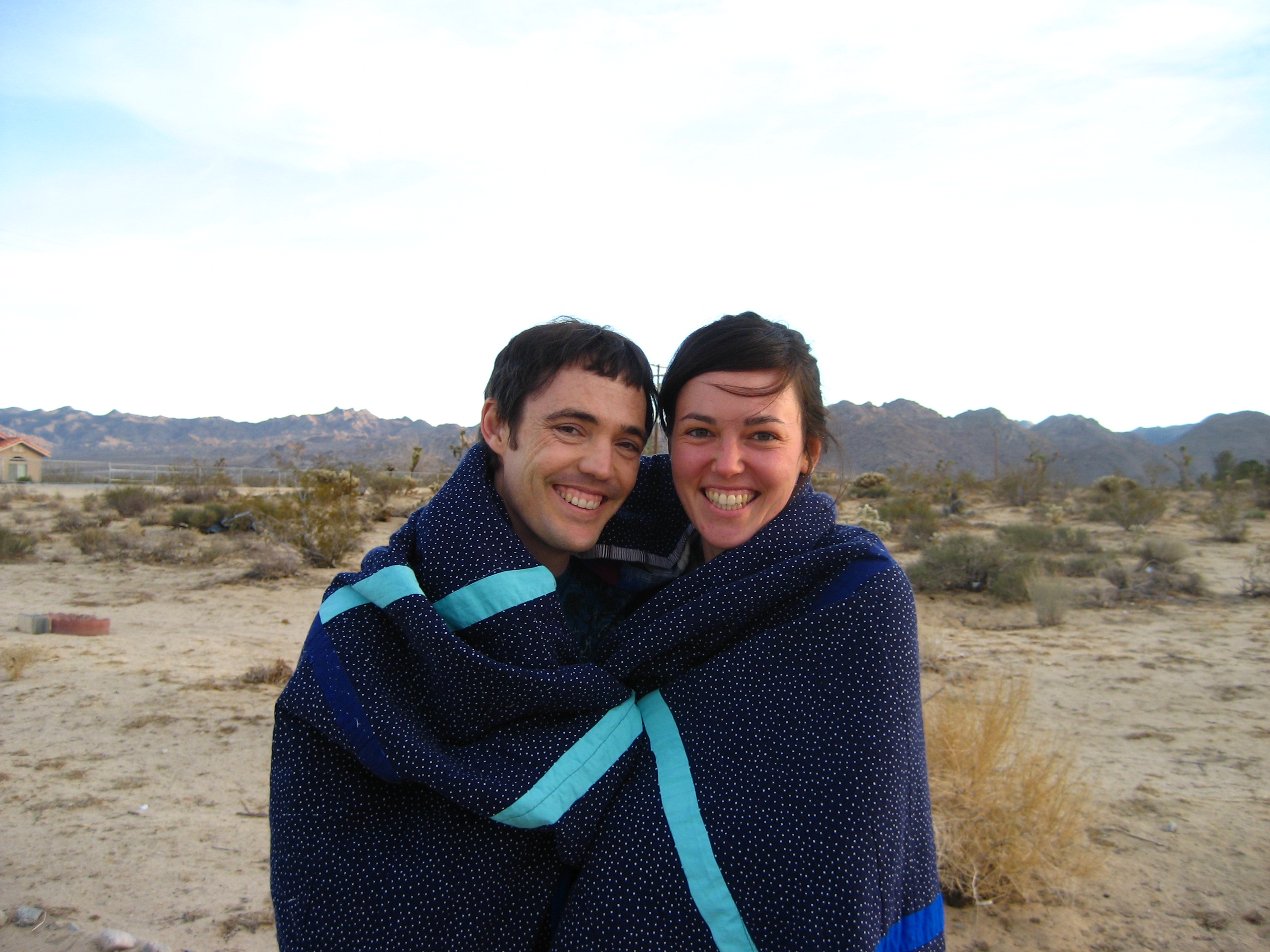
Nathen, Reanna, Quilt, Desert

Reanna and I are in the process of officially combining our finances. I’d been a little nervous about it, but so far it’s going great. One of the tools we’re trying out is Mint.com, a free, online program for tracking money. Maya pitched us pretty hard on You Need a Budget instead of Mint, and my early impression is that YNAB is in a lot of ways simpler and more useful. We’re trying Mint first mostly because we can access it from our own computers. (How about some way to sync one account between two computers YNAB?) I’ll post a review after I know Mint better. So far, it seems adequate and is mostly pretty fun and intuitive for me, coming from Quicken.

Here are the tags we’ve agreed upon so far:

Reanna and I have just about finished re-sealing our 1962 Kenskill travel trailer. Everything that was screwed into the corrugated aluminum that covers the outside of the trailer had to be resealed: access hatches, tail lights, door, windows. It turns out that this is hard work and takes a long time. We did not anticipate this, mostly because the instructions for the process are very simple: 1) unscrew the window or vent or whatever, 2) remove the old putty tape, 3) apply new putty tape, and 4) screw the part back in. No problem!

Reanna vs. Butyl Putty

These instructions leave several questions unanswered, foremost of which is how much of the old putty tape needs to come off for the new putty tape to seal well? Old butyl putty is sometimes impossible to completely remove with a putty knife, short of scraping all of the paint off the aluminum. No one mentions solvents in removing this stuff, but that is the only way I can imagine getting it all. Even the non-butyl putty, which gets crumbly and easy to scrape off in its old age, hides in the tiny crevices created by staples and folds in the aluminum and takes almost forever to remove completely.

Another question is how important is it to leave the paint on the aluminum intact. I found that I could speed up the process of chipping and scraping the five or six layers of rubbery and/or rock hard sealants on the roof vents using my putty knife at a sharp angle and hitting it with a hammer. Uncovering a vent could take two hours to uncover, pre-hammer technique, and now takes only just over an hour. Unfortunately, it is an unsubtle technique which inevitably gauges the paint and the aluminum underneath. Is this a problem? Even if we are going to cover everything in sealant?

Also, is there any advantage to using non-butyl putty tape? Our extremely reticent local RV repair guy would say only that he used butyl for roofs and non-butyl for walls and that butyl was stickier. People who talk about it online mostly seemed to use butyl. We found the butyl to be much easier to work with and stopped buying the non-butyl after a couple of rolls. Half of the wall-mounted stuff like windows are sealed with butyl now. Will that be a problem?

I’d like to share the several techniques I invented during this job, but I have no idea what the results will be during the next rain, much less in a couple of years. There are only three things that I know I wish I had known beforehand:

1) Don’t go to the putty knife too quickly when removing the remnants of non-butyl putty. You can get a lot of it off by rubbing hard with a wet rag for a while. It is not easy to do for hours, but quicker than going after each speck of putty with the corner of a blade.

2) You will probably have to throw away almost all of the screws you pull out, so you will spend a lot of money on new ones. And while you are correct in your initial assessment that the trailer is put together almost entirely of #8×3/4″ and #10×1″ screws, you will need a large assortment of other sizes because of water damage. I now have 3/4″ screws in #8, #10, #12, and #14, 1″ screws in #10, #12, and #14, and 1 1/2″ screws in #10 and #12. And several of those kinds of screws meant another trip to the hardware store to get them.

3) Sealing up the trailer will take a lot longer than a week if you have anything else you like to do with your life. More like three weeks. (Actually, I’m not sure I would have been better off knowing that one…)

And finally, here is the only video we found, after considerable searching, of someone actually applying putty tape. (Thanks, Canned Ham Trailers!)

Left: About to put chains on my B2200, just north of Mt. Shasta. Right: Mazda & Reanna, Indian Cove, CA.

My Mazda B2200 pickup was first sold the year I started driving, 1988. I bought the truck from my girlfriend’s dad in 1992 for $3,800, with about 80,000 miles on it. It was my second vehicle, after a 1979 Honda Civic that went through two engines in three years. It wasn’t a great deal but I thought it was a good vehicle after driving it off and on for six months. Nineteen years later I can say that it was a good buy.

Now it has 254,566 miles on it, total, and is 83,857 miles into its second engine. It just pulled a load that weighed over 4,235 pounds for 1,112 miles – from Eugene to Joshua Tree – including the highest pass on the I-5 and several other passes. I never even had to go into first gear to get up those grades. In fact, it made the entire trip with no problem at all. (I don’t recommend pulling 4,000 pounds with your B2200, by the way. It’s only rated for 1,000 pounds of cargo, passengers included. It’s basically a station wagon in the shape of a pickup. But we did make it!) It was a slow trip, though. We were surprised to pass a tractor-trailer on a hill just south of Eugene, so we started a tally of vehicles passed:

Tally of Moving Vehicles Passed Between October 30 and December 4, 2011. (That driver passed us back as soon as we started downhill.)

My B2200 gets between 15 (around town) and 27 (on the highway, no stops, downhill, with a tail wind) miles per gallon. That’s 350 miles to the tank. I average about 22 mpg over a year of driving – pretty bad, I know. Gas mileage is my main complaint about the truck. It may run pretty clean, though. At its last smog check – in 2001 because Oregon does not require them – it blew 17 parts per million hydrocarbons (of 120 allowable and 30 average), and something less than .01% carbon monoxide (of 1% allowable and .1% average) at an idle, 792 RPM. At 2,453 RMP it blew 35 ppm HCs and still less than .01% CO. We’ll see how it does ten years later, now that I’m back in California.

The truck costs me about $1,500 to own and operate each year. I spent exactly $9,253.21 from the beginning of 2004 to the end of 2010 on everything truck-related, including fuel, registration, parts, labor, insurance etc etc. That was while I was living in Eugene, though, where I didn’t have to drive much. We’ll see how much it costs now that I’m living in driving country again. I should also say that I do most of my own auto repair – anything easy. I’ve done pretty much all of the routine maintenance, things like spark plugs, caps, rotors, fuel, air & oil filters, and tire rotations, plus other parts as they broke or wore out: the power steering pump, alternator, generator, shocks, various hoses and belts. I took it to real mechanics for the harder stuff, like the new engine, a couple mufflers, a vacuum leak, a new bumper and fender.

Whenever I hit a major repair, I have to decide if it’s worth it to keep going with this truck. Each one costs more than I could sell the truck for. So far I’ve always gone with my truck. It always seems like the it’s worth it. The transmission will probably be my next big expense – I’m still on the original transmission. That will cost $1,500 or so.

It definitely looks like a beater. Plenty of primer. I bumped into a few things over the years and always had more pressing things to spend my money on. During the big move, Reanna and I talked about a new paint job to reward the truck for hauling all my worldly possessions over those passes so admirably. We’re thinking yellow, or maybe red. My dad used to be a car painter, so he can show us how.

Moments With My Truck: A reunion, a roadtrip, the recent move. (Collages by Reanna)


Reanna and I moved from Eugene to Joshua Tree in early November. We were there about a month before leaving to visit her family, and our primary project was starting to set up a new living space: an early-1960s Kenskill travel trailer. We will see how this arrangement suits our needs in real life, but the idea of living in a trailer suits the idea of our needs quite well for the time being. I have lived in trailers off and on throughout my life, and while I found nothing glamorous about it, I really appreciate how cheap and mobile they are. Cheap is very appealing now, with large student loans to pay off. Reanna has been interested in the tiny home movement and travel-trailer renovation for years (check out Tumbleweed Tiny Homes, Tiny House Blog, and a couple of trailers), so her vision is the engine for this project.

The first phase was creating a space for the trailer and a little yard for us. We did this in the “north 40” of my parent’s property. Here are some before, during and after shots (all photography and editing by Reanna):

Before, Looking Northwest: From left to right you see the sauna/bath house, our trailer in its old spot, Uncle Bill's shed (to be moved), Grandpa Bob's workshop (to be made into sewing palace), and the old goat pen.

Before, Looking Northeast: In between the fence and the structures, you can see a pile of 2,500 pounds of plywood and other stuff, the remains of an 8' vert ramp. Then left to right, an 8' trailer, Uncle Bill's shed, our 24' trailer, and the sauna/bath house.

During, Looking Southwest: Behind me you can see the 8' travel trailer that served as my bedroom in high school. We gave it away to a local a few days later. It actually made me quite sad to watch it limp away.

During, Looking North: The pile of plywood on the right was the last third or so of the landfill.

After, Looking Northwest: The plywood is gone, 24' trailer in its new place. You can see we'll have a nice little yard in between the trailer and the bath house, once we move Uncle Bill's shed.

After, Looking Northeast

After, Looking West

After, Looking North: Here's the best shot of the trailer. My friend John lived in it while he did his undergrad. It had been his grandparents' and parents'. He gave it to me in the late 90s, when I lived in it for two years. It's got an unusually nice layout, with big windows on the kitchen/dining room side (the right), bedroom in the middle, and bathroom in the back.

Weatherizing in a Wind Storm

Every Heavy Thing in the Yard on Top to Hold it Down

Still to do: seal it up to prevent further water damage, prep for paint, paint, put in new flooring, fix plumbing, furnish, move in.

Here are some photos from my move with Reanna to California:

Joe, Nathen, and Layer 1 in U-Haul

Layer 2 in U-Haul

Layer 3 in U-Haul

Layer 5 in U-Haul

Reanna on U-Haul at Rest Stop

Just Another Trailer

Lauri & Ev's Apple Cider

Reanna Makes Lunch

Reanna (Tiny), Sign (Huge)

Caswell State Recreation Area

Nathen, Stanislaus River

Nathen, Bedhead, $6 Sunglasses

U-Haul Trailer Tire, Blown Out (Rim Behind Tire is Cracked)

Reanna, Tumbleweed Pom-Poms

Welcome Display by Mom

Reanna Meets Oliver

Reanna Plays With Oliver

Reanna and I just moved from Eugene, OR, to Joshua Tree, CA for $693.79. Our boxes were free, mostly from the Oakway Nike outlet dumpster. Our labor was free, mostly our own, plus a couple friends at key moments. We paid $218 for our 5×8 U-Haul trailer ($170 for seven days, plus $48 for trailer-plus-$5k insurance). Our U-Haul guy threw in an extra day (which we used) and a bag of packing blankets (which we used a few of).

We paid $70.71 for food. We ate at Casa Ramos in Corning for $22.76 and bought a date milkshake for $4.95 at Charlie Brown Farms in Littlerock, CA. The rest was for groceries.

We paid $126.99 for lodging. We stayed for free with my cousins Tom & Megan in Ashland the first night. We planned to stay at campgrounds the other three nights but that didn’t work out very well. We could’t find the first one before it got dark, so we stayed at the Economy Inn in Corning for $44. (We liked that room. Reanna liked the cinderblock construction and bathroom layout enough to take photos. The advertised pool, however, had clearly been out of commission for a long time.) We did camp on the third night, at Caswell State Recreation Area, for $30. It was very pretty there. A tiny remnant of central CA old growth forest. If you go, spend some time choosing your campsite. Some are adequate and some are really nice, right on the river.) Our fourth night of camping was undone by a blowout on our trailer. We spent three hours huddled in the dust between the I-5 and an almond orchard just south of Coalinga, while U-Haul and Billingsley tires figured out where we were, that the rim was cracked, and just what size of wheel we needed. We sprung for a motel that night, as we were pretty sure some of that dust was pesticide. We’d seen a crop duster flying over the almond orchards a few minutes north. It was worth the $52.99 just for the shower at the Econo Lodge Inn in Buttonwillow. (Though the wifi was terrible and the advertised pool was covered in some kind of scum.)

The biggest expense was gasoline: $278.09 for 72 gallons for the 1,112 mile trip. That’s only 15.44 miles per gallon, but not bad to move that much weight–6,900 pounds, including me and Reanna.

I also bought new tires before the trip ($310 on sale at Wal-Mart) but I am not counting that as a moving expense since I needed them anyway–my old tires were in OK shape for occasional town driving but ten years old with well over 100,000 miles on them.

So our total was $693.79, which is my most expensive move by far, but pretty good, I guess, for moving 40 years worth of possessions over a thousand miles.

I first saw Sumi Ink Club art at my brother Ely and Christina’s wedding reception. The party was on the roof of the Pasadena Museum of California Art, and there was a whole room of Sumi Ink Club downstairs. It was striking–densely packed, collaborative, black drawings covering white walls from floor to ceiling. I have to admit I was primarily overwhelmed by it, and that it was Reanna who stayed interested, setting up a Sumi Ink Club party for an issue of her magazine. That’s how I had the idea to do Sumi Ink Club during my advisee group at the first New Hampshire session of Not Back to School Camp.

We started with two picnic tables of almost blank white paper and 14 sharpies. (Sumi Ink Club uses sumi ink and brushes, of course, but sharpies work. I’ll paste in the official rules at the bottom of this post.) We just started drawing and rotated to a new spot every couple of minutes. It was really fun and we were excited about the final product, which we figured took about 26 person-hours to complete:

Full Composition, 5×8′, Paper & Sharpie (Occasional Crayon, Marker & Paint by Anonymous Artists)

Section 1

Section 2

Section 3

Section 4

Section 5

Section 6

Sharpie Artists, in Front of Our Meeting Place, the Charles H. Watts Craft House, Camp Huckins, NH, September 2011: McKinley Corbley, Liam Woodworth-Cook, Signe Constable, Justus Joy, Joel Malkoff, Maddie Pryor, Jacob Adams, Rio Nelson, Eve Blane, Hannah Conrad-Reingold, Kiera McNicholas, Nathen Lester, Sophia Kramer, and LarkinHeintzmann in front.

Here are the guidelines for doing Sumi Ink Club, from the website sumiinkclub.com:

sumi ink club rules*:

– anyone can join in (all ages, all humans, all styles)

– everyone adds to the same drawing

– keep moving around, don’t spend too long in one area

– add to what other people have started

– keep the ink pure, don’t dilute with water

– no words allowed, but things that look like words are ok!

* you can experiment with making your own rules and using new materials, of course you can!

While Nathen is away at Not Back to School Camp in New Hampshire, I, his lonely fiancé, am trying to keep myself busy and in good company. To that end, I moved in with some friends of ours, Nick and Tilke, for a few days.

While I was staying there, Tilke and I talked a lot about colour (or “color,” as I might start spelling it after I get my green card). Colour is a lifelong passion of Tilke’s, and she is in the midst of revising a book she wrote and illustrated on the topic as well as writing the syllabus for a workshop called Experiencing Color.

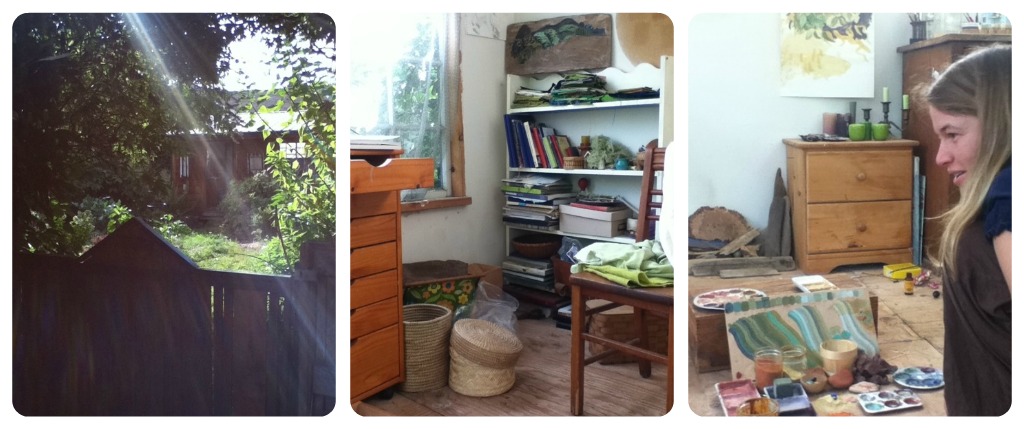
Tilke's backyard studio

While talking to her about her workshop, I started to describe my own challenges with colour: Since I started making quilts a couple years ago, I’ve struggled with figuring out how I want to put colours together and have realized how little confidence I have about colour. When I do hit on something I like, I mostly don’t know why it works. I described how a few days earlier I’d been in a fabric store trying to choose a few solid colours to buy: when I went for my favourites, the ones that caught my eye –fuchsia, emerald green and bright blue– they looked terrible together. When I tried to narrow my choice down to two colours that I thought of as complementary, the connotations seemed all wrong. I ended up leaving without buying anything.

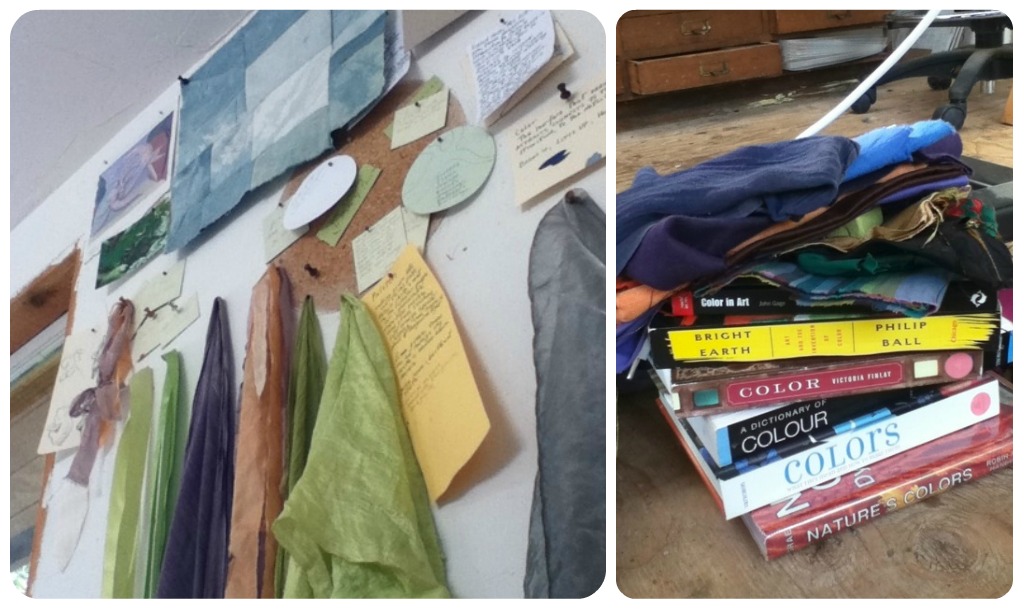
Plant-dyed fabrics, books about colour.

So here she was, someone trying to figure out how to teach people about colour, and here I was, a real, live colour novice with a hunger to learn. We went to look at her fabric stash and talk it out.

Tilke has a very distinctive colour palette that anyone who knows her would recognize, a family of colours she uses in her work and surrounds herself with. She described the way that certain colours in her family support or “bridge” other colours. I noticed as she moved fabric around that she mostly grouped her colours in sets of three or more. She agreed and showed me how adding a third colour can add a subtlety and depth that you can’t get with two colours.

I started to get a feel for what she was saying. I tried putting together my own set, choosing first a turquoise I liked and then adding another blue, a mushroom, a brown and an orange until – magic! – I had a group of colours that looked great together.

“What if you couldn’t have this one?” Tilke asked, and took out the orange. So I shuffled things around and brought in new colours until I had another set I liked. We talked about the importance of arrangement (which colours are beside each other) and proportion, looking at paintings and photos around her house for examples. Later we played a game with her new “colour library” of fabric samples, where we challenged each other to take the worst colours (eg: neon peach or drab burgundy) and make them beautiful by combining them with good supporting colours. Very fun!

I was so inspired that I started “editing” some patchwork pieces I’d sewn together a year ago that weren’t doing it for me: it suddenly seemed obvious which colours weren’t working, and taking them out made a big difference.

My quilt project, before and after colour editing.

We also had great talks and I got to try out throwing around medicine balls with them in the park (Ooof. My hands were too shaky to keyboard afterwards). It’s so fascinating to peer into – and join in on – other peoples’ lives like that. I’d like to do it again some time.

« Previous PageNext Page »