I came across this article on sex-selective abortion on The Rational Optimist (via Jad Abumrad‘s tweet), about the skewing of sex-ratios as access to wealth, abortions, and ultrasound technology increases. This, for example, is a map of China showing sex ratios by region. White areas have naturally-occurring ratios. The darker the red, the higher the skew towards males (and the richer the region). This kind of thing is happening in about half of the world’s countries, not just China, and it’s likely to increase as we get better at sperm-sorting and genetic manipulation.

This is a map of “son preference” by country:

I was caught off guard by one of the comments on the article. I realized that I had breezed past this section:

“Policy seems largely powerless to fight this problem. Sex-selective abortion is illegal in virtually all countries. China’s authoritarian “one-child policy” is in marked contrast with India’s more laissez-faire attitude to family planning, yet both have produced widespread killing of female fetuses.”

I read this focused on their point that different policies on family size were producing similar results in terms of sex-selective abortion. The part about sex-selective abortion being illegal did not catch my attention at all. And if it had really  caught my attention, I probably would have thought something like, “Oh, good for them. I wouldn’t have expected that in highly sexist cultures.” Then I read the comment:

“If a society permits abortion on demand (which many do), then it permits abortion on demand. Permitting abortion on demand *except* when this is used to achieve sex selection seems peculiarly inconsistent.”

Whenever I think seriously about abortion I am impressed by how difficult the ethics are to untangle. The simple, clearcut answers that my inner idealist wants are offered only by heavy duty idealogs, and those answers don’t make sense to me. And opinions tend to be so impassioned that it can be difficult–scary, even–to carry on a sustained conversation about it. I notice, even as I’m writing and editing this little piece, that I am tending to say less and less as time goes on…

I vote pro-choice, but that does not get to the complexities of the issue for me. My votes are acts of passing the buck to the individual women making those decisions, letting myself off the hook as best I can. At the same time, I  believe that fetal life has moral import, and feel myself getting more squeamish about abortion the more aesthetic the reasons for it. When I think about its use by people who have value-structures very different from my own to further their own cause, it is troubling. Sex-selective abortion is one clear example. Another is the rumors that the conservative support of Planned Parenthood has been a kind of race-selective abortion, because women of color are having more abortions than white women. Shudder.

Maybe I just want to avoid this discomfort, but I wish only women could vote on this issue, and let me the rest of the way off the hook about it.

My regular podcasts* have not been able to fill all my listening needs during this trailer-renovation project, so I’ve been trying out some new ones. The two that I am most excited about are After Words from booktv.org and This Week in Microbiology from microbeworld.org. They are both at least an hour per episode and have a considerable back-catalog, so I should have plenty of excellent listening and learning for the rest of my project.

In each After Words episode, the author of a recent scholarly book is interviewed by another expert in/about their field. For example, Jack Abramoff was interviewed by CQ Roll Call’s lobbying reporter Eliza Newlin Carney about his book Capitol Punishment: The Hard Truth About Washington Corruption From America’s Most Notorious Lobbyist. Sam Donaldson from ABC interviewed Chris Matthews about his book, Jack Kennedy: Elusive Hero. Yale psychiatrist Sally Satel interviewed cognitive neuroscientist Michael Gazzaniga about Who’s In Charge? Free Will and the Science of the Brain. I’ve listened to 13 episodes so far, biographies, histories, ethics, law, science, and every one has been excellent. After each one I’m spinning on new ideas and new depth of understanding. If you are a nerdy eclectic, I think you will like it.

In This Week in Microbiology, Vincent RacanielloMichael Schmidt, and Elio Schaechter present and discuss new articles and ideas from the world of microbe scholarship. Now you might think that pretty boring way to spend an hour and twenty minutes each week, but you’d be wrong. Did you know that the more variety of microbes that live on your skin the less mosquitos are attracted to you? That hydrogen sulphide (the gas farts are made of) is toxic to the skin of your intestines? That there is evidence of a significant difference in the bacteria in the guts of autistic vs. neurotypical children with gastrointestinal distress? That many bacteria navigate by sensing the earth’s magnetic field? With my strictly-200-level organic chemistry and biology education, I do get lost in some of the discussions of specific substrates and protein types, but the hosts consistently bring the conversation back to the bigger ideas: What could this mean for us? For science? What do we still not know? What are the next steps? It’s fascinating. They also produce podcasts called This Week in Virology and This Week in Parasitism (and are threatening great-sounding shows like This Week in Micology (fungus) and This Week in Immunology), which is a problem–the problem of every modern-aspiring renaissance man: You can’t keep up with science anymore. Oh well, it’s still fun to try!

*In alphabetical order: Freakonomics, Left Right and Center, Planet Money, Radiolab, Seminars About Long-Term Thinking, Sound Opinions, This American Life.

R: I’m ordering tags to sew onto the napkins I’m making for the wedding, so people can use them for souvenir hankees or something. I was going to put “Nathen and Reanna, May 16, 2012.”

N: Good idea.

R: Should I put something else on it?

N: What do you mean?

R: I just thought you might come up with something poetic, you know, that summed us up nicely.

N: Oh, yeah, like a slogan. We need a slogan for the wedding!

R: Hmm.

N: How about “Grins Galore”?

R: Ha!

N: “Ta-ta for now”?

R: “TTFN?”

N: No! “Enchantment Under the Sea”

R: God…

N: Oh, I’ve really got it: “A Salute to our Veterans”

R: Unfortunately, I just pressed the “send” key. Too late.

I have always driven slow cars. It’s not that I have anything against fast cars, though. It was more or less an accident, aided and abetted by poverty. When I was young and wanting to drive fast, I got my first slow car, an extravagant $1,200 gift from my grandmother, a 1979 Honda Civic. It would go about 80 miles an hour with a tail wind, and I managed to get a few speeding tickets in it before I turned 20. It looked just like this except with a lot less paint:

1979 Honda Civic CVCC Hatchback

I bought my second (and current) slow car at 20, a 1988 Mazda pickup, and got my next and final speeding ticket a few months later. I was on the I-5 just south of Corning, CA. The Highway Patrol officer said, “You were going well over 70 miles per hour.”

I decided at that moment that speeding was not worth it. It was expensive and stressful because of the tickets and because of constantly watching the rear-view. “Oh crap, is that a Mustang? Is is black and white, or is that just sun glinting off of it?”

So why would I want a fast car? If I can get speeding tickets in slow cars, why would I want to tempt myself with all that velocity-headroom? No reason I could think of, until now.

Reanna and I just drove to Joshua Tree from Whistler in a fast car, a 2001 Acura 3.2CL. Borrowed. The owner told us he’d been clocked by radar at just under 150 miles per hour, and then the officer who clocked him (after he was off duty) drove it just over 150.

Still, I was not much tempted to speed. My aversion to paying speeding tickets has only grown over the years. But I realized that velocity is not the real reason to have a fast car. It’s acceleration. Driving is a series of decisions about what is safe to do. Is it safe to pass this slow car? Do I have enough room to change lanes? Make this left turn? Etc. In my Mazda, the answer is very often, “No, I’d better not.” In my decades of driving it, all those “No” decisions became invisible. It’s not a choice if there’s only one choice, right? In the Acura, even with my habitually conservative driving style, the answer is usually “Yes, no problem at all.” A very different experience!

Fast Car, Slow Car

And even though I was still driving the speed limit, I think that all those “Yes” decisions add up to to a faster trip, especially on a long trip like we just made. I continue to think that fast cars are probably not worth the extra money for the purchase price or for the lower gas mileage, but I concede that fast cars probably increase your quality of life.

I listened to a lot of TED Talks as I’ve been renovating my trailer. I tend to like them and I’ve learned a lot–what a great resource! I’ve also noticed that listening to most of them is fine–no viewing necessary. Not with this one. It’s my favorite TED Talk of the 50+ I’ve been through so far.

John Gottman is best known for his research on couples (which I’ve written a few things about here) but I think that some of his most important work has been distinguishing two distinct parenting styles: emotion coaching and emotion dismissing. I’m reading his new book, The Science of Trust, right now, and he goes over these findings because it turns out these styles of relating to emotions have big ramifications on building or losing trust in one’s partner. I’ll write more about that as I come to understand it better. (And by the way, if you are a serious couples therapy nerd like me, this book is great. Check it out.)

The basic idea is that parents have different reactions to emotions in their children. We call these reactions “meta-emotions” because they are emotions about emotions. “Emotion coaching” means when an emotion shows up in your child, you treat it as useful information, you engage your child around it in a way that tells them it is OK to have that emotion. “Emotion dismissing” is the opposite. You communicate that they are choosing to have this emotion that you find unpleasant and that making that choice is unacceptable. (This is similar to a problematic parenting technique called “mystification” which I wrote a little about here.)

Clearly this is a potentially complicated phenomenon, because we can have different emotional reactions to each emotion in our kids. We may, for example, have a coaching reaction when a child shows, say, pride, but a dismissing reaction when they show anger. Or vice versa. And our reaction may be different in different contexts, like at home versus out shopping. And other cultural factors are at play, too, like gender or age of the child, which can cause us to react differently. For the following lists, Gottman is using the coaching/dismissing distinction with a broad brush. The list items are direct quotes from pp. 181-188, but the list titles are my paraphrases (note that “affect” is psych-speak for “emotion”):

What Emotion-Dismissing Parents Do:

  • They didn’t notice lower-intensity emotions in themselves or in their children (or in others, either). In one interview we asked two parents about how they reacted to their daughter’s sadness. The mom asked the dad, “Has Jessica ever been sad?” He said he didn’t think so, except maybe one time when she went to visit her grandmother alone and she was 4 years old. “When she boarded the airplane alone,” he said, “she looked a little sad.” But all children actually have a wide range of emotions in just a few short hours. A crayon may break, and the child becomes immediately sad and angry. These parents didn’t notice much of Jessica’s more subtle emotions.
  • They viewed negative affects as if they were toxins. They wanted to protect their child from ever having these negative emotions. They preferred a cheerful child.
  • They thought that the longer their child stayed in the negative emotional state, the more toxic its effect was.
  • They were impatient with their child’s negativity. They might even punish a child just for being angry, even if there was no misbehavior.
  • They believed in accentuating the positive in life. This is a kind of Norman Vincent Peale, the power-of-positive-thinking philosophy. This is a very American view. The idea is: “You can have any emotion you want, and if you choose the have a negative one, it’s your own fault.” So, they think, pick a positive emotion to have. You will have a much happier life if you do. So they will do things like distract, tickle, or cheer up their child to create that positive emotion.
  • They see introspection or looking inside oneself to examine what one feels as a waste of time, or even dangerous.
  • They usually have no detailed lexicon or vocabulary for emotions.

What Emotion-Coaching Parents Do:

  • They noticed lower-intensity emotions in themselves and in their children. The children didn’t have to escalate to get noticed.
  • They saw these emotional moments as an opportunity for intimacy or teaching.
  • They saw these negative emotions–even sadness, anger, or fear–as a healthy part of normal development.
  • They were not impatient with their child’s negative affect.
  • They communicated understanding of the emotions and didn’t get defensive.
  • They helped the child verbally label all the emotions he or she was feeling. What does having words do? They are important . With the right words, I think the child processess emotions usually associated with withdrawal (fear, sadness, disgust) very differently. I think it becomes a bilateral frontal-lobe processing. Withdrawal emotions still are experienced, but they are tinged with optimism, control, and a sense that it’s possible to cope.
  • They empathized with negative emotions, even with negative emotions behind misbehavior. For example, they might say: “I understand your brother made you angry. He makes me mad too sometimes.” They do this even if the do not approve of the child’s misbehavior. In that way they communicate the value, “All feelings and wishes are acceptable.”
  • They also communicated their family’s values. They set limits if there was misbehavior. In that way they communicated the value, “Although all feelings and wishes are acceptable, not all behavior is acceptable. (We had other parents who did everything else in coaching but this step of setting limits, and their children turned out aggressive.) They were clear and consistent in setting limits to convey their values.
  • They problem-solved when there was negative affect without misbehavior. They were not impatient with this step, either. For example, they may have gotten suggestions from the child first.
  • They believed that emotional communication is a two-way street. That means that when they were emotional about the child’s misbehavior, they let the child know what they were feeling (but not in an insulting manner). They said that was probably the strongest form of discipline, that the child is suddenly disconnected from the parent–less close, more “out.”

Teaching by Emotion-Dismissing Parents

  • They have lots of information in an excited manner at first.
  • They were very involved with the child’s mistakes.
  • They saw themselves as offering “constructive criticism.”
  • The child increased the number of mistakes as the parents pointed out errors. This is a common effect during the early stages of skill acquisition.
  • As the child made more mistakes, the parents escalated their criticism to insults, using trait labels such as “You are being careless” or “You are spacey.” They sometimes talked to each other about the child in the child’s presence, as in: “He is so impulsive. That’s his problem.”
  • As the child made more mistakes, the parents sometimes took over, becoming intrusive.
Teaching by Emotion-Coaching Parents
  • Gave little information to the child, but enough for the child to get started.
  • Were not involved with the child’s mistakes (they ignored them).
  • Waited for the child to do something right, and then offered specific praise and added a little bit more information. (The best teaching offers a new tool, just within reach. Then learning feels like remembering.)
  • The child attributed the learning to his or her own discovery.
  • The child’s performance also went up and up.
Outcomes for Children of Emotion-Coaching Parents
  • They had higher reading and math scores at age 8, even controlling statistically for IQ differences at age 4.
  • This effect was mediated through the attentional system. Coached children had better abilities with focusing attention, sustaining attention, and shifting attention.
  • Coached children had greater self-soothing ability even when upset during a parent-child interaction.
  • Coached children self-soothed better, delayed gratification better, and had better impulse control.
  • Parents didn’t have to down-regulate negativity as much.
  • Coached children don’t whine very much.
  • Coached children had fewer behavior problems of all kinds (aggression and depression).
  • Coached children had better relations with other children.
  • Coached children had fewer infectious illnesses.
  • As coached children got into middle childhood and then adolescence, they kept having appropriate “social moxie.”
  • Emotion-coaching parents also buffered the children in our sample from almost all the negative effects of an ailing marriage, separation, or a divorce (except for their children’s sadness). The negative effects that disappeared were: (1) acting out with aggression, (2) falling grades in school, and (3) poor relations with other children.
  • As Lynn Katz, Carol Hooven, and I reported in our book Meta-Emotion, coached children, as they develop, seem to have more emotional intelligence.
Steps to Learn Emotion Coaching
  1. Noticing the negative emotion before it escalates.
  2. Seeing it as an opportunity for teaching or intimacy.
  3. Validating or empathizing with the emotion.
  4. Helping the child give verbal labels to all emotions the child is feeling.
  5. Setting limits on misbehavior, or problem-solving if there is no misbehavior. If the parent doesn’t do this last step, the kids tend to wind up becoming physically or verbally aggressive toward other children.

Not Back to School Camp comes right before my birthday, so I often use our closing intention circles to make public goals for my personal new year. In 2010, I announced that I would sit and meditate for 30 minutes each day, every day, all year. I chose this goal for two reasons, one completely practical, and one speculative.

The practical reason was diligent self-care during my last year of grad school. I knew I would be working long hours, and wanted to remain as clear-headed and stress-free as possible, so that I could learn, write, and support my clients at the best of my ability. There is a sizable body of evidence that a regular mindfulness meditation practice could help. I also imagined that succeeding at this goal would help make this kind of self-care a permanent part of my lifestyle.

The more speculative reason came from reading meditation advocates like Ken Wilber, who claim that a mindfulness practice can be an engine of personal development. They conceptualize growing up as a process of continually refining one’s sense of self, becoming less egocentric and more compassionate. While practicing a mindfulness meditation you are learning to make objects of observation out of the contents of your consciousness that you normally inhabit with your identity. The sensations, emotions, and thoughts that you are become objects that you notice, distinct from your self. You can move, for example, from being anger about a certain injustice to having and observing that anger. This increase in perspective should be extremely helpful for family therapists like me–we need to be able to see all sides of the story: How does each person’s perspective on this problem make sense?

The only way I can present the results of my year-long experience in a clear-cut fashion is by the numbers, and in that way I failed in my goal. I meditated 30 minutes on 254 out of 365 days in that year. That’s 111 days of not meditating. Most of those days were during the summer that Reanna moved in with me. I found it hard to prioritize alone-time after two years of a long distance relationship.

The other way I failed by the numbers was that I did not sit for 125 of those 254 days. When I said I would sit and meditate every day, I meant it. Pretty soon, though, I had a day when I was so tired that I really, really did not want to sit up. I decided that on the rare days like these, I would lay down and do a relaxation-meditation called yoga nidra that my friend Guyatri Janine had recorded. It turned out that days like that were not rare at all. (When I did sit, by the way,  I sat Vipassana as taught by S. N. Goenka from my birthday in September to the new year (42 days), and then zazen (79 days) as taught by my friend Debra Seido).

The third failure is that I have not continued meditating after my year was over–less than 30 times in the last four months. It’s easy to imagine this says something about the results I experienced from meditating. I apparently did not value what I got from meditating enough to continue prioritizing it when I had my fiance’s attention available, starting last summer, and even less after my official commitment to meditating was up in September.

But what I got from my meditation practice is by far the most difficult thing to be clear about. I can say that without exception I felt better afterwards than I did before I sat down to meditate. Sometimes it also seemed like I was “getting better” at meditating, that I was indeed training my mind at this very difficult task. I can’t say, though, how much it lowered my stress or changed my ego-centrism or compassion levels. I have no control group to compare myself to. I can say that I was fairly stressed out in grad school and that I did a good job with it–the writing, the learning, and serving my clients. I think I can also say that I am more compassionate than I was before that year, but more I’m inclined to credit the connections I made with my clients than my meditation practice.

The problem with evaluating this kind of program is more than just not having a personal control group. It’s also that the program advocated by Wilber and meditation teachers is very long term. “Don’t just sit a year and expect to know what’s going on,” I imagine them saying. “Try 20 years. That’s more like it.”

The skeptic in me replies, “That’s a very convenient way to make testing all this out extremely expensive.” The researcher in me says, “Well, let’s get to it! This could be important. Who’s going to design a huge longitudinal experiment, fund it, and run it? You can still get it done before I die!” The idealist in me says, “20 years, huh? I am strongly considering it.”

I used a Palm Tungsten E2 for several years before moving to an iPod touch a year and a half ago. The Palm was my external brain in GTD style. They work great except that the screen goes out every two years. My solution to that was buying Staples’ $60 extended warrantee, where they would replace the unit one time, “no questions asked.” When the screen got fritzy, I would take it in, get a new one, and buy another extended warrantee. After the initial purchase price I was just renting it from Staples for $30 a year. Not bad.

This arrangement ended when the saleswoman at Staples (Eugene, OR) led me to believe that the warrantee she was selling extended the manufacturer’s one year warrantee for two more years–three years total. I naively took her word for it. When the screen died in 2 1/2 years, my warrantee had been dead for six months. Instead of re-upping I started using a hand-me-down 8GB iPod Touch from Reanna.

There are ways, of course, that an iPod is more useful than a PDA. You can watch videos, check email, and surf the net, for example. I hadn’t been missing those features, though, so what I most noticed when I made the change was that the iPod was way slower, less stable, and badly set up to be my GTD external brain, compared to my PDA. The neat-o factor was strong, though, and free fit my grad-school budget perfectly, so I spent several months slowly figuring out how to get it to do what I needed. Here’s what I came to:

For the Palm’s calendar function, I use the iPod calendar synced with iCal on my Mac desktop. This setup works adequately, though the iPod calendar is very slow to load and iCal occasionally freaks out and starts replicating “all-day” events every few minutes, which is a serious pain to fix. On the upside, both the iPod and iCal calendars are super cool to look at and you can color-code your calendars in any shade of any color. I love that.

For the address book, I use the iPod’s contacts app synced to Address Book on my desktop. Apart from being a little slow, this works just as well as the Palm.

For the Palm’s Tasks, I use Todo on the iPod synced with the desktop version of Todo. The desktop version cost me $15 extra and it was totally worth it. Toodledo online was terrible and I tried using iCal’s to-dos for several weeks first and that system sucked worst of all. Todo has its problems–it’s slow on the iPod and occasionally forgets how to sync and I have to relearn how to set the sync back up–but it’s a slightly more powerful system than the Palm’s. (By the way, I use Todo’s Lists as GTD contexts, not Todo’s contexts. Lists sort items way better. The downside is that Lists in Todo are basically iCal calendars, which can make your Lists list very long. I just put an @ at the beginning of each context-List so that they show up at the top of the list of Lists. (Leave me a comment if that explanation was both important to you and impossible to understand. I’ll try it again.))

For Palm’s Memos, I use Simplenote on the iPod synced to Notational Velocity on my desktop. Aside from Simplenote being infuriatingly slow, this system works great. It’s better than Memos. I tried out Evernote, which looked awesome–actually bought it–but it crashed my iPod every time I tried to use it.

For Palm’s Expenses, I use a project in Todo. This is not a great system, but I’m limping along with it.

Palm’s Notepad was cool and I used it a lot, but I don’t seem to miss it much now. There is probably a good drawing app for the iPod, but I quickly became conservative about adding new apps. About half of the ones I tried (Skype and Evernote, off the top of my head) crashed the iPod. For one thing, I need a stable system way more than I need a cool drawing app, and for another, I hate having to buy something to find out if it crashes the iPod.

I never used my Palm’s Media function, so I can’t really compare it to the iPod, but I’m sure the iPod would easily win in that category. I don’t use my iPod to store photos or videos, but I do love being able to store music and podcasts on it. And I do enjoy being able to stream videos on it. I also really like that I can plug a mic in and record–I keep an audio journal and this means that I don’t have to carry around an extra gizmo. (Though it sucks that Voice Memo is so unreliable. I lose about 15% of the longer recordings I make which, as a recording engineer, gives me a small heart attack every time. And I haven’t seen a recording app that seems better yet. Any suggenstions?)

And I really do love the interface. So neat! So pretty! I was fairly obsessed with it for a while. My friend Debra named my iPod “Petunia” and asked if Reanna was jealous, I was spending so much time with it.

Reanna is from the Pacific northwest and I grew up in Joshua Tree, CA, where we are currently living. We have an ongoing conversation about humidity here because having grown up in a wet climate, she is vigilant for the ways that moisture in the air decomposes things. “If we don’t keep it warm in here, won’t condensation damage the books?” No, it won’t, and probably wouldn’t even if we had a constantly boiling pot of water. The only place I’ve ever seen mildew in Joshua Tree is in one of our bathrooms which, until very recently, had no windows and no fan. This was not aggressive mildew either, just noticeable every once in a while. “If the roof of the trailer has leaks, won’t there be tons of mold in the walls?” No, not likely, because even if rain was pouring right through the trailer, it would be completely dry again within hours.

I have never tracked humidity levels before, so while I knew that Joshua Tree was dry, I didn’t know what level of humidity qualified as dry. I also didn’t fully understand the different measurements of humidity that are floating around out there. The short version of that story is that there are three units of humidity: absolute, specific, and relative humidity. Absolute humidity is grams of water per kilogram of moist air and specific humidity is kilograms of dry air. Relative humidity is more complicated. If I understand correctly (if incompletely) it is the ratio between 1) the pressure that the water vapor in a given amount of air would exert on the insides of a container, should it somehow be trapped there without its accompanying dry air, and 2) the pressure below which water would start condensing out of the air. Relative humidity is the measure of humidity that you usually see in weather reports, partly because it takes into account temperature–at lower temperatures, air holds less water.

Here are some cities with different levels of relative humidity, to give a sense of where we are in Joshua Tree. I’ll also include precipitation. (Data is from Weather Underground unless otherwise noted.)

Seattle, WA, 2011: High 99%, Low 34%, Average 82%, Precipitation 12.92 inches

Honolulu, HI, 2011: High 96%, Low 18%, Average, 65.6% Precipitation 23.82 inches

Joshua Tree humidity, 2011: High = 83%, Low = 10%, Average = 30.7%, Precipitation 1.53 inches

Las Vegas, NV, 2011 (the driest city in the US): High 98%, Low 2%, Average 28.7%, Precipitation about 2.5 inches (precipitation according to climatestations.com)

Kolkata, India one of the most humid cities in the world, on July 15, 2011: High 94%, Low 64%, Average 84%, Precipitation 0.0 inches

And Kartoum, Sudan (Sahara desert), on January 4, 2011: High 43 %, Low 10%, Average 24%, Precipitation .51 inches

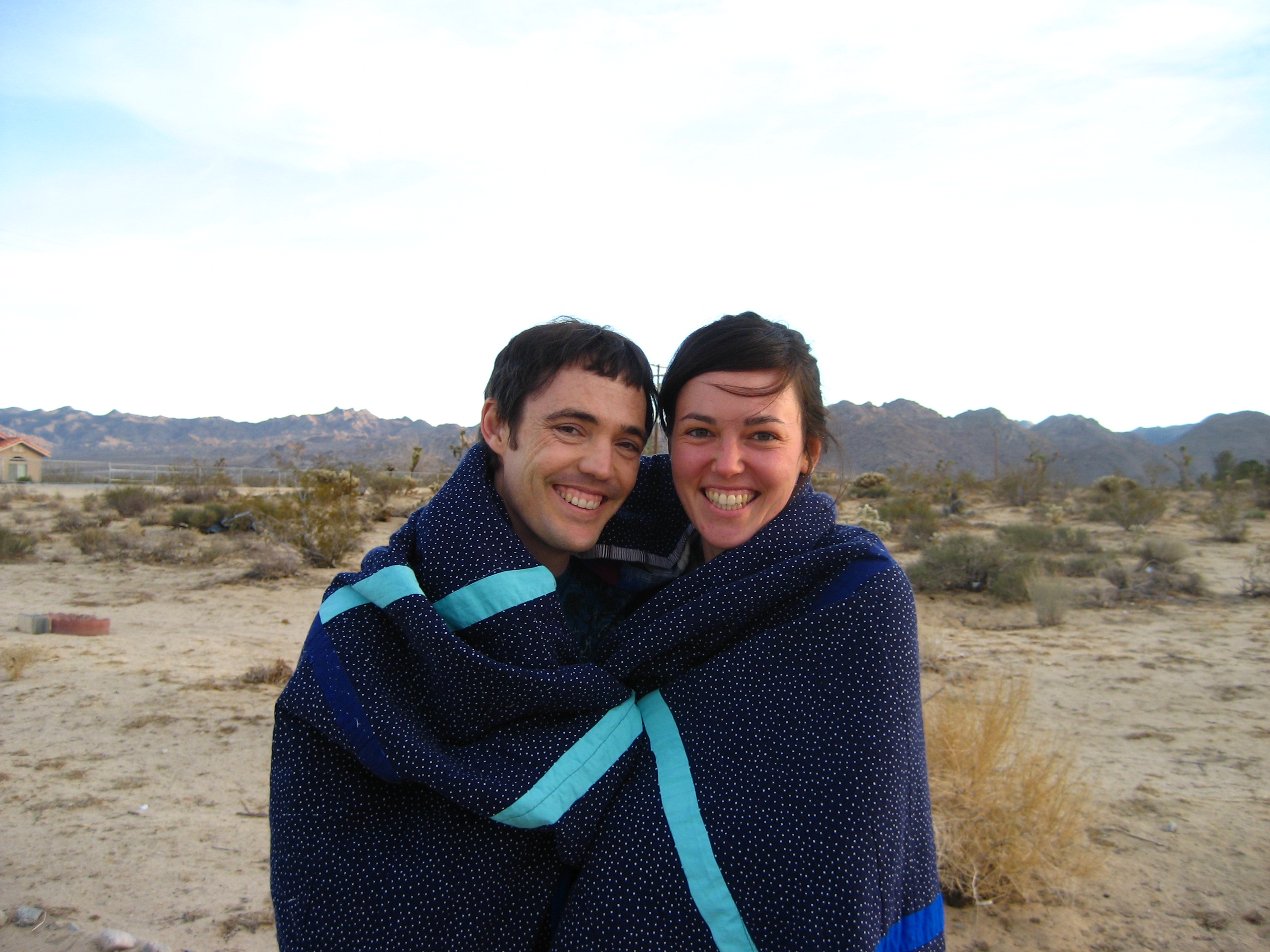
Nathen, Reanna, Quilt, Desert

I’ve been listening to a lot of Ted Talks while working on my trailer the last couple of weeks. I’ve been enjoying them, mostly, but I’ve also become annoyed at the presenters saying, “The reality is…” before making assertions. It’s a powerful-feeling thing to say, and I think for lot of people it may be a powerful-feeling thing to hear. It may even help these presenters change peoples’ minds. When I hear that phrase, though, I go off on a mental tangent something like this: “Wow, sounds like you think you have direct contact with reality the way the Pope thinks he has direct contact with God. That’s either pretty arrogant or pretty careless of you to say. I wonder if you are that careless or arrogant when analyzing the data that you are summarizing right now. Or maybe you have a handle on how much direct contact you have with reality and you’ve just said that because you think I will be swayed by you talking that way. Are your ideas not strong enough to stand on their own? Oh, and what was it you were saying for the last 30 seconds?”