Is California becoming the movie Brazil?

I was laid off from my job as a family therapist in a company-wide lay off when Morongo Basin Mental Health closed their doors on June 30 and now am actively seeking work. I have all the documentation to prove that and to show my income for any number of past quarters. It seems I am the ideal candidate for unemployment insurance.

Except that I have worked at a summer camp in Oregon for a few weeks in the last 18 months. (Each summer for the last 13 years, actually, but the Employment Development Office only wants 18-24 months of information.) That means I have to file for UI by telephone. The EDD website says you can apply online, by mail, or fax but eventually says it’s got to be by phone if there’s any out-of-state income.

The problem is, because of the sequester, you cannot get through by phone. Hours of operation are 8-noon, Monday through Thursday, and with limited staff. Last week, the outgoing message implied that if I called early enough I might be able to talk to someone, but I was not able to get through. This week, the message says they just don’t have the staff to answer my call.

Both weeks, the message kindly encourages me to apply online.

As far as I can tell my only options are to lie about my out-of-state income or to give up. Or maybe drive eight hours to Sacramento to make a stink at the Employment Development Office. (No, they do not process claims in person.)

eApply4UI_logo

I get half of my political news and analysis from a great podcast called Left Right & Center. (The other half is from Fareed Zakaria’s Global Public Square.) LR&C is an ongoing conversation between three guys from different political perspectives on what’s happened this week, and has been very valuable for the development of my own political thinking.

The other day, I was listening to another great podcast, This Week in Microbiology, and it hit me that these two shows have the exact same format. TWiM is also an ongoing conversation between three guys about the news of the week. The superficial difference is that TWiM is about bacteria and LR&C is about US politics.

The more abstract difference between these two podcasts, though, is that Left, Right & Center is an excercise in outcome-irrelevant learning, while This Week in Microbiology is an exercise in outcome-relevant learning. That is to say, the empirical events of the week change the opinions of the TWiM guys but almost never change the opinions of the LR&C guys. This is a huge difference. On TWiM, when there is a disagreement, they look up what is known about the issue and almost immediately come to an agreement based on facts: either one person is right and the other wrong, or else we really don’t yet know the answer to that question.

On LR&C, when there is disagreement (which there is on every topic), each fact that comes into the conversation is either disputed or used to proove each person’s own point. In politics, the facts are basically irrelevant. Makes me wonder why it remains so interesting.

I had a tearful farewell today with my team at the Military Family Support Program–the Twentynine Palms office of the now-defunct Morongo Basin Mental Health. These folks have been great to work with. When I was hired six months ago the office was like a graveyard, and by the time we got the word that MBMH was shutting down, we were so busy we needed a second clinician.

IMG_20130529_110107_372

Jackie, Heather, Laura, me, Jennifer

I’m just as sad to leave our clients, but of course I can’t post pictures of them here. Our office had come to feel like a little community center, with people of all ages coming and going all day.

I am assured by those in charge at the county that there will be a military family support program up and running again soon–probably in about a month. I believe them. They all seem enthusiastic about the project and on the ball. When that happens I will definitely apply for the job again. It has been good work.


I can sympathize with Ted Cruz and many others’ sentiments about amnesty as part of immigration reform along the lines of, “It’s not fair to those of us who’ve gone through the hell of the legal US immigration process!” My wife is Canadian, now a permanent resident (“green card”) in the US. She did almost all of the work to get here, but having supported her through it, I can say that it is extremely difficult–daunting, even, at times. It’s very expensive, confusing, and sometimes scary. The waiting periods are indefinitely long, the instructions are labyrinthine and contradictory, and there is very little truly helpful help available unless you can afford to shell out for an immigration lawyer. And we are highly educated, savvy with the internet, good at dealing with beaurocracy, and we had the money and time–several thousand dollars and a couple years.

The problem here is not that privileged people like my wife and me have a hard time with this process. It is that less  privileged people in terms of education, savvy, money, or time do not have a realistic shot at it, which amounts to a class barrier to immigration into the US; poor people need not apply.

It may be that Mr. Cruz and others do not consider this a problem. They may believe that it is better for the US and for the citizens of the US that we keep poor and uneducated people from immigrating here. That has a certain “American exceptionalist” appeal. “Bring us the cream of your crop!” Or maybe, “Keep the cream of your crop, and especially your poor, huddled masses.”

In my opinion, however, it is both wrong and short sighted to effectively bar poor people from US immigration. It’s wrong because poor people are the ones who need it the most. It’s short sighted because poor immigrants, in my experience, are the most motivated, hardest working people I’ve ever met, not to mention that entire US industries are depending on that cheap, motivated work.

It is difficult to know when you are an adult in our culture. It is easy to find people in their 20s and 30s wondering if they are a “real” adults, and what that even means. They don’t “feel” like an adult, and their archetypes of adulthood—parents, mentors, maybe bosses, celebrities—are moving targets. This was not the case for our ancient ancestors, and maybe all of our ancestors before the 20th century. There was a moment in your life after which you were an adult, by community decree. What you could expect from others and what others expected from you changed forever. It was this renegotiation of relationships that made you an adult, not how you felt and not even really what you did. I imagine this was in some ways terrifying but far less prolonged and anxiety provoking.

The downside of the old system, from a modern perspective, is the loss of freedom. Along with ka-chunk adulthood came a tightly prescribed life in terms of age and gender roles that most of us would find intolerable today. It’s very difficult to imagine moving back to that. And that’s the sticking point. An initiation is meaningful to the extent that it has permanent consequences, but permanent consequences tend to mean a loss of freedom that is difficult for an individual to choose.

Here are some thoughts about our various initiations into adulthood:

Turning 18 is pretty weak. On the plus side, everyone does it—it just happens to you—and it comes with privileges and responsibilities; in a sense it is a renegotiation of your relationship to the state. On the other hand, your life and personal relationships do not change, especially now that kids have unlimited access to pornography on the internet. The ritual itself, the birthday party, is barely worth mentioning.

Turning 21 is also barely worth mentioning except to say that the freedom to drink legally, while a renegotiation of a few relationships, is a step backwards from adulthood for some.

High school graduation is a little better. The ritual is easy and boring, but there is a major consequence: You can never go to high school again. This means a major renegotiation of lifestyle (in most cases) and expectations. On the downside, not everyone does it and no one considers you an adult because you did it.

College graduation is not as effective as high school graduation. It’s available to a much smaller subset. In some ways, your freedom increases—certain jobs may be open to you—but the major consequence is that you start having to pay off your debt, which you can always put off by going for another degree. If your family is rich enough to pay your way, you are shielded from all consequences.

Boot camp in some ways may be the best initiation into adulthood we have. Only a small subset do it, but it is a before-and-after ordeal and it carries major consequences, in the self-image of the initiate, in lifestyle, and in role shift between teenager and soldier.

My wedding was by far the most powerful initiation ritual I’ve experienced. It felt meaningful, carried strong role consequences, and involved the participation of most of the people who are really important to me. Unfortunately, not everyone has access to marriage, at least in a way that is supported by our culture. And it is badly timed for an adulthood ritual for some people. It took me decades of adult life, for example, to find a person who I wanted to marry and who wanted to marry me.

Self imposed ordeals can be valuable, but have limited effectiveness as an initiation into adulthood. Many young adults try to use solo travel or some other ordeal to induce a feeling of adulthood, but it doesn’t tend to work because the ordeal doesn’t carry cultural or relational consequences. They may have an increased sense of their own power and others may be impressed with their accomplishment, but without the buy-in of the family and culture, without a role shift as a consequence of undergoing the ordeal, the young adult is left with a sense that nothing has really changed.

In my first round of thinking about this, I thought maybe we could remedy the situation one individual at a time: Each young person could decide what adulthood would mean for them, design an ordeal or ritual, and invite everyone important to them to witness and support them in their new, adult roles and relationships.

After talking with a bunch of late-adolescents about this idea, though, I realized it won’t work. They either reported being completely uninterested in the idea, interested but not ready to do it, or (very rarely) already identifying as an adult and not interested in doing all that work. Once you are ready, it’s too late.

So it has to come from the culture, not from the individual. It has to be the individual participating in the culture. And unfortunately, that leaves us with just a few, mostly tepid initiation rituals, and a lot of young adults wondering when adulthood will come to them.

May 18, 2013: Something has been eating my new garden for a while now. It couldn’t be rabbits. I’ve already done rabbit-proofing. That leaves lizards, squirrels, birds, and insects. Neither Reanna or I had ever seen any of those in there, which makes me think nocturnal, but rabbits are the nocturnals on the list, and it’s not rabbits.

Tomato

Tomato, top leaves & part of a fruit eaten

Pepper plant, topped off

Pepper plant, topped off

Nub of cantaloup stem

Nub of cantaloup stem

This barren ground used to have cilantro growing in it.

This barren ground used to have cilantro growing in it.

I spent some time today, sitting quietly, watching for the perpetrator. Nothing came by except a hummingbird. I had a nice time. As I sat I remembered the story of the homesteading Keys family, up in what would become the Joshua Tree National Park, staking out their garden with shotguns every day. They grew all of their own food except for sugar and flour. I can drive a few minutes and buy groceries, but they had to go to Beaumont for supplies, two days away. Still, the basic principle is the same. People have been doing this as long as people have been growing food.

My stakeout spot, in the old pigeon pen

My stakeout spot, in the old pigeon pen

My view of the garden for the day

My view of the garden for the day

Maya came by later and said it was probably birds. She’s been gardening around here for years, with great success, so she’s probably right. Reanna had already bought some bird netting–technology that could have saved the Keys a lot of time and bullets.

May 19, 2013: We put up the bird netting:

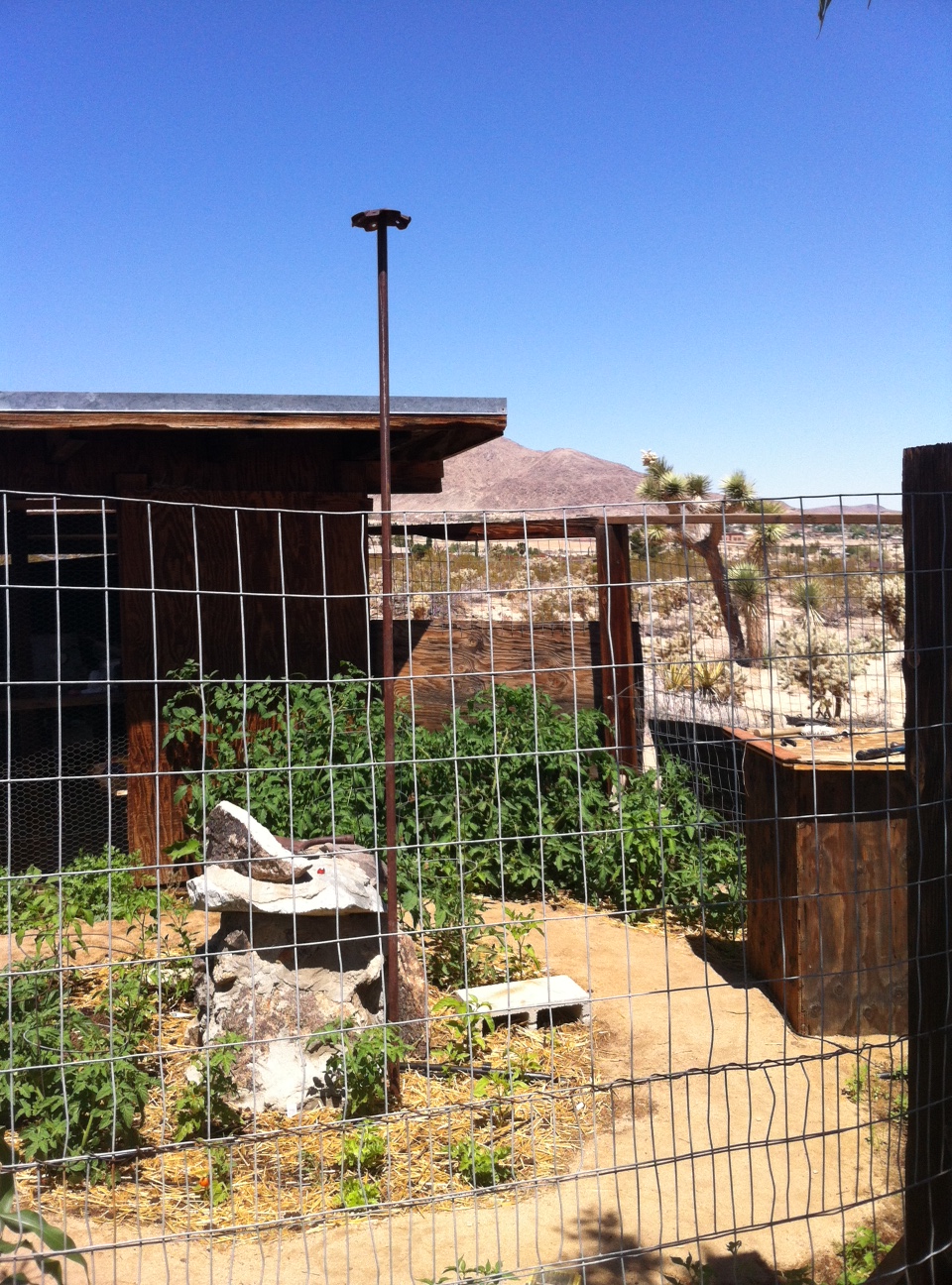
I pounded a pole into the ground and mounted an old hub on the top.

I pounded a pole into the ground and mounted an old hub on the top.

Attaching rope and bird netting to the hub and the fence

Attached rope and bird netting to the hub and the fence

Reanna in completed garden fortress

Reanna in completed garden fortress (the plywood and corrugated metal are wind-breaks against our crazy south-west winds.

I didn’t particularly want a fortress garden. So many desert gardeners end up with them. I like it, though–I guess it’s my fortress, and that makes the difference.

Aaron & Ronda's fortress garden

Aaron & Ronda’s fortress garden: lumber, rebar, mesh, bird netting, and shade cloth

Karen’s fortress garden: lumber, wire mesh, corrugated fiberglass

Tee & Eric's garden fortress

Tee & Eric’s garden fortress: lumber with 1/4″ wire mesh on 5 sides, apricot tree inside.

May 24, 2013: Reanna caught a rabbit in the garden today. Way back in the rabbit-proofing stage, I’d missed a spot under the ephedra that grows through the fence under the hose bib. Hopefully that does it, because the garden is still getting eaten!

New rabbit proofing, by Reanna

New chicken-wire rabbit proofing, by Reanna

May 27, 2013: The garden continues to be eaten. Today we caught a lizard in there. We didn’t see it eating anything, so no smoking gun. I’ve only ever seen lizards eating bugs around here. If it’s gotten a taste for pepper plant leaves, we’re in trouble. It crawls through chicken wire no problem. Covering the whole garden in wire mesh would be a big job.

May 28, 2013: Reanna caught another rabbit in the garden and found another crack in the fortress, behind the compost bin, which she shored up. Does that let the lizard off the hook?

June 1, 2013: Found another lizard in the garden and stayed still enough that it kept going about its business for a couple minutes. It drank water out of our drip system but I didn’t see it eat anything. Something is still at it, though. The peppers are disappearing, and it’s started eating marigolds, too. This could take a while.

Marigold, stem eaten. The leaf lying partly on the blossom is a partly munched pepper leaf. Oh, the carnage!

Marigold, stem eaten. The leaf lying partly on the blossom is a partly munched pepper leaf. Oh, the carnage!

In my 9th grade geography class, Mr. Ferguson had several standard rants he liked to visit on us, like how high school freshmen were not yet fully human. We all had the potential of full humanity, and in a few more years we could achieve it, with work. We were halfway between primordial ooze and human.

Another rant was how we lived on the outskirts of civilization, Los Angeles being civilization. “And you can see,” he’d say,”as you go from LA towards the desert, that the people get less and less hip until you get here, right on the edge.”

At the time I thought he was funny and slightly mean, but probably wrong. I was living in Joshua Tree and going to school in Twentynine Palms. Almost three decades later, I’m back living in Joshua Tree and working as a therapist in Twentynine Palms, and I’m thinking he was probably right. I don’t know about people getting less hip as you leave LA–it’s arguably true, but depends a lot on your values and aesthetics–but look at this map of population density and you will see that I do live on the edge of civilization. (Click on it for a clearer view.) Joshua Tree and Twentynine Palms are the last two splotches of orange (at least 100 people per square mile, no more than 250) heading east out of LA. Just east of us is all fewer than 10 people per square mile for an hour’s drive, then less than 1 person per square mile for another hour. It’s beautiful country, but desolate.

Southern California Population Density 2000

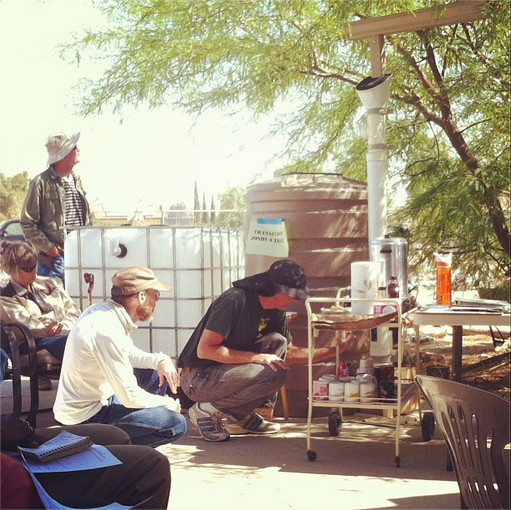
I went to my first Transition Joshua Tree event, a rainharvesting workshop on April 28. It was fun and inspiring to meet with a good-sized group (maybe 20?) of neighbors interested in water sustainability in Joshua Tree. It was nice timing, too. Reanna and I just spent the previous day on the Desert-Wise Landscape Tour, looking at how local people are designing for low-water use.

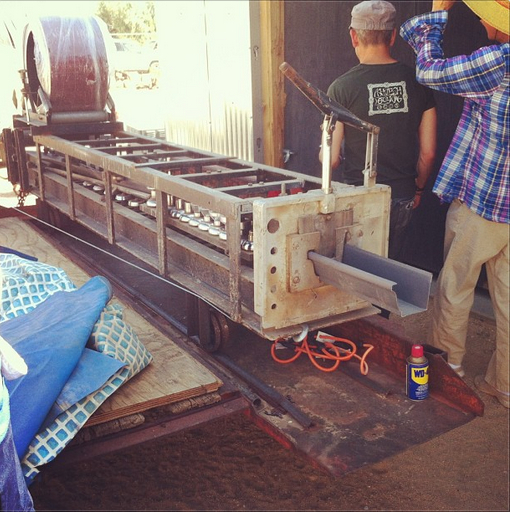
The main topic was how to catch and store rainwater that falls on your roof. Our presenter, Buck, seemed to have quite a bit of experience installing gutters and catchment tanks, and thinking about water in the desert. He had a machine that made seamless gutters of any length out of strips of aluminum:

gutter maker

And showed us some tanks and filtration systems:

catchment tanks

One of the participants reported catching over 2,000 gallons of water in a four-minute “rain event” with one of these systems. While it is very dry here (less than a half inch in 2013 so far, I believe) it can rain really hard. In my 10 years in the rain country of the Pacific northwest, I never saw it rain half as hard as a big rain in Joshua Tree. So you can wait a long time for a rain event but you want a large storage capacity when it does.

We want to catch as much of the water as possible because we are using up our aquifer about 10 times as fast as it is replenishing. (If it is replenishing, that is–there seems to be some controversy about it.) Water that runs off of our roofs flows down washes to the dry lake in Sunfair, where it mostly evaporates, and eventually rains on someone else downwind of us. According to the conservation representative from the Joshua Basin Water District in attendance, we use 151 gallons per person per day and sustainable use is under 15. She talked a bit about two plans to replenish our aquifer using technology: One, under way right now, is piping in northern California water from the Hisperia aquaduct down into our aquifer. Another, under study, is diverting the Quail Springs wash from the surface (and the dry lake) underground. I’m not sure what that will look like–I picture a 600 foot hole in the middle of the wash, with caution tape around it–but at least it would be using our own water.

Living on less that 15 gallons of water a day looks to be tough. Here’s an essay by my sister-in-law, Maya, about going from 420 gallons per day to 50 gallons a day, with a toddler and while continuing to grow food. I’d like to visit each person who came to the workshop and see what systems result in what level of water usage. Because Reanna and I share a water main with my family, I don’t know how much we are currently using. I will figure it out and write a post about it.

I just visited my brother Ely in Glendale and the forecast was calling for rain in the next couple days. He was happy about that. They need the water. Glendale gets an average of 21.09 inches of rain a year (according to Wikipedia) and had only 16.95 inches in the last ten months (according to Weather Underground). Ely just emailed me that a meteorologist on the radio today said they’ve only gotten 5.15 inches so far this year, 9 inches below average).

But what is going to happen to that rain water? Almost all of it will fall on rooftops, sidewalks, parking lots and roads:

Glendale

For a case study, I looked at Ely’s neighbor’s roof. They have a gutter on the low side, which will catch most of the rain that falls on that roof:

photo (23)

photo (24)

The neighbor’s gutter dumps into a drain pipe that heads towards the street on Ely’s side of the wall, picking up the runoff from another roof along the way.

photo (25)

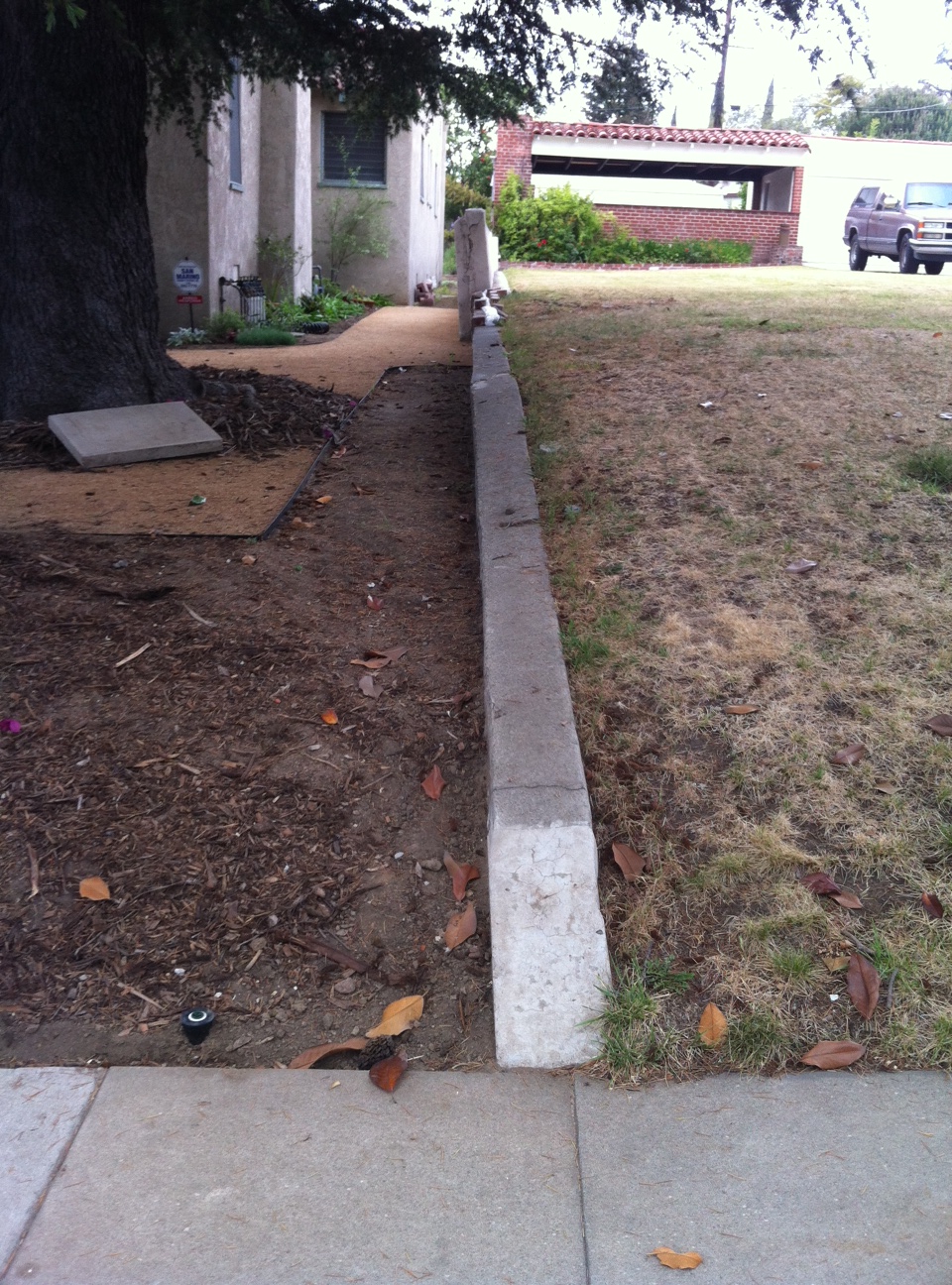
Back on the neighbor’s side of the wall, the pipe dumps on the ground.

photo (26)

The water runs along the wall, down onto Ely’s yard, and onto the sidewalk.

photo (27)

Down the sidewalk, into the street.

photo (28)

Down the street.

photo (29)

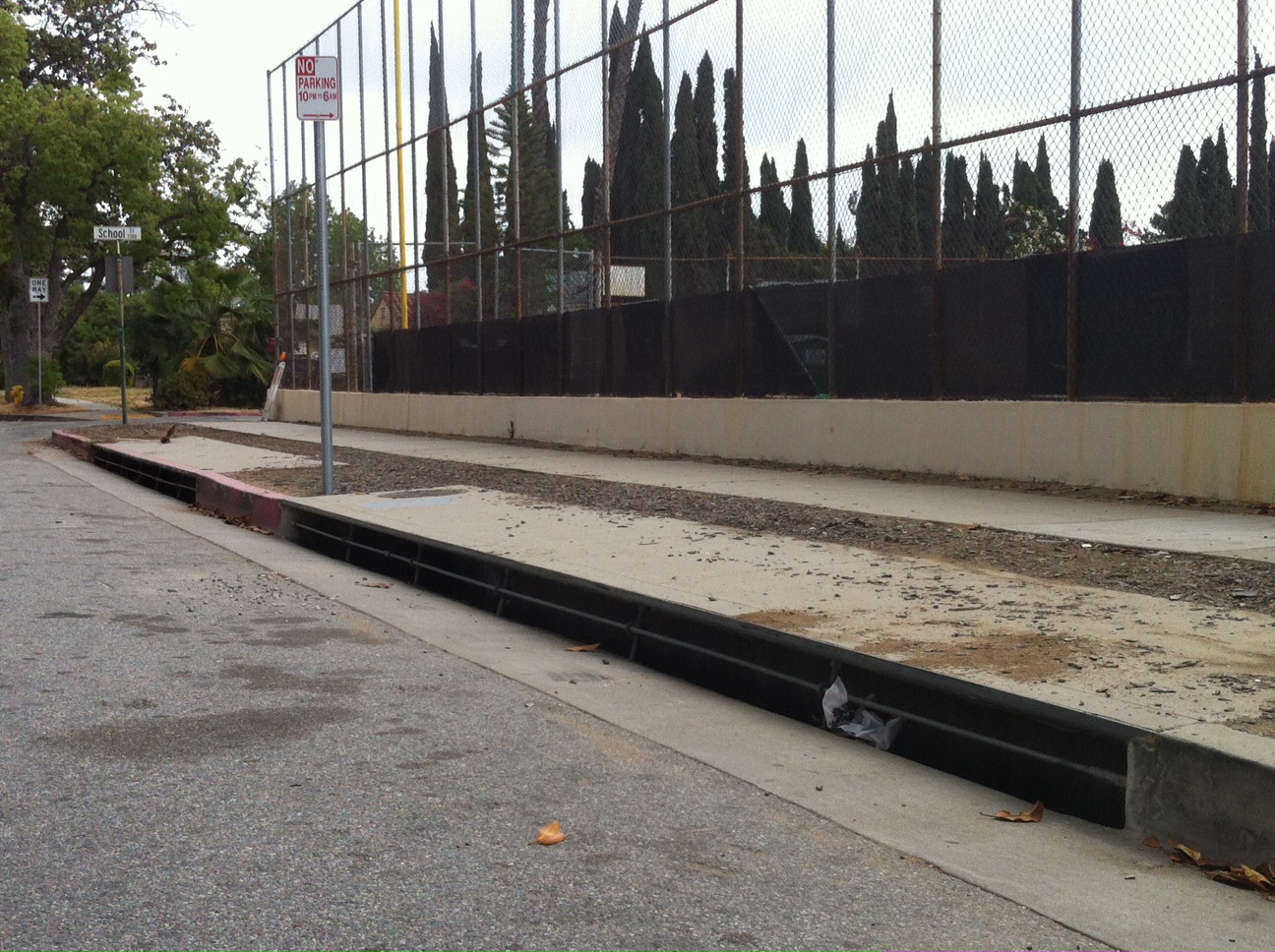
And into 50 feet of storm drains.

photo (31)

Verdugo Wash

The drain dumps into the Verdugo “wash,” a giant concrete culvert a few blocks away.

Los Angeles River

Which is a tributary of another, even bigger concrete culvert, the Los Angeles “river.”

(photo by Ron Reiring

Which dumps into the Pacific Ocean at Long Beach Harbor. (photo by Ron Reiring)

The system moves the water that lands on Glendale to the ocean quickly and efficiently. Meanwhile, they wash their cars and water their lawns with water pumped in from the distant Colorado River.

Here’s a totally different way of thinking about rainwater, from another, drier city that also relies on the Colorado River–Tucson, Arizona. Watch for the wow moment, starting around 1:20:

One of the last books I read before starting to work full time was Atule Gawande’s Checklist Manifesto, on the recommendation of my friend Joe Dillon. It was really good and I’ll pass the recommendation on to you. He argues that across many disciplines we no longer live in a very very complicated world; we live in a truly complex world. Part of what that means is that our brains, our intuitions, are no longer up to the task of flying modern airliners, constructing modern buildings, or performing modern surgery. To do these things well, we need well-constructed checklists to keep from killing people.

One particularly frustrating, inefficient day in grad school, I realized that my brain/intuition wasn’t up to the task of leaving the house with everything I needed for the day. I put some serious thought into a checklist, wrote the list on a note card and taped it to the inside my front door, at eye level:

Keys

Money

Phone

It was very helpful. I started singing it after a week and have ever since, eventually abandoning the note. I sing it before I go anywhere and check my pockets for each item as I do. It sounds like this:

"Keys Money Phone"(Tempo varies with mood, but usually 120+ bpm)