Matt Miller has started a new podcast called This Is Interesting. I just listened to the first one and it’s good. I’m a big fan of his political conversation podcast Left, Right and Center, where he moderates as the political centrist between a liberal and conservative pundit. I’ve listened to him do that show hundreds of times, so I am very familiar with where he’s coming from and interesting in his take on things. (I’ve written about LR&C here.)

I think this show will stand on its own, though. So far it’s a bit like a “deep read” episode of Planet Money, talking in some depth to authors about their topic. In the first This Is Interesting–“The Robots are Coming!”–Matt talks to Martin Ford of The Lights in the Tunnel and Erik Brynjolfsson of Race Against the Machine.

A couple of the ideas I’m left with:

Outsourcing jobs is just a stage in the direction of mechanizing them, so countries like China and India stand to be hit the hardest by the rise of robots.

What a job pays is not a great indicator of whether it is in danger of robot-takeover. Radiologists will be robots pretty soon, but housekeeping staff will not. Auto mechanics are safe for a while too, combining the physical dexterity and cognitive flexibility that is difficult for now to mechanize. (I’m guessing I’m safe as a therapist (though they’re working on it) for the time being. I hope we get some county-approved-paperwork robots, though.)

If education is about creating the ability to add value to the economy (i.e., have a paying job) then we need to be focusing education on what machines can’t yet do. This may be tough–a quickly receding horizon.

There is no reason to believe that market forces will create as many jobs as there are people, and this is likely to happen less and less. If we lose the massive wealth redistribution system that is jobs-with-mechanizable-routines, we will end up having to massively expand our welfare system.

this-is-interesting-250

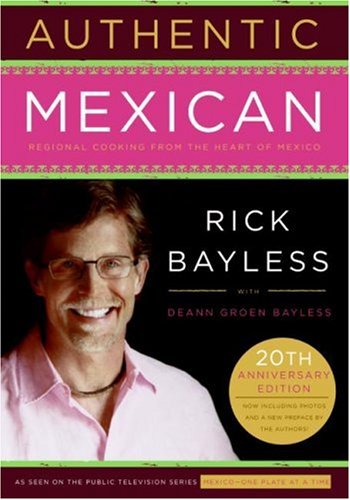
Bayless cover

I bought Authentic Mexican: Regional Cooking From the Heart of Mexico because it was the highest-rated Mexican cookbook on Amazon. It was part of an effort to build a great cookbook library and to create a food culture for my family. It was also to turn my wife, Reanna, on to Mexican food. I grew up in southern California and love Mexican food. She grew up in Vancouver, BC, and never developed a taste for it. My limited sampling of Canadian Mexican food made it clear why: It was not very good.

Because I imagined referring to this book for several decades, I almost bought the second-highest rated book because the cover was so much better, but I realized that both images were probably on dust covers, which I hate and throw away immediately. I stuck with the Bayless’s book.

I am so glad I did. Everything I’ve cooked out of this book so far has been very, very good. Surprisingly good. This food tastes like fine dining–nothing fast-food about it. My wife has had “food-gasms” on several occasions and agreed that we would have been happy to have paid top dollar at a restaurant for what we just ate.

I’m a good prep cook, an OK cook cook, and not much of a real chef. I love that I can follow these recipes exactly and produce inspiring food. I also believe that going through this book is teaching me how to cook. I’m learning the architecture of the cuisine–the staples, the flavors, the dishes, the variations. I can imagine eventually being able to stock our fridge intuitively and improvise great food from whatever we have. What more can you ask for in a cookbook?

I was at a party last year with a woman who had recently lived in England. Her funniest story was about flossing. She mentioned the use of dental floss to her friends there and found a widespread belief that flossing was bad for you. The punchline was something like, “It makes your gums bleed. It’s bad for you!”

I imagine I was more amused by that story than others at the party, because I pay special attention to what dentists say about dental hygiene. I know, for example, that plaque causes inflammation in your gums, which makes them more likely to bleed. This inflammation also makes your gums more porous, so that bacteria leak into your bloodstream, causing more inflammation throughout your cardiovascular system, resulting in a significantly shorter lifespan. I also know that your body treats plaque as its own tissue, building capillaries inside the plaque, to feed it. This is why plaque can bleed when hygienists scrape it out.

[Shudder]

I do what my dentist tells me. Exactly. I am a highly compliant patient.

So far it’s paid off. I’ve had very few cavities and hygienists often fawn over my teeth, both very nice. At the end of a visit I always say, “I want to keep these teeth for 60-70 more years. Am I on track to do that? Is there anything I could be doing better?” The answer has always been “Yes, you are on track to keep your teeth,” and usually, “No, just keep doing what you are doing.”

Every five or six years, though, I get a new set of instructions about how best to brush my teeth. I can remember several off the top of my head: horizontal strokes including the gums, circles including the gums, vertical sweeps including the gums. The last time I got a new set of instructions was in 2011. “Brush along the gum line with a 45 degree angle toward the gums with very small horizontal strokes, using no pressure at all and the softest brush you can find. Move to a new spot every minute or so. Do not brush your gums.”

I was surprised at these changes and a little annoyed. The last time I’d heard horizontal strokes was the 1980s. I’d assumed the move away from that had been an improvement. And don’t brush the gums? I’d never heard that from anyone. I complained that dentistry kept changing things up and that these changes didn’t make sense to me, if the other changes had been real improvements.

My hygienist sympathized and said, “Well, we used to think that brushing the gums toughened them up and kept them from receding. Recently we started noticing that patients who brushed their gums were causing them to recede, so we’ve changed our minds.”

That’s when it hit me. Dentists are performing a very poorly organized and poorly controlled longitudinal experiment on us, without getting our consent, and presenting themselves as having knowledge and authority that they clearly do not yet have. The good dental hygiene of the future could have almost nothing in common with what we have today. We may abandon brushing altogether, in favor of regulation of oral pH and microflora, or who knows what.

To be fair, dentists have an extremely difficult task in this experiment. The number of people who actually follow their recommendations is very small, and even that select group probably fluctuate in their compliance a good deal. And if they told us they were experimenting on us, we’d likely be even less compliant. Plus, they have to put their hands and faces in our stinky mouths all day.

This winter, I worked several weeks with a woman who, during that time, had to get a whole bunch of fillings on the surfaces between her teeth because of flossing. As far as I could tell, this woman (who is an urban legend to you, by definition, but to me is a real person with first and last name, phone number, husband, and child) is one of my high-compliance compatriots. She flossed every day and it wore the enamel off the inner surfaces of her teeth, “because my teeth are close together.” She was pretty upset about it, and I would be too. She was just doing as she was told by the experts. Perhaps she would have been better off in England, where flossing is bad for you.

Still, dentists’ advice is the best we have. Until otherwise notified, I’m sticking with my highly endorsed protocol: brushing as described above twice per day, plus hydrofloss in the morning and dental floss in the evening. I just keep in mind that protocol will inevitably change, and that I may be doing some harm in the meantime.

I just had the pleasure to attend a lecture by Dr. Bruce Perry. It was great, and if his books are as good as his lectures he may be my new hero. The topic was his “neurosequential therapeutics,” which sounds nerdy (and it is) but is much more intuitive and helpful than it is technical. The basic idea is that the developmental stage at which a client was traumatized is an important clue into what kinds of therapeutic activities will be helpful to them, and in what order and priority. Pre-verbal trauma is unlikely to be helped by cognitive therapy, for example.

Anyway, more on that when I get the time to read his books. Another thing I liked about Perry was his attitude towards the DSM, the mental health industry’s diagnostic Bible. Here’s my paraphrase of one of his tangents on the DSM:

The heart is a fairly simple organ. It’s a blood pump. Cardiologists know several hundred ways that the heart can get sick and all of them are diagnosed and named in terms of the physiology of the heart. However, the symptoms that bring the patient in, however, are few–often chest pain and shortness of breath.

The brain, on the other hand, is an extremely complex organ. The DSM lists several hundred psychological symptom clusters which ostensibly represent ways the brain gets sick. But none of them are diagnosed or named based on brain physiology. They are all named based on symptoms: Panic Disorder Without Agoraphobia, Major Depressive Disorder With Postpartum Onset, etc.

If cardiologists followed this protocol, they would have only a few diagnoses, along the lines of Major Chest Pain Disorder With Shortness of Breath, Major Chest Pain Disorder Without Shortness of Breath, etc.

Funny!

I have been debating with two of my brothers for over a decade about the longevity and importance of 20th century popular music and musical artists. In 100, 200 or 300 years, assuming basic continuity of our civilization, which artists from the last century will be household names, will be known at all outside of music historians, will be considered important in any way?

Our positions have changed a bit over the years, but I tend to argue like this: How many artists can you name from the 19th century? The 18th? The 17th? My music history education is probably better than average, but my lists quickly narrow. I can think of ten or so 19th century composers (and zero musicians) off the top of my head and have put in significant listening time with only Brahms, Chopin, and Beethoven. I can think of about five 18th century composers and have spent significant time with two–Mozart and Bach. I can only think of one composer from the 17th century and have spent no time with his music. By the 16th century, I don’t even recognize any musicians‘ or composers‘ names.

And none of the above wrote in English. If I had needed to understand the words to enjoy the music I would have no use for any of them.

So, I argue, why should we expect more than ten or so musical artists of our era to be generally known and considered important in 100 years, or more than five in 200 years, or two in 300 years? To do so seems to inflate the importance of our music, and to deflate the probable importance of future generations’ music to the generations that produce it and the probability of major shifts in the dominant culture. It’s an easy mistake to make, I think, for the Gen Xers and Millenials in the cultural shadow of the Boomers. After all, who have our generations produced to eclipse The Beatles or James Brown?

And there’s the way language changes. Even assuming English remains dominant, our modern English is quite likely to sound stilted in 100 years and pretty hard to understand in 300. How many people will listen to Bob Dylan purely for the sonic experience, especially once the historical context of 20th century folk music and Dylan’s “going electric” is long gone?

My brothers, on the other hand, tend to argue that digital storage of music and globalization have changed everything and my looking at history to predict the future is not clear thinking. First, there is unprecedented access to fame in modern times: The composers I cite could write down their pieces and try to get others to play them, but couldn’t put them on YouTube with a video to go viral. As far as I know it’s true that even the best known of my list of composers had nowhere near the fame of Michael Jackson. Maybe popes or emperors had a shot at that kind of fame, but not Bach. Second, my composers wrote on paper that can decompose or get thrown away with grandpa’s old junk after he dies. This is way, way less likely to happen with the way we store information now. A recording of music can theoretically live forever in easy access. Third,  the trend seems to be nichification, not extinction. The memory of and enthusiasm for Carl Perkins, for example, lives on in young people who are into neo-rockabilly, psychobilly, gothabilly and who knows what other sub-genres to come.  Finally, my wife, Reanna, points out that language may not drift the way it used to because of globalization and the internet. It seems like standardization (to Californian English) is the trend these days, not drift. Dylan may be only a little harder to understand in a couple centuries than he is today.

For all these reasons, they argue, why should we expect any really great music from the 20th century to lose its place in the popular culture of the future?

We will never know the answer. Still, it makes for an interesting exercise to predict. When or if general knowledge of 20th century music narrows to 10 artists, who will it be? Five artists? Two?

Here are my best guesses. This was very difficult, though a very interesting process to go through. Compelling, even. How can I keep my aesthetics and hopes out of it? How long can a dead musical artist remain in memory based on the force of their charisma or persona or being a major voice of their generation?  I am actually less sure about my guesses now that I’ve thought them through. Perhaps I’ll write another post about the process. 

I’d love to know, what are your versions of these lists?

100 year list: 20th century musical artists still generally known in the year 2100:

  • Aretha Franklin
  • Billy Holiday
  • Bob Dylan
  • Duke Ellington
  • Elvis Presley
  • Frank Sinatra
  • Louis Armstrong
  • Michael Jackson
  • Ray Charles
  • The Beatles

200 year list: 20th century musical artists still generally known in the year 2200:

  • Duke Ellington
  • Louis Armstrong
  • The Beatles

[Note: I gave myself five slots to fill on this list but decided not to.]

300 year list: 20th century musical artists still generally known in the year 2300:

  • Duke Ellington
  • Louis Armstrong

The answer is no, it isn’t. Please stay home.

Don’t get me wrong. I don’t think that getting sick is that big of a deal. I can handle the discomfort of a flu, and so can you. But if I had a choice between you punching me in the face and you giving me a flu, I would prefer the punch as long as you didn’t break anything.

Why is the relatively mild punch to the face clearly unethical and going to work sick is not? It’s because when it comes to getting sick, we suffer from magical thinking.  When it comes to mysterious misfortunes, we tend to rely on magic potions, magic words, magic thoughts, or magic feathers. If punches to the face were a mysterious misfortune that struck with no clear puncher or intended punchee, we would probably have a whole range of face-punch invulnerability talismans, herbs, and spells. And going to work when you might punch someone would not seem like an ethical question.

Remember how everyone in your office got the flu this winter and it was so bad that it was funny and you sat in a meeting and sympathized with a sick colleague as they described their distress, and then later joked about how you probably got it from them? That was possible only because neither of you could see the mechanism of infection or feel the viral load enter your bloodstream when you rubbed your eye. The vivid experience of a perpetration would limit the possibility of magical thinking, and going to work sick would become an obvious ethical question.

I was washing my hands at work two months ago when my wedding ring slipped off my finger and fell into the sink. I grabbed it before it went down the drain, but it took some luck. I’d just gotten over a flu and my left-hand ring finger had lost some weight. I couldn’t have my wedding ring falling off at random moments so I decided to wear it on my right hand until I gained my weight back.

That day has come. My ring fits on my left hand again. Now I’m wondering what I may have been broadcasting by wearing my ring on my right hand. Here is a list, cobbled together from the internet, none of which are true for me:

That I am not married and wear a ring for decoration

That I am a gay man in a committed, monogamous relationship

That I am married but want to cheat on my wife

That I am left-handed and don’t want to wear a ring on my dominant hand

That my wife is dead

That I am from one of the many countries, cultures or religions that prefers weddings rings on right hands or has no preference

I started Nathen’s Miraculous Escape inspired by my friends Jeannie Lee and Ethan Mitchell who write great blogs about whatever strikes their fancy. I love this format but I know I shed readers who are only interested in one of the topics I write about. A psychology student, for example, might lose interest after a few posts on my family life, ecology, epistemology, or some other random rant. A Joshua Tree local, family friend, or fellow desert-sustainability explorer will almost certainly tire of my deconstructions of the DSM or various essays about theories and practices of psychotherapy.

I will continue posting everything I write for the public here, but have started two new blogs which will get a more focused subset of my writing. Here are the links, with top ten lists of the posts therein:

NathenLester.com, for my posts about psychology and therapy.

1. Three Approaches to Psychotherapy: A Film Series

2. Experiential Family Therapy: The Humanistic Family Therapy Model

3. Congruent & Incongruent Communication, Paradox & Double Bind

4. Oppositional Defiant Disorder Assessment

5. Albert Ellis’s 15 Irrational Ideas

6. DSM-IV-TR Diagnostic Criteria for Eating Disorders

7. Diagnostic Criteria for Substance Abuse and Dependence

8. Sternberg’s Triangular Love Typology

9. Review of the Sleep Cycle App

10. Lee’s Love Typology: Love Styles

Living in Joshua Tree, for my posts about living in the desert and striving for a sustainable lifestyle here.

1. Guest Post: We are moving to the desert!

2. Humidity in Joshua Tree

3. Some Thoughts on Sealing the Outside of my Trailer

4. A Quick Foray Into Carbon Footprint Calculation: 10.41 Metric Tons of CO2

5. How Deep is Your Ecology?

6. A Couple Things About Gas Mileage

7. Causes Cancer in California

8. Some Things I Love About Joshua Tree

9. A Violent Storm on the Beaufort Scale

10. Keeping Cool in the Desert: “You might say the secret ingredient is ‘water.’”

I am struck by the lack of data in the gun-control conversation I have heard on TV and radio lately. Perhaps this is because, as my friend Ethan wrote, “the dialogue on gun laws in the US is locked between two positions that are both completely divorced from reality,” and there is no room for data in that kind of dialogue. Whatever the reason, casual listeners like myself hear a lot of talk and very little statistics.

What kind of guns fire the bullets that kill people in this country? If for some reason we’re only interested in mass killings (which most of the time seems to be the case), what kinds of guns fired those bullets? What percentage of the guns were purchased (new? used?) by the shooter? What percentage stolen? How many killings were “good guys” killing “bad guys”? In other words, how much of the killing that has happened would be have been effected by each set of proposed gun-control regulations?

What are the media diets of murderers? Do they differ in any real way from non-murderers? Is there any hint of a dose-response relationship between media violence/1st person shooters and murder? In other words, do you increase your chances of killing someone by playing Half-Life 2 for 900 hours?

I am in a similar state of frustrated ignorance about mental illness and mass killings, or murder in general. This is a subject that interests me greatly, as I work in the mental health system. It is somehow much more controversial to increase the regulations on guns than it is to create a national database of people who have been diagnosed with mental disorders. I can’t think of a better way to reduce the number of people who get help with psychological troubles that to create a database of them.

Maybe I could be swayed, though, if I had some facts to work with. How many murderers have been diagnosed with what disorders? What psych meds were they on? How many had inpatient vs outpatient treatment? How do those numbers compare to the general populations? Clinical populations?

One thing no one seems to talk about is that mass killings could be a trend the way methods of suicide have trends. I find this idea plausible and quite disturbing. Now, in the US, when you realize that you need to do something spectacularly evil, the obvious thing to do is go to a school or mall and kill a bunch of people. I went to school in the 1980s, before this trend established itself, and I feel lucky to have gotten out when I did. I remember at least one kid who was bullied so bad I’m surprised he didn’t bring a gun to school. It just wasn’t what you did yet.

From that perspective, it seems unlikely that making it more difficult to buy certain guns will make much of a difference. (Of course, I have no empirical evidence to back myself up there, and I am happy to be swayed by evidence.) From that perspective, the most and perhaps only effective intervention for the problem would be the media refusing to report the incidents. This seems way less likely than gun-control legislation, and media-control legislation is more obviously unconstitutional.

The question of constitutionality of gun-control is also confusing to me. Assuming “arms” was synonymous with “weapons” in 1791, there was a pretty good constitutional argument against any kind of weapons-control 200 years ago. That argument is long obsolete. I don’t hear anyone advocating unregulated access to rocket launchers or nuclear weapons. So we’re left in this zone that is not mentioned by the constitution, where we have to draw a line between weapons we want to regulate and those that we don’t using the democratic process. That process doesn’t seem to be about the constitution any more, except when gun-rights advocates invoke it without getting into the issue of rocket launchers or Adam Lanza with a combat drone.

Finally, I am most baffled by the folks who are talking about “starting another civil war” if the government tries to “take our guns.” It’s not just that no one of any consequence is talking about disarming anyone. It’s the most clear example of the pro-military-anti-government disconnect in the right wing. Just like conservatives never seem to be thinking of the military when they mention government spending or government employees, they must not be thinking of our military as “the government” when they talk about a civil war. A civil war would not be fought against corrupt, middle-aged bureaucrats and politicians, it would be fought and lost against the United States military.


As I wrote recently, I am in the strange position of boning up on the soon-to-be-obsolete diagnostic criteria in the Diagnostic and Statistical Manual of Mental Disorders IV-TR.

The structure of Panic and Agoraphobia Disorders diagnostic criteria in the DSM-IV-TR is similar to that of Mood Disorders; there are the “ingredients” of Panic Attack (which I have quoted below from p. 432 of the DSM-IV-TR) and Agoraphobia (quoted from p. 433), and then the Disorders are like recipes, including or excluding the ingredients in different ways. The Disorders are Panic Disorder Without Agoraphobia (quoted from p. 440), Panic Disorder With Agoraphobia (quoted from p. 441), and Agoraphobia Without History of Panic Disorder (quoted from p. 443).

Please remember that you cannot ethically or accurately diagnose yourself or anyone you know, even if you are a mental health professional. I am posting these criteria for general interest, not diagnosis:
Criteria for Panic Attack

Note: A Panic Attack is not a codable disorder. Code the specific diagnosis in which the Panic Attack occurs (e.g., 300.21 Panic Disorder With Agoraphobia [p. 441]).

A discrete period of intense fear or discomfort, in which four (or more) of the following symptoms developed abruptly and reached a peak within 10 minutes:

(1)    palpitations, pounding heart, or accelerated heart rate

(2)    sweating

(3)    trembling or shaking

(4)    sensations of shortness of breath or smothering

(5)    feeling of choking

(6)    chest pain or discomfort

(7)    nausea or abdominal distress

(8)    feeling dizzy, unsteady, lightheaded, or faint

(9)    derealization (feelings of unreality) or depersonalization (being detached from oneself)

(10)  fear of losing control or going crazy

(11)  fear of dying

(12)  paresthesias (numbness or tingling sensations)

(13)  chills or hot flushes

Criteria for Agoraphobia

Note: Agoraphobia is not a codable disorder. Code the specific diagnosis in which the Panic Attack occurs (e.g., 300.21 Panic Disorder With Agoraphobia [p. 441] or 300.22 Agoraphobia Without History of Panic Disorder [p. 441]).

A.      Anxiety about being in places or situations from which escape might be difficult (or embarrassing) or in which help may not be available in the event of having an unexpe3cted or situationally predisposed Panic Attack or panic-like symptoms. Agoraphobic fears typically involve characteristic clusters of situations that include being outside the home alone; being in a crows or standing in a line; being on a bridge; and traveling in a bus, train, or automobile.

Note: consider the diagnosis of Specific Phobia if the avoidance is limited to one or only a few specific situations, or social Phobia if the avoidance is limited to social situations.

B.      The situations are avoided (e.g., travel is restricted) or else are endured with marked distress or with anxiety about having a Panic Attack or panic-like symptoms, or require the presence of a companion.

C.      The anxiety or phobic avoidance is not better accounted for by another mental disorder, such as social Phobia (e.g., avoidance limited to a single situation like elevators), Obsessive-Compulsive disorder (e.g., avoidance of dirt in someone with an obsession about contamination), Posttraumatic Stress Disorder (e.g., avoidance of stimuli associated with a severe stressor), or Separation Anxiety Disorder (e.g., avoidance of leaving home or relatives).

Diagnostic criteria for 300.01 Panic Disorder Without Agoraphobia

A.      Both (1) and (2):

(1)    recurrent unexpected Panic Attacks (see p. 432)

(2)    at least one of the attacks has been followed by 1 month (or more) of one (or more) of the following:

(a)    persistent concern about having additional attacks

(b)   worry about the implications of the attack or its consequences (e.g., losing control, having a heart attack, “going crazy”)

(c)    a significant change in behavior related to the attacks

B.      The absence of Agoraphobia (see p. 433)

C.      The Panic Attacks are not due to the direct physiological effects of a substance (e.g., a drug of abuse, a medication) or a general medical condition (e.g., hyperthyroidism).

D.      The Panic Attacks are not better accounted for by another mental disorder, such as Social Phobia (e.g., occurring on exposure to feared social situations), Specific Phobia (e.g., on exposure to a specific phobic situation), Obsessive-Compulsive Disorder (e.g., on exposure to dirt in someone with an obsession about contamination), Posttraumatic Stress Disorder (e.g., in response to stimuli associated with a severe stressor), or Separation Anxiety disorder (e.g., in response to being away from home or close relatives).

Diagnostic criteria for 300.21 Panic Disorder With Agoraphobia

A.       Both (1) and (2):

(1)    recurrent unexpected Panic Attacks (see p. 432)

(2)    at least one of the attacks has been followed by 1 month (or more) of one (or more) of the following:

(a)   persistent concern about having additional attacks

(b)   worry about the implications of the attack or its consequences (e.g., losing control, having a heart attack, “going crazy”)

(c)     a significant change in behavior related to the attacks

B.       The presence of Agoraphobia (see p. 433)

C.     The Panic Attacks are not due to the direct physiological effects of a substance (e.g., a drug of abuse, a medication) or a general medical condition (e.g., hyperthyroidism).

D.      The Panic Attacks are not better accounted for by another mental disorder, such as Social Phobia (e.g., occurring on exposure to feared social situations), Specific Phobia (e.g., on exposure to a specific phobic situation), Obsessive-Compulsive Disorder (e.g., on exposure to dirt in someone with an obsession about contamination), Posttraumatic Stress Disorder (e.g., in response to stimuli associated with a severe stressor), or Separation Anxiety disorder (e.g., in response to being away from home or close relatives).

Diagnostic criteria for 300.22 Agoraphobia Without History of Panic Disorder

A.      The presence of Agoraphobia (see p. 433) related to fear of developing panic-like symptoms (e.g., dizziness or diarrhea).

B.      Criteria have never been met for Panic Disorder

C.      The disturbance is not due to the direct physiological effects of a substance (e.g.,  a drug of abuse, a medication) or a general medical condition.

D.      If an associated general medical condition is present, the fear described in Criterion A is clearly in excess of that usually associated with the condition.