Many decades in the future, when human nutrition is finally a reputable science, our current tendency to think of foods in categories like “good for you” or “bad for you,” will seem quaint. We will probably find not only that all foods have both helpful properties and less helpful properties, but that those properties are enhanced, dampened, or reversed depending on many, many factors like quantity, preparation, combination, microbiome ecology, genetics, epigenetics, other physiological factors, environmental factors, psychological factors, and who knows what else. I don’t say this to insult people who spend their time thinking about nutrition and diet, but to point out a useful fact. When science tackles any very complex topic, the knowledge it turns up, even if it was basically correct, always seems quaint 100 years later. That goes double for folk wisdom and other less-rigorous forms of collecting knowledge.

That is the caveat to the following explanation of how I am currently thinking about chocolate:

To the extent that such a category exists, it is looking like chocolate may be “good for you.” I won’t go into how or why, as there are a zillion articles about that, all waiting to be proven wrong or quaint, but there is a strong chance that eating chocolate is largely helpful.

The problem is that chocolate tastes terrible by itself, so it is almost always sold in combination with sugar, a food that is very, very likely “bad for you.” Sugar has the power to make chocolate and many other foods taste great, but also the power to screw you up in a bunch of ways; the Satan of food, if you will.

What is your minimal sugar requirement to make chocolate tolerable? How about pleasurable? It’s easy and fun to figure out. (Although while I was figuring it out in a grocery with my friends, Abbi and Matt, a woman said, “You are ruining chocolate for me. Make a choice and get out.” Clearly this is not fun for everyone.) It just takes a grocery with a decent chocolate selection, a little math, and some chocolate money.

Chocolate selection at the Kiva, Eugene. Site of ruining chocolate for one woman.

Here are the “nutrition facts” for a 41-gram bar of Hershey’s Special Dark dark chocolate:
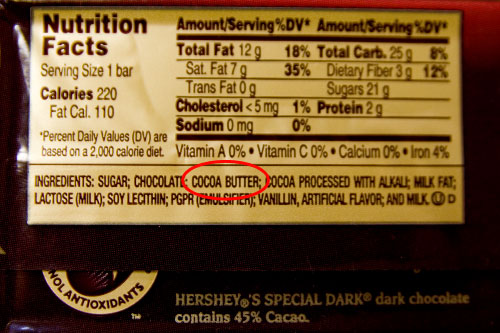
The math here is easy, since the “serving size” is the whole bar. Just over half of this chocolate bar is pure sugar. Imagine the bar below with the ingredients separated, the chocolate on the right, the sugar on the left:

Hershey Special Dark dark chocolate bar, sugar mixed in.

The six squares on the left would be pure sugar. That’s a lot of sugar.

The lowest-sugar bar at the Kiva was Lindt Excellence 90% Cocoa Supreme Dark bar, at 7.5% sugar. That’s like almost one of one of the squares above. I found it taste tolerable–enjoyable, even, but more in the way wine can be enjoyable than in the way I normally expect chocolate to be enjoyable. Interesting rather than incredibly delicious. I also found that I did not eat it nearly as compulsively as I do sweeter chocolate.

The runners-up were E. Guittard’s Nocturne “pure extra dark chocolate” 91% cacao, at 8.8% sugar and Theo’s Venezuela 91% Cacao, at 9.5% sugar; each had the equivalent of a little more than a square of sugar out of the bar above, about 10 and 20% more sugar than the Lindt. These bars were easier to eat–less burned and bitter tasting, but still definitely in the enjoyable-like-wine category, a little smoother and maybe fruity or aromatic.

The rest of even heavy-duty dark chocolate bars were at 20% or more sugar. That’s at least almost three squares in the bar above. Green & Black’s Dark 85%, for example, is exactly 20% sugar. I haven’t tried it recently, but after eating these 3-10% bars, I expect it to taste quite sweet, with more than twice as much sugar as the runners-up and almost seven times as much as the Lindt Excellence.

Sometimes the nutritional facts numbers do not add up. I noticed that with the Green & Black 85% bar. It’s got 8 grams of sugar per 40 gram “serving” in a 100 gram bar. That’s 20 grams of sugar per 100 gram bar, thus the 20% sugar I calculated. How is it, then, that the bar is also 85% cocoa? Chocolate companies, please explain your math.

Because it is so dry in Joshua Tree, water is great for cooling off. According to my calculus-free, 200-level physics education, this works because a tiny bit of the heat energy stored in our bodies is used up every time a water molecule evaporates. It’s almost like the water molecule uses our body’s heat to achieve escape velocity, to become a gas. A lot of water evaporating creates a significant cooling. This is how sweating cools us, if we’re lucky enough to be in a dry area.

So when it is hot, which is every day in the summer, we get wet a lot. Inside, we have spray bottles handy so we can spray each other whenever someone starts complaining about the heat.

Above the stove is the handiest place for the spray bottle.

Outside, we often hose each other off. A good drenching keeps us cool even on the hottest days, until we are dry. Granted, that might only be for 15-20 minutes on a really hot day, but comfort is worth taking breaks that often.

If we’ve stored up some heat from a bike ride or forgetting to hose off, we also have a stock tank in the yard for dunking ourselves:

Reanna, cooling off.

The water stays cool even on the hottest days, also because of evaporation, so it is always refreshing to take a dunk. I built the little platform so when we drain the tank, we can water our plants.

12-inch dirt-filled stock-tank platform with screen lid and hose outlet. This photo was taken before I put plank decking on each side of the platform so we don’t get our feet dirty getting in and out.

We also got a “swamp cooler” from our friends Mike and Sarah. It wasn’t big enough to cool their house, but it’s good for our trailer. Reanna sewed a sleeve to funnel the air into our back window, so we didn’t have to cut a big hole in the wall.

Swamp cooler, on home-made platform

Reanna’s sleeve, held to swamper with a drawstring

Sleeve, inside window, held open by a wire frame

It makes a huge difference. A swamp cooler is simple and effective: A pump pulls hot, dry air from outside through wet sponges, creating cool, moist air inside. The physics involved is similar to sweat-cooling, except the heat energy used to turn the water into a gas is drawn from the air itself.

It requires simple enough plumbing that I could handle it myself:

A splitter where our (lead free) hose feeds the trailer, fitted with a compression joint to attach copper tubing. You can kind of see the copper-tube cutter (red) at the bottom of the frame.

Another compression joint, feeding the float valve that lets water in when the level gets low.

Swamper, inside: The float valve (blue) lets water in. The water pump (green) pulls it up and pours it down the three sponges in the left, right and back (removed) walls. The fan (drum at top) pulls the air in through the sponges and pushes it into the trailer. Simple!

The most fun way to use water to cool off, of course, is swimming. My mom got Reanna and me a month’s pass to the pool at the Joshua Tree Retreat Center (AKA Mentalphysics) as a wedding present, and we used that quite a bit. It was awesome. Thanks, Mom!

Reanna at the JT Retreat Center. Note luxuriously empty pool.

Reanna & Rob at the Joshua Tree Inn’s Hacienda Pines pool.

Matt at JT Inn pool.

Backstroke race at the Yucca Valley High School pool, also open to the public in the summer.

Kids in Ken & Katie’s blowup pool.

Joshua Tree is in the Mojave Desert and hot in the summer. The average high is 100 degrees. That’s not Sonora Desert hot, but it’s still hot. My subjective thermometer of summer temperatures is something like this:

70s: Nice. Rare.

80s: Warm. Still nice.

90s: Hot. The sun is hot.

100s: Baking Wall of Heat. The sun is hot, but the air is also hot.

One option for dealing with this is not dealing with it: Stay inside with the swamp cooler on. If I spend most of the day in the office, my moments spent outside feel refreshing, a warm-up.

Another is dressing for it. If you can avoid the sun, say in a hammock under a tree, I advise being as naked as you can get away with. Bare skin is pretty good at keeping cool via sweat evaporation, at least in the dry of the desert. If you can’t avoid the sun, it’s more complicated. Here’s my yard-work costume:

1) Straw hat with a wide brim, loose enough for ventilation, but not loose enough to blow off in a breeze. I think the sun is good for us, but getting sunburned is not. I get sun on my skin every day but avoid burning. The hat helps with that.

2) Polarized sunglasses. I also think unfiltered sunlight is good for our eyes, and I get a fair amount every day, but hours in this kind of intense light makes me feel like I’ve sunburned my retinas.

3) My best white dress shirt. My wife Reanna was appalled at this sacrifice, but this is how I justify it: a) I do way more yard-work than I do dressing up, so it gets more use. b) It fits really well, so it’s comfortable, doesn’t restrict my motion, and doesn’t get tangled in the saw or drill or plant-to-be-pruned. c) It’s bright white, so reflects the sun really well. d) It has long sleeves, so I don’t have to wear sunscreen on my arms, but I can roll them up when appropriate. e) It has a collar which I can turn up to protect my neck. When the sun is low, my hat doesn’t do the trick for my neck. Again, less sunscreen. f) It buttons up, so I can button or unbutton, as needed, for venting. Most often I have only the second-to-top button fastened for maximum venting plus protecting the skin of my upper chest, which received more than its share of sun damage in my youth. g) Once it has some paint and a few tears, neither of us will feel remotely precious about it.

4) White work gloves. Sometimes gloves are not appropriate to the work I’m doing, but when they are, I wear white cloth gloves with rubberized palms and fingers. They save sunscreen and save my delicate musician hands from injury.

4) Shorts to the knee. Protects my thighs from sun while allowing leg-venting. This does leave my calves vulnerable to sun. In the middle of the day they get somewhat shaded by my body. At other times I can often find a shadow to fall on them. If not, sunscreen or sunburn. I find the trade-off worthwhile.

5) White socks. This is the part I’m most conflicted about. I generally eschew socks when I can get away with it, but in this kind of heat my feet can sweat and get stinky and uncomfortable. Plus, socks help make having sand in your shoes less uncomfortable. And they protect your ankles from sunburn.

6) Light, vented shoes. I wear Nike Free 3s, the most comfortable shoe yet created. They do not protect feet from dropped tools or lumber but, cross my fingers, so far it’s worth it.

Here are a couple photos of the costume, taken by Reanna, missing only socks and gloves:


I’ve listened to 247 podcasts of Planet Money over the last several years–about 80 hours. This show is the best way I’ve found way to learn about economics in fun, thought-provoking, 20-minute bursts.

I just finished a show called “The No-Brainer Economic Platform,” about six economic reforms that apparently almost all economists agree on, regardless of ideology. The major point of the show was that even though there is agreement, political candidates will not consider running on them. And if they did, they would stand no chance of winning.

One of the major points (though probably unintended) of my 80-hour economics education has been that economists are much closer to political pundits than scientists. The “facts” vary widely depending on their political stance. That’s why this show was so exciting: There actually are six things that economists agree on across the political spectrum!

1) Eliminate the home mortgage interest deduction. It is extremely regressive and distorts the housing market in bad ways. They make it sound here like almost all economists are in favor of eliminating all tax loopholes and deductions, though the point is less clear. Read on, though, and you’ll see that loopholes and deductions would become mostly obsolete under this platform.

2) Eliminate the deduction for employer-provided health insurance. It’s one of the main reasons for high healthcare costs in the US.

3) Eliminate taxes on corporations. If you want to tax rich people, do it directly. The idea is that tax rates serve as incentives/disincentives. Don’t tax things we like. We like American businesses making money.

4) Eliminate the individual income tax and payroll tax. We also like individuals making money and we like businesses creating jobs. Make up for the loss by taxing consumption, I think especially on luxury items–make it progressive in some way.

5) Tax things we don’t like. Use taxes as disincentives for things like cigarettes and pollution.

6) Legalize drugs, or at least marijuana. The war on drugs is basically a massive waste of money that makes drug cartels rich. Without it, we’d have another kind of consumption that we don’t like to tax.

Again, the major point of this show was that these ideas are political non-starters, but I wonder if that is true. Each plank on its own would have entrenched detractors, but as a system of reforms it’s more appealing. Pay more for your mortgage and gasoline, but pay no income tax. You would have to show people a model of it working.

Here’s a challenge for any math-oriented readers: Give us some examples. How much would we need to charge for cigarettes, pot, gambling, fossil fuels, yachts, and mansions to make up for the loss of all income taxes?

I’ve just begun reading Antonio Damasio’s The Feeling of What Happens: Body and Emotion in the Making of Consciousness. I bought the book while I was in grad school, knowing it would be years before I could get to it, but so excited by the title! Consciousness and how it relates to the body and emotions is one of my favorite topics of inquiry. Plus, Damasio is a scientist with a (rare) good reputation as a writer.

In the introduction he describes six facts that a good theory of consciousness will have to take into account. Here are my paraphrases:

1) There will be an “anatomy of consciousness”: Elements of consciousness appear to be associated with activity in certain parts of the brain.

This may be scary to those who believe that consciousness is magical, or that its magic would be somehow diminished if it relied on the brain’s circuitry. I too used to be uneasy about that idea. After diving into brain studies a bit, though, I feel both excited and humbled by it. It’s just neat that our brains apparently produce all the subtleties of our experience. Also, it’s a good reminder that our experiences of feeling, thinking, knowing, and of awareness itself is created by our brains, and is not a direct line on reality.

2) Consciousness is more than wakefulness or attentiveness. Humans can be awake and attentive without being conscious.

Damasio describes patients who are clearly awake and attentive, but not conscious, and promises to devote two chapters to the significance of this phenomenon.

3) You cannot have consciousness without emotion.

I am excited about this point because I’ve thought it both crucial and little recognized since reading The Mind’s I many years ago. It had an essay which convinced me that real artificial intelligence would not be possible without emotion. Without emotion all you have is processing power. And in human intelligence at least, emotion brings in the body. Emotions are not just mental phenomenon. I can’t wait to see how Damasio deals with this.

4) There is a distinction between “core consciousness,” producing a sense of moment-to-moment “core self,” and “extended consciousness,” producing a story-making “autobiographical self.”

This distinction could bring clarity to the debates about consciousness in infants and non-human animals. Core consciousness may be the kind that everyone has, and extended consciousness the kind that we develop as our experience becomes more and more intertwined with language and concepts.

Core consciousness sounds to me like the experience that meditators work to remain in. We live most of our lives in the useful but problematic realm of extended consciousness, judging experiences as good or bad, right or wrong, safe or unsafe, and other ways they relate to the story we have of ourselves. Once we are living this way it is difficult to escape. Meditators find that maintaining awareness of core consciousness can be a welcome rest from all that. This practice may help the autobiographical self have an easier time as well.

5) Consciousness cannot be wholly described by other mental activities. Things like language and memory are necessary but not sufficient for full consciousness.

You can’t leave consciousness out of the discussion. It is more than its parts. I like this because I think a lot of scientists are squeamish of even using the word “consciousness.” It makes you sound like a hippy. Prepare to hear a lot of scientists trying to talk about consciousness without sounding like a hippy.

6) Consciousness also cannot be described wholly by describing how the brain creates our experiences out of sensory and mental data.

I read some famous scientist saying that if he were to be at the beginning of his career, he would be looking into creation of qualia, the “particles” of experience, that this was the next holy grail of psychology. That’s a good one, for sure, but I think an explanation of consciousness is a better holy grail than an explanation of qualia.

I’ve written very little about my wife, Reanna. She prefers to stay out of the public eye, for the most part. But she’s been blogging more lately, and it’s her birthday today, and I’m feeling optimistic about getting away with it:

I am so lucky to have married Reanna! I’ve always been a lucky man, but she takes it over the top. I am certainly going to  have a bigger, happier, prettier, more interesting, more connected life because of her. And when my eventual death occurs to me, I feel noticeably calmer about it.

I get to hang out and talk with Reanna every day. She’s super fun to talk with because she’s so smart. It’s not just that she grasps and manipulates concepts and models so easily, it’s that she’s hungry for them and tenacious with them, working and talking through them until she’s made them her own. I love it!

And I love how physical she is. She inhabits her body fully. I’m so lucky to get to watch her swimming, dancing, stretching, smiling, to feel her confident touch.

I love how she is compulsively honest. I love how she thinks about her friends and family. I love her family and feel so lucky to have them as my family. I love that she makes quilts and tailors my clothes. I love that she likes gardening and loves cacti.

I love how she inspires me. I think of her as my audience when I write. Hers is the voice of my internal devil’s advocate. I take on projects I never would have because of her–our trailer renovation is a good example. We’re planning to write books and blogs together, have a family of our own, and who knows what else?

Best of all, with my family’s genetics I very well may get to live 50 or more years with Reanna. Lucky!

I finally found the obscure screwdriver bits that work on my 1962 Kenskill travel trailer windows, “clutch type,” on a website called Zoro Tools. I’m happy to have found this company in almost every respect. They had my obscure parts for very reasonable prices, and shipped them to me quickly and for free. My total cost was $3.90.

So the following complaint is a small, fixable part of my experience with this company. But look at this: My two screwdriver bits arrived in a two-gallon cardboard box, stuffed full of packing bubbles.

The size and durability of the objects shipped does not seem to be a factor in choosing the volume or type of the shipping container, nor the amount of cushioning. A small envelope would have gotten them to me unharmed, even if a truck ran over them en route. A small padded envelop would have done the job if the bits’ packaging was somehow precious. 

This is not just a complaint about Zoro Tools–I have the same experience with Amazon and most other shippers I’ve used. I’ve gotten an extremely durable hard plastic container of skin cream in the mail from Amazon in a small box packed in a much larger box filled with bubble plastic. I’ve gotten an ace bandage packed the same way.

Now it may be that Zoro Tools normally ships to larger companies, so they only have large boxes to ship in. (Though Amazon does not have this excuse.) It may also be that they ship mostly to retailers for whom the state of the packaging actually is precious. And there are certainly other shipping considerations that companies make that I am not aware of.

But it actually hurts me a little bit to see this kind of waste of energy, resources, and space. I don’t want to be part of it. I’d like it if there were a “Not Fussy” shipping option to choose from: “Please just slap an address label and a stamp on the actual product and put it in the mail, if at all possible.” Something like that. The company that does that will get my business.

I posted earlier about my first carbon-footprint calculation attempt, on carbonfootprint.com and thought I’d try another couple calculators to see how they compared.

First, I tried The Nature Conservancy‘s calculator. They gather a lot less detailed information than carbonfootprint.com, but also ask some new questions, like how often I check my truck’s air filter and tire pressure. They also have a way to be clear that I’m getting my individual carbon footprint, not that of my household, which was not so clear with carbonfootprint.com. They calculated my carbon footprint as much bigger than carbonfootprint.com, though, at 17 metric tons of CO2 per year: 17.8% on home energy, 64.6% on driving and flying, 2.8% on waste and recycling, and 14.9% on food and diet.

They also provide an opportunity to offset my entire carbon footprint and calculated the cost for me to do was $255: $15 per metric ton. That’s pretty cheap. I’ll have to look into carbon offset schemes and see if they are convincing.

Second, I tried footprintnetwork.org. They try to calculate how many planet earths it would take to support a population living my lifestyle–an interesting way of thinking about it. They gather a lot of the same information as the other sites, like how local is my food and how much I fly and drive. In some areas they gather more details, like how often I eat each of several kinds of animal products, how often I buy new clothes, furniture, appliances, and computer gear, and what kind of siding my house has.

This site estimates that if everyone lived like I do, we would need 3.5 planet Earths to sustain us. They suggested several ideas that would decrease my footprint: .1 of an Earth if I half my animal product consumption, .2 of an Earth if I “pledge to use less packaging,” .1 of an Earth if I use public transportation once a week, and .1 of an Earth if I do not fly this year because I chose “a local vacation.”

If I did all of these things we would need only three Earths to sustain us all at my standard of living. Half of an Earth’s savings is nothing to scoff at, but doesn’t really get us there. Plus, I already use very little packaging, and do not often fly for vacations.

They estimate how many “global acres of the Earth’s productive area” my lifestyle requires:  7 acres “energy land,” 2 acres “crop land,” 1 acre “grazing land,” 2.5 acres “forest land,” .5 acres “built up land,” and .25 acres “fishing grounds.”

They also calculate my “ecological footprint” percent by category: 52% in services, 11% in goods, 12% in mobility, 4% in shelter, and 16% in food.

Something is wrong about these calculations, but I’d need more details to know what. Half of my land-use is for energy, but half of my footprint is in “services.” What are these services that are using so much energy?

Still, a picture emerges. I have estimates of 10.41, 13.7, and 17 metric tons of CO2 per year, approximately 3-5 times as much as an ethical target. I probably create the most CO2 by burning fuel, driving and flying.

Reanna and I picked up a truckload of prickly pear pads of several kinds from our friends, Elise and Wolf. They are not a kind of prickly pear that is native to this part of the desert, but they grow well here. They said to plant them with the bottom pad about half underground and to water them for the first month. After that, they shouldn’t need water. And we can look forward to them growing quickly and producing yellow and salmon flowers, plus edible fruits. The rounder ones grow up a couple feet but stay close to the ground. The longer ones (like just to the right of Reanna) grow taller, six feet or so.

Reanna Planting Prickly Pear

A few weeks ago, one of my posts received a comment that was worth a whole post:

I am also a therapist (though I’m still in training). I’m wondering if you would be willing/able to recommend some family therapy books you’ve found helpful. My program is very focused on the individual and I’m trying to fill in some gaps and find your perspective on therapy to be very resonant with my own.

I’d love to recommend some family therapy books! My program was extremely family-systems focused, which I’ve been grateful for since leaving school. If you want to see an exhaustive reading list (I can’t remember having been assigned a real dud), you can see reverse-order lists of everything I read in my first year here and my second year here.

I’ll try to create a bare-bones list for you here—much more useful for you and a good exercise for me. I should warn you before I begin that I am super nerdy when it comes to family therapy reading and I can imagine many in my cohort rolling their eyes at my “must-read” list. If you are nerdy like me, though, here goes:

Pragmatics of Human Communication: A classic and profound book by Bateson’s MRI team, the first and probably still the best attempt to apply system theory to human relationships.

Susan Johnson’s books The Practice of Emotionally Focused Couple Therapy and Emotionally Focused Couple Therapy for Trauma Survivors. Johnson combines system-thinking, Rogers-style experiential therapy, and attachment theory, creating one of my most-used therapy models.

John Gottman’s books, especially The Marriage Clinic and The Science of Trust. Gottman has taken up the project started with Pragmatics, largely abandoned by family therapy, and is doing it in fine style, with solid science.

Metaframeworks: This book presents my favorite meta-model of family therapy, combining the best parts of the many family therapy models.

A major work by each family therapy model-builder is also important reading: Haley, Madanes, Satir, Whitaker, Minuchin, Bowen, Selvini-Palazolli/Milan group, Weakland/Fisch/MRI group, deShazer/Insoo-Berg, Epson/White, and Hubble/Duncan/Miller. Keep in mind that their books are presentations of informed opinion, not science. Every one of these folks have got some things right and some wrong. They have also advanced the field significantly, and are the largest part the conversation on how to think about families.

Finally, a couple things that I was not assigned in school, but I found extremely helpful in making sense of the flood of information. First, a grounding in systems/complexity theory: Family therapists think of themselves as system-theory experts and throw around a lot of lingo that they may or may not really understand. It’s easy to get confused in this situation. The best introduction to modern system thinking is still Capra’s The Web of Life (though we’re overdue for an update). Also, check out Bateson’s books Steps to an Ecology of Mind and Mind and Nature. Second, familiarity with Wilber’s integral theory really helped me navigate the heated arguments about modernism vs. post-modernism and intervention at the level of individuals vs. family systems vs. larger systems. Check out Integral Psychology or A Theory of Everything.