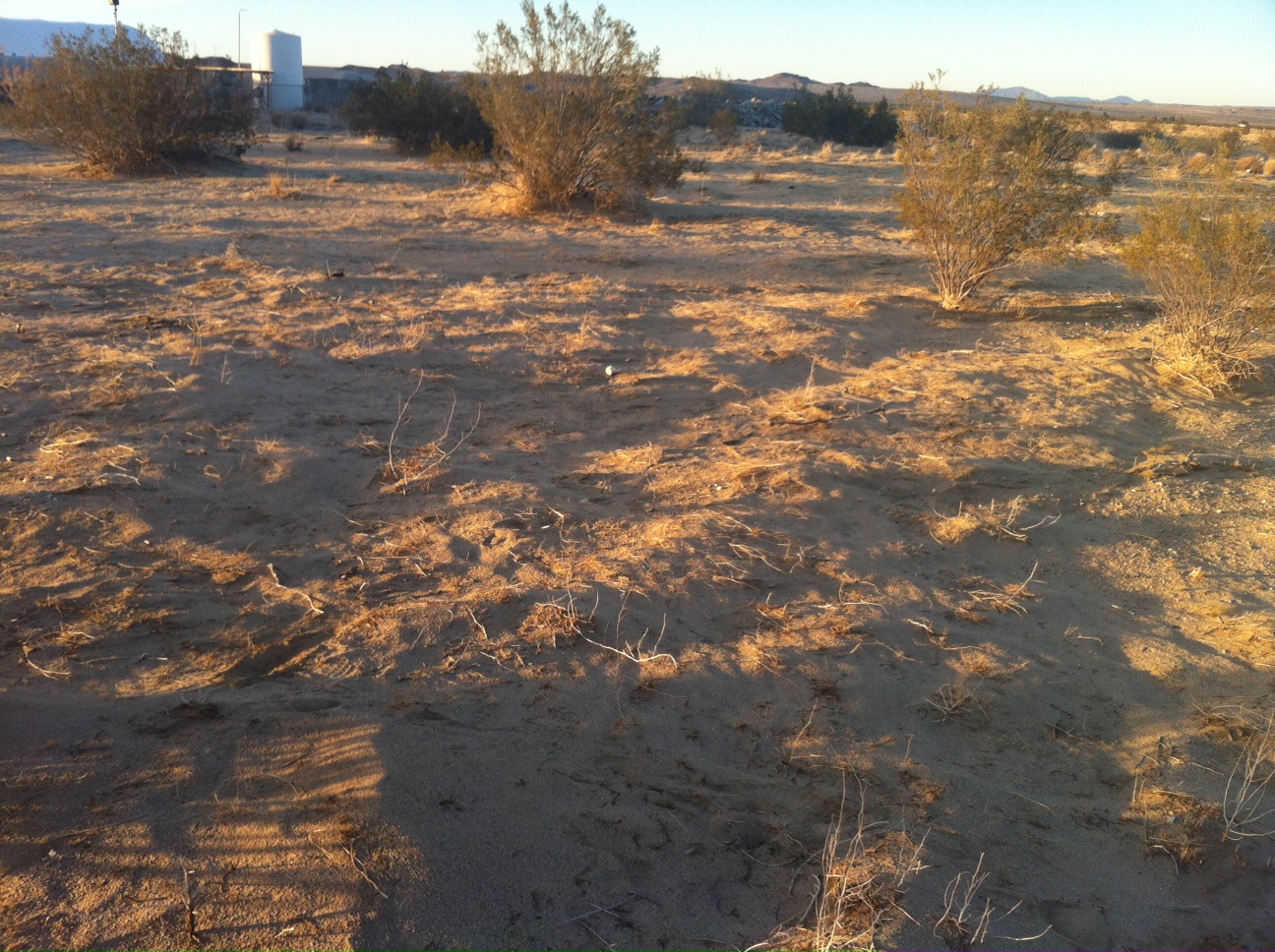
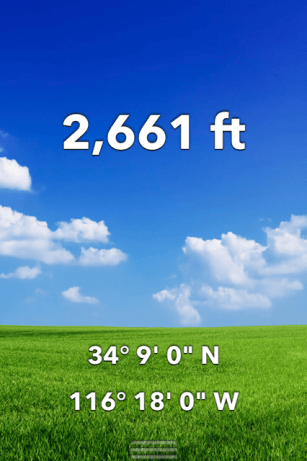
Last week I realized that I’ve been working near a latitude and longitude microconfluence in Twentynine Palms, so I walked over to it on my lunch break.

photo-5

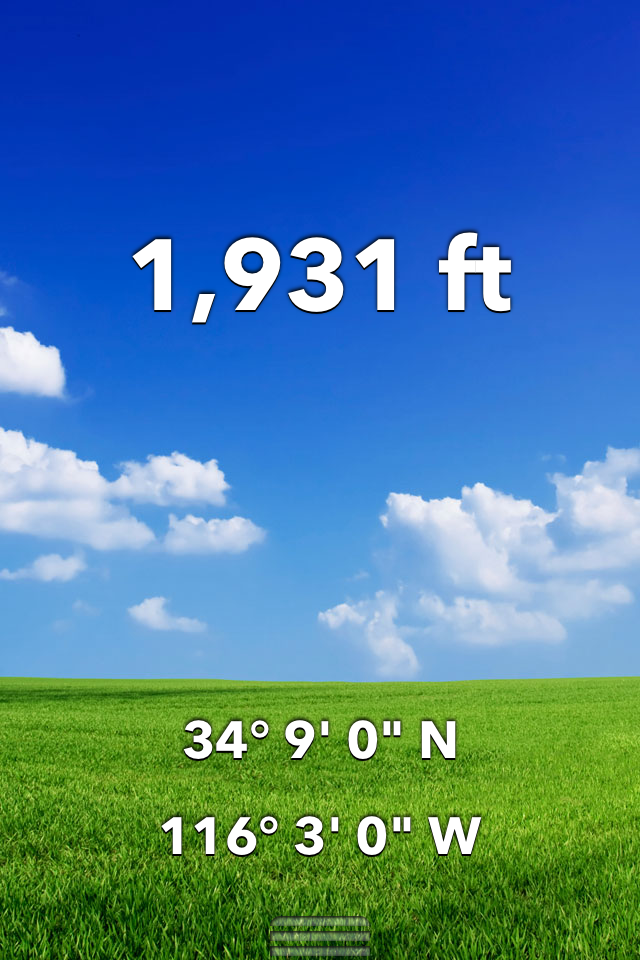
Screen shot of Altimeter app

photo-7

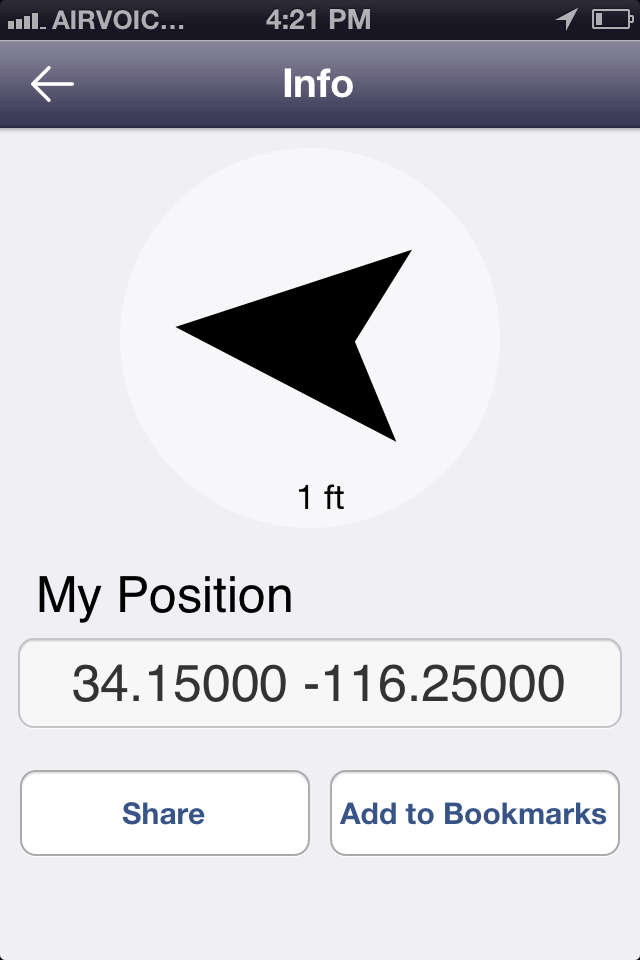
Screen shot from Maps With Me, showing metric coordinates

image-2

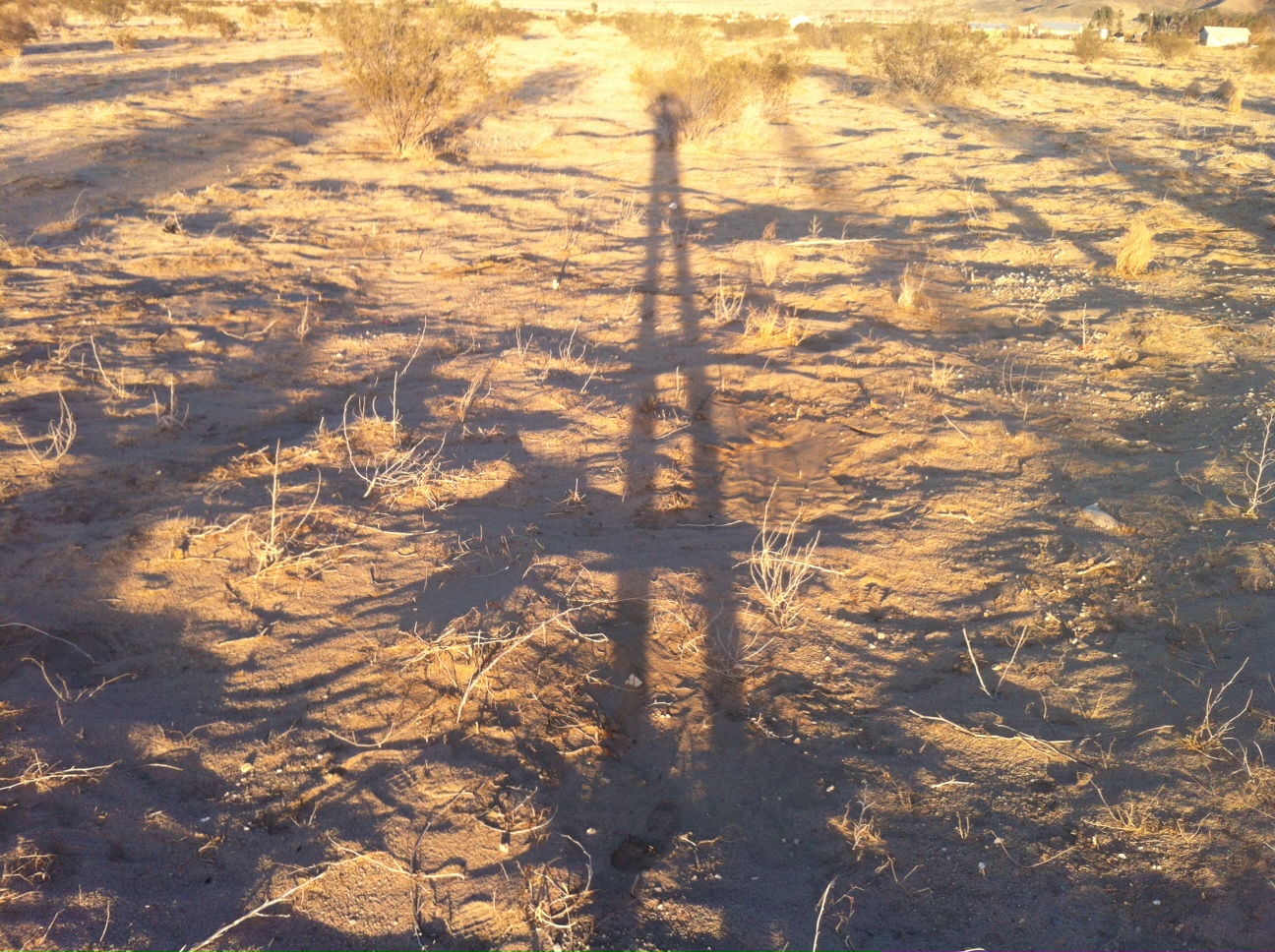
And the microconfluence itself

The spot is in the front yard of a house on the southwest corner of Two Mile Road and Aztec Avenue. You can see the yard through a gap in the “hedge” that I’m shooting through, with a concrete U driveway on the other side of that awesome cinderblock wall.

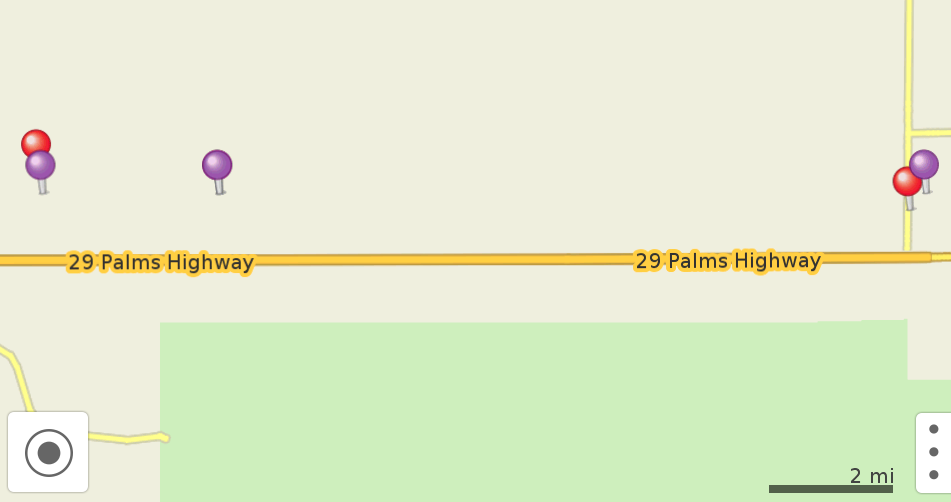
The funny thing about this adventure was that it took finding three microconfluences on Two Mile Road (the first two are here and here) before realizing that Two Mile Road is right on 34.15 degrees north latitude (34 9′ 0″) all the way from Joshua Tree into Twentynine Palms, even though the road doesn’t go through. (Copper Mountain is in the way.) I didn’t expect such consistency from early Morongo Basin road builders. I see that I can find three more microconfluences just by following the line of Two Mile Road between Joshua Tree and Twentynine Palms, probably climbing part of Copper Mountain in the process.

The purple dots are microconfluences. From left to right, Joshua Tree, Sunfair, Twentynine Palms.

The purple dots are microconfluences. From left to right, Joshua Tree, Sunfair, Twentynine Palms.

The same basic area on Google Maps. JT National Park is south of the highway, Copper Mountain to the north in the middle. Two Mile Road is not paved in JT, so it's hard to see.

The same basic area on Google Maps. JT National Park is south of the highway, Copper Mountain to the north in the middle. Two Mile Road is not paved in JT, so it’s hard to see. I think you can click on this image to see it bigger.

I posted yesterday about Cool Climate Network’s interactive maps, where you can find find and compare average carbon footprint and average annual vehicle miles traveled by zip code in the US.  I tried in that post to compare the carbon footprints I had calculated here and here to Cool Climate Network’s averages for Joshua Tree, with muddled results because of the variation in carbon footprint numbers each calculators gave me. Today I realized that Cool Climate Network has their own carbon footprint calculator, so I tried it out. I figured I might be better off comparing my carbon footprint to Joshua Tree’s average if they were calculated by the same people.  Who knows, really? I’d love to do a full and convincing inventory, like Saul Griffith in his Long Now talk. Perhaps once I’m licensed…

Cool Climate Network’s carbon footprint calculator is pretty similar to the other three I’ve tried (Carbon Footprint, Nature Conservancy, and Global Footprint Network), but on the simple side. It took about ten minutes. Here are the results:

Cool Climate 2013 Estimate

A total carbon footprint for both Reanna and me of 19.7 tons of CO2 in the last year is “59.9% better than the average household in the United States with 2 people and similar income.” It’s also 55% of the 35.8 tons of CO2 they estimate for average in Joshua Tree. I wonder why they match by income. What I’d really like to know is  our number of standard deviations from the Joshua Tree, US, and worldwide average: where we are on those Bell curves.

Beneath these results, Cool Climate Network lists 41 ways to decrease our carbon footprint, mostly things that the survey did not ask about. We’ve done about 20 of them already, though some we could do more of.  This is another way a more detailed calculator would be better. Those 20 things we’ve done already add up to about 6 tons of CO2, so it may be that our actual footprint is more like 14 tons of CO2.

These images are from three interactive maps of the US at Cool Climate Network:

JT Average Vehicle Miles

(Joshua Tree in red oval)

Reanna and I drive our Yaris about 1,200 miles a month. That’s less than 40% of average if what they mean is how many miles individuals are traveling in vehicles per month. They could mean how many miles each vehicle travels per month, though, which places us at 75% of average.

JT Average Energy Carbon Footprint

(Joshua Tree in red oval)

JT Average Carbon Footprint

(Joshua Tree in red circle)

I tried out a three carbon footprint calculators (and wrote about it here and here) in 2012, which produced estimates of 10.41, 13.7, and 17 metric tons of CO2 for me. That makes it look like Reanna and I were somewhere between average and 2/3 of average, which I doubt. I bet we’re at half or less of Joshua Tree average–we live in a very small space with solar-generated electricity, don’t spend much money, and drive a fairly efficient vehicle–but I can’t prove it without a really good, thorough carbon footprint calculator. Can anyone recommend one?


I don’t carry a cell phone in my pants pocket any more, unless it’s in airplane mode or turned off. Several months ago I read and agreed with Tim Ferriss in The Four Hour Body that you probably don’t want a radiation emitter cuddling with your testicles. He apparently tripled his motile sperm per ejaculate during an eleven-week program of no phone-testicle cuddling, cold treatments, and eating Brazil nuts. So I carry my cell phone in my breast pocket if I have one and in my hand if I don’t.

The problem is, I also care about my heart, lungs, muscle, bone, and lymph nodes which my cell phone is now cuddling with. And I don’t care for the phone-strapped-to-arm look. I often just keep it turned off or in airplane mode, which is fine. I don’t mind not being on call to everyone who has my phone number.

But now I am actually  and professionally on call. My work has a two-week rotation for therapists to be on call 24 hours a day for crisis intervention and I’m on until next Monday. My work cell has to be on and it has to be on my person or I will likely miss a call. So now I’m carrying two phones.

Oh, what to do?

IMG_1108

I took the dirt bike out to find my second microconfluence this afternoon. (See my post about the first here and about Charlie Loyd’s proposal of the idea here.) I’ve decided to go after what I’m thinking of as “minute-microconfluences,” which are microconfluences as defined by Charlie (decimal degrees at the hundredths) and also intersections of minute-lines of longitude and latitude. This is partly because they are farther apart and so feel slightly more… well, rare if not important, but mostly because the app I have that reads latitude and longitude in real time does so in the minute-second version. Perhaps this will offend metric purists, but I guess it would be nice to write something important enough to metric purists to cause offense.

I found it just north of Two Mile Road and just east of the cement factory. To the north and east were Sunfair Airport and Sunfair Road, respectively.

34o9' altimeterphoto-4

I found that my minute-second reading app and my decimal reading app disagreed a bit with each other, so I took photos of a fairly large area to be sure I had the actual spot shown:

photo-5

Looking just north of west over the spot

photo-6

Looking just west of north over the spot. Concrete debris in the background is the north end of the cement factory.

sunset 2014 01 04

The sunset heading home was the best part.

The WordPress.com stats helper monkeys prepared a 2013 annual report for this blog.

Here’s an excerpt:

The concert hall at the Sydney Opera House holds 2,700 people. This blog was viewed about 47,000 times in 2013. If it were a concert at Sydney Opera House, it would take about 17 sold-out performances for that many people to see it.

Click here to see the complete report.

I photographed my first microconfluence today. You may be familiar with the Degree Confluence Project, where people take photos of  the meeting point of lines of latitude and longitude along with the story of finding it.

Charlie Loyd created the microconfluence because he wanted to take part, but all the full degree confluences near him had already been photographed. Microconfluence points (if I’m understanding him correctly) are at the meeting points of 1/100s of latitude and longitude, which are something like 2/3 mile apart. (Distances vary, of course, because the grid is on a curved surface.)

The degree confluences near Joshua Tree have also already been photographed, so I also liked the idea of microconfluences. (Plus, it reminds me of Ethan Mitchell’s blog about finding state border confluences.) Charlie was kind enough to make me a web-based app for it, so I knew one was a few blocks away. I was out on my dirt bike today and found it. I used a different app, called Altimeter, because I pay for phone and data by the datum (and pay way less per month because of it) :

photo-2

Then I realized that Charlie was talking about decimal coordinates, not the “minute-second” coordinates that Altimeter uses. Luckily, it turns out that microconfluences with minute coordinates divisible by three are also decimal microconfluences. This is from Maps With Me:

photo

And here’s the piece of dirt. The tire track on the left is the west edge of Border Avenue, a bit north of Two Mile Road. The little bush is a creosote.  Anti-climactic, you say? Maybe I should mark the spot with a monument of some sort.

photo-2

Family friend Robert Spoeker died last week.  I knew him to be an intelligent, witty, and very gentle man. I’ll always appreciate the friendship he showed my dad, and I imagine as the years go by I’ll primarily remember him by how he lived, but right now I’m thinking mostly about how he died. He decided it was time, stopped eating, and spent his last few days at home in his own bed, with my dad and a hospice nurse keeping watch. By all accounts he was peaceful and clear about what he wanted throughout. No doctors, no hospital, no emergency. I didn’t know we could still die like that, and I’m moved each time I remember.  I hope, when it is my time, that I can be as graceful.

Robert in 2011, far right

Here’s how my dad described it:

Robert made a very classy transition. His housekeeper called me Wednesday, saying he was refusing food and wouldn’t/couldn’t get out of bed. She was freaked and wanted to call 911. Robert and I had had the conversation about this, and I told her to sit tight. When I got over, I could see that he had started the transition. I questioned him about his wishes once again (actually several times), and he said he was fine as he was. He wouldn’t take any food and little water, and was very definite about his wishes.
 
Over the course of the next several days several family members came over to say goodbye. My youngest son’s fiancee is an ER nurse, and when she saw him, she took his vital signs (with his permission) and he was normal. She said that even if we sent him to ER, they would just give him some tests and discharge him. 
 
Over the next day, I read Sar Bachan poetry to him. I had never read it before, I just found the book on his shelf. It’s beauty really struck me. That, and the Master’s photo, seemed to brighten up his lucid moments quite a bit. Finally, he asked me to stop reading, as if he was too busy inside to be bothered even with Sar Bachan, or any other external communication. After that, he seemed to be aware of me, but was non-communicative. 
 
On Saturday, we called a friend who was a hospice nurse. I didn’t know what to do when the time came. She was a neighbor/friend, and was very sympathetic. She came up to his house on her day off unnoficially, and looked at him, and said that he had only a day or 2 left. We went over to the closed hospice office in a windstorm and signed him up (he had years ago given me power of attourney to make healthcare decisions when he was not able). That was very good luck because they didn’t interfere with him at all, but took care of the aftermath beautifully. They even sent over a bag of morphine for him on Saturday night, which, of course, I didn’t give to him  because he was managing his process perfectly well, with no complaints (I did think about taking some myself- but didn’t). I went to sleep Saturday night on the couch at 12:30. He was breathing a bit heavily and sighing when he breathed out. I woke up very alert at 6:30 SundayAM, went in, and he was gone. He looked very much at peace.
 
I am humbled to have been with him and witnessed it all.
 
stev0


My family celebrated Thanksgiving on Friday this year instead of Thursday, so I spent Thanksgiving day giving money away and buying Christmas gifts–a great way to do it! This is the first holiday season in my life that I’ve begun with a solidly-above-the-poverty-line income. It’s a whole different experience. I’ve given to charities before, of course, but always with a little mental wrestling over each gift. This year I could make a list of everyone I really wanted to support, send each some money, and it just felt fun. Here’s my list so far:

The Long Now Foundation: I got on to these folks through their really, really good Seminars About Long Term Thinking. They see our culture’s “pathologically short attention span” and have a mission to “foster long-term responsibility.”

Mojave Desert Land Trust: These folks really caught my attention when they managed to purchase (save, really) a large and beautiful swath of desert on the western edge of Joshua Tree, surely the next to fall to big box stores as Yucca Valley slouches east. It made me so happy. They focus on land conservation and stewardship around here, including wildlife corridors.

Rocky Mountain Institute: Amory Lovins has been a hero of mine since I saw him speak at the University of Oregon ten years ago–to this day one of the most inspiring lectures I’ve seen. (Here’s a TED Talk.) He started RMI with the vision “a world thriving, verdant, and secure, for all, for ever,” and the mission “to drive the efficient and restorative use of resources.”

Wikimedia: I use Wikipedia almost every day, and so do you, probably.

Chicago Public Media: WBEZ in Chicago, which produces at least two of my regular podcasts, This American Life (in-depth news, great stories) and Sound Opinions (music news & reviews). I can’t quite tell if they also produce Planet Money (economics-related stories and explanations), another of my regulars… they seem to be associated with This American Life, so I threw in some extra money for it.

New York Public Radio: Mostly for Radiolab, which makes science-related podcasts.

KCRW: Probably the best radio station in the world. I have cut myself off from the daily news cycle in the interest of staying sane, but I still listen to a lot of KCRW. Their music programs are great, and they produce Left, Right, & Center, the only political show I listen to intentionally these days.

The Human Food Project: These folks are going after large-scale microbiome base rates in various populations. They have an open source project going called American Gut where you can join and get your gut microbiome sequenced and compared to the others involved.

Mil-Tree: A local military/civilian integration and healing project based on the work of Ed Tick. Their Art of War show was one of the most moving things I witnessed this year.

I made a composter last year that has been working pretty well:

My model for composting comes from my aunt & uncle, who have three fenced-in areas for compost. They use one for a year and then let it sit for two years. It is the epitome of low-maintenance composting: throw in your kitchen scraps and come back in a couple years.

In the desert, you can’t just have a fence. The critters will eat what they can and leave with your compost in their bellies. The rest will eventually either mummify or turn to dust and blow away. In the desert, you need a box with a lid and you need to keep it moist. The plan was to have a box that held a year’s worth of kitchen scraps that we would keep moist by dumping in the rinse water when we needed to rinse out the bucket.

And it worked. The size, 2′ x 2′ x almost 3′, was perfect. Over a year we put in a couple hundred gallons of kitchen scraps, half of a straw bale, a bunch of silage from the garden, and only enough water to keep our compost bucket from stinking, and it’s standing at 3/4 full and dropping. No turning or fussing.

But we needed a new box and I’ve just finished it, with help from my nephew Ollie:

It’s a lot bigger–4’x4’x3′–for a couple reasons. We want it to last longer and we’re expecting to have more to put in it this year. Also, I think the 2’x2’x3′ box is too small to really get cooking. My brother Damian got intensely into compost this year and inspired us to buy a compost thermometer and we found that our compost peaked at 117 degrees and usually hovered around 100, no matter what we did about the carbon/nitrogen ratio. 100 is fine for a low-maintenance composter, but if we can get it really hot just by having a bigger box, why not?

I made one other design change that I’ve never heard anyone else doing. I always wonder about the bottom corners of a rectangular composter. It seems like they will have less composting mass down there and won’t be able to heat up as much. So I dug a hole inside it to make the eventual pile more spherical:

As usual, I have no control group for this experiment, so I’ll never know if it’s helpful.

My second new composter is a little more edgy, so if you’re squeamish about urine, read no further.

In the desert, we are lucky to have two places to pee–into a septic system or onto the ground. Septics are OK, and it’s great to be able to pee inside when it’s cold outside, but there are problems. If you maintain them properly, they ferment your sewage, but it’s basically an underground landfill. The city west of Joshua Tree, Yucca Valley, for example, has irrevocably poisoned one of their aquifers by letting it touch their underground “septic plume.”

Peeing outside is one of the great pleasures of living in a rural area. The problem is, the pee is still a waste product. As a kid, I figured I was watering the thirsty desert plants that I peed near, often choosing which bush by who looked the most parched. I have since proven to my satisfaction that peeing on desert bushes does not help them. I’ve peed on various bushes for various periods of time and watched how they responded and they don’t. No extra growth, no increase in blooming. If anything, the pee stunts their growth.

Then I came across the idea that urine is great fertilizer, but is too strong to go directly on plants. Usually  these folks say to water it down 7:1 or so, and your plants will shoot up. I have also disproven this idea to my satisfaction.

The healthy greens on the right were watered with pure hose water. The dead greens on the left were watered for less than a week with pee watered down 20:1. Now if you are in the permaculture grapevine, you may be thinking, “Oh, that’s because you didn’t age or ferment the pee first.” OK, maybe, but don’t tell me about it. Show me a photograph of some aged-pee-watered plants next to some regular-watered plants that are not doing as well.

Now there is a rumor going around that you can make compost by peeing on straw. (Root Simple, for example.) The idea is, nitrogen from the pee plus carbon from the straw plus time equals compost. I happen to think that compost is more complicated than that, and that the benefit of compost has more to do with having the right bacterial ecology in your garden soil than just having decomposed organic matter. But the prospect of doing something useful with pee that involves peeing outside was very appealing. So I buried half a straw bale near my trailer:

Sorry about the photo–I may have taken it by headlamp after digging past dusk. Point is, I dug a hole about 2.5′ deep so my just over half a straw bale would fit in on end. I didn’t get a photo of the new finished product. Imagine the end of a straw bale–compact straw–flush with the ground.

It’s temperature has been between 80 and 100 F, and the level of the straw has dropped a few inches in the last two months. So maybe it’s making compost. If so, I get to pee outside and feel good about making compost, and maybe I’ll plant a tree near there. If not, I’m creating a slightly stinky hole in the ground that I can fill in with sand pretty easily. (And I should note here that it is much less stinky than if I’d just peed on the ground in the same spot for a couple months, which I know because I’ve done it.) Here’s what it looks like now: