Not Back to School Camp


I first saw Sumi Ink Club art at my brother Ely and Christina’s wedding reception. The party was on the roof of the Pasadena Museum of California Art, and there was a whole room of Sumi Ink Club downstairs. It was striking–densely packed, collaborative, black drawings covering white walls from floor to ceiling. I have to admit I was primarily overwhelmed by it, and that it was Reanna who stayed interested, setting up a Sumi Ink Club party for an issue of her magazine. That’s how I had the idea to do Sumi Ink Club during my advisee group at the first New Hampshire session of Not Back to School Camp.

We started with two picnic tables of almost blank white paper and 14 sharpies. (Sumi Ink Club uses sumi ink and brushes, of course, but sharpies work. I’ll paste in the official rules at the bottom of this post.) We just started drawing and rotated to a new spot every couple of minutes. It was really fun and we were excited about the final product, which we figured took about 26 person-hours to complete:

Full Composition, 5×8′, Paper & Sharpie (Occasional Crayon, Marker & Paint by Anonymous Artists)

Section 1

Section 2

Section 3

Section 4

Section 5

Section 6

Sharpie Artists, in Front of Our Meeting Place, the Charles H. Watts Craft House, Camp Huckins, NH, September 2011: McKinley Corbley, Liam Woodworth-Cook, Signe Constable, Justus Joy, Joel Malkoff, Maddie Pryor, Jacob Adams, Rio Nelson, Eve Blane, Hannah Conrad-Reingold, Kiera McNicholas, Nathen Lester, Sophia Kramer, and LarkinHeintzmann in front.

Here are the guidelines for doing Sumi Ink Club, from the website sumiinkclub.com:

sumi ink club rules*:

– anyone can join in (all ages, all humans, all styles)

– everyone adds to the same drawing

– keep moving around, don’t spend too long in one area

– add to what other people have started

– keep the ink pure, don’t dilute with water

– no words allowed, but things that look like words are ok!

* you can experiment with making your own rules and using new materials, of course you can!
While Nathen is away at Not Back to School Camp in New Hampshire, I, his lonely fiancé, am trying to keep myself busy and in good company. To that end, I moved in with some friends of ours, Nick and Tilke, for a few days.

While I was staying there, Tilke and I talked a lot about colour (or “color,” as I might start spelling it after I get my green card). Colour is a lifelong passion of Tilke’s, and she is in the midst of revising a book she wrote and illustrated on the topic as well as writing the syllabus for a workshop called Experiencing Color.

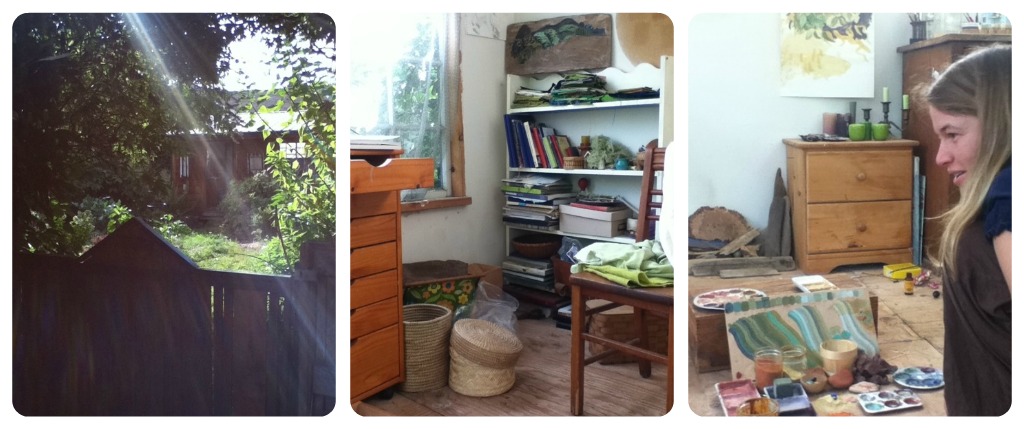
Tilke's backyard studio

While talking to her about her workshop, I started to describe my own challenges with colour: Since I started making quilts a couple years ago, I’ve struggled with figuring out how I want to put colours together and have realized how little confidence I have about colour. When I do hit on something I like, I mostly don’t know why it works. I described how a few days earlier I’d been in a fabric store trying to choose a few solid colours to buy: when I went for my favourites, the ones that caught my eye –fuchsia, emerald green and bright blue– they looked terrible together. When I tried to narrow my choice down to two colours that I thought of as complementary, the connotations seemed all wrong. I ended up leaving without buying anything.

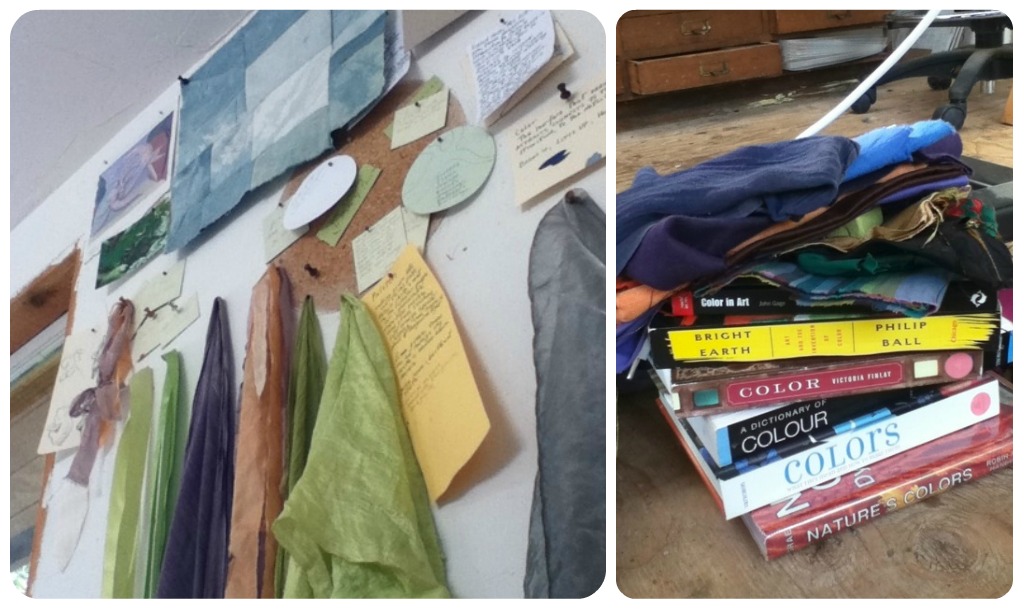
Plant-dyed fabrics, books about colour.

So here she was, someone trying to figure out how to teach people about colour, and here I was, a real, live colour novice with a hunger to learn. We went to look at her fabric stash and talk it out.

Tilke has a very distinctive colour palette that anyone who knows her would recognize, a family of colours she uses in her work and surrounds herself with. She described the way that certain colours in her family support or “bridge” other colours. I noticed as she moved fabric around that she mostly grouped her colours in sets of three or more. She agreed and showed me how adding a third colour can add a subtlety and depth that you can’t get with two colours.

I started to get a feel for what she was saying. I tried putting together my own set, choosing first a turquoise I liked and then adding another blue, a mushroom, a brown and an orange until – magic! – I had a group of colours that looked great together.

“What if you couldn’t have this one?” Tilke asked, and took out the orange. So I shuffled things around and brought in new colours until I had another set I liked. We talked about the importance of arrangement (which colours are beside each other) and proportion, looking at paintings and photos around her house for examples. Later we played a game with her new “colour library” of fabric samples, where we challenged each other to take the worst colours (eg: neon peach or drab burgundy) and make them beautiful by combining them with good supporting colours. Very fun!

I was so inspired that I started “editing” some patchwork pieces I’d sewn together a year ago that weren’t doing it for me: it suddenly seemed obvious which colours weren’t working, and taking them out made a big difference.

My quilt project, before and after colour editing.

We also had great talks and I got to try out throwing around medicine balls with them in the park (Ooof. My hands were too shaky to keyboard afterwards). It’s so fascinating to peer into – and join in on – other peoples’ lives like that. I’d like to do it again some time.

Campers at NBTSC threw me and Reanna a little engagement party, along with the other engaged couple at camp, Sean and MJ. It was very sweet. I cried. They made us blackberry cheesecake with freshly picked berries and gave us a standing ovation with hearts. Thanks guys!

(If you want to see the hearts and faces better, Mom, zoom in with ctrl+.)

For the last seven years, I’ve led a music project at session 2 of Not Back to School Camp. It’s always fun–a group of musicians of all skill levels and a broad range of instruments get together for the first time, learn to play as a band, write a piece of music, and play it for the rest of camp. In the past, we’ve had 10 hours to accomplish this task. This year, we had 6. Here is our performance:

I am on staff at Not Back to School Camp for my 13th year, this year, from mid-August to early October. These are the roles I’m filling:

Advisor: Each session I meet daily with a group of about 10 campers each morning for an emotional and physical well-being check-in. We practice listening to each other and get to know each other quite well during the session, so that by the end we feel close, like a little family unit at camp.

Project leader: At the second Oregon session this year I led two projects. In the Music Project, we had camper musicians of all skill levels, playing violin, banjo, melodica, harp, ukulele, electric and several acoustic guitars. In six hours over the course of three days, we learned to play together as a band, wrote a song, and then performed it for the camp. In a project called On Becoming a Man, I led a group of six young men in a two-day discussion of the difference between being a boy and being a man, how each of us related to those roles, and what we thought would be the ideal elements of a ritual induction into manhood for each of us.

Workshop leader: I am leading five workshops at each session of camp. They are hour-long presentations open to anyone who is interested. In “On Trauma and Healing” I present the modern understanding of psychological trauma and what it takes to heal. In “A Theory of Everything,” I present an overview of Ken Wilber’s integral philosophy. In “Family Maps” I teach campers how to make what family therapists call a genogram, showing their entire family and the relationships between each member. In “Partner Dancing,” I teach the basics of how to dance with another person, regardless of the music being played. In “The Human Bowel Movement,” I teach the physiology of bowel movements, complete with a tour of the digestive tract, using a full-length, stretched-out drawing of one, and diagrams of each stage of the bowel movement.

Staff therapist: I am available as a therapist to any of the campers who are looking for that kind of support. I use a humanistic, strengths-based, systemic approach, emphasizing relationships, self-care, and the power of honest communication.

Grace, Yared, Frisbee Game

Cuddle Puddle

A Few of My Favorite Food Servers

Forest Dell

Vanessa, Jake

Grace, Yared, Poppy

Staff Circle, Left

Staff Circle, Middle

Staff Circle, Right

Nathen With Delicious Cupcake, Camp Myrtlewood

Blake Losing a Wrestling Match, Gawkers

Dandy Treeclimbing, Camp Latgawa

Serena

Session 1 Advisee Group

Christian, Jeannie, Ia'ala, Yared, John

Community Meeting, Session 2

Angry Mob Takes Blake to the Swimming Hole

Christian, Reanna, My Knees

Reanna, Ia'ala

Reanna, Nathen, Camp Myrtlewood

I am piloting a new project this year at Not Back to School Camp called “On Becoming a Man.” I thought it would be a salient topic for many of the 13-18 year old males at camp. This is how I described it for campers looking for a project at camp:

“This project is for campers who are interested in becoming a man. It will include exploring the issues of what it means to be a man, the difference between manhood and boyhood, and the freedoms and responsibilities of manhood. Each participant will be supported in coming to a personal definition of manhood and, if they so decide, design a ritual entry into manhood.”

I’ve been thinking about the meaning of manhood a lot for many years, so I feel prepared for that part of the project. I am least prepared for the part where we design a coming of age ritual for each camper who chooses to have one. I’m doing some reading on it (Imber-Black and Roberts Rituals For Our Times) but not having had a coming of age ritual myself, I have next to no concrete examples. The gom jabbar ritual from Dune springs to mind, but I don’t have a poison needle or a pain box. (Plus I don’t think the NBTSC consent forms cover the possibility of death by poison needle!)

Did you have or have you witnessed a great coming of age ritual? Why was it great? Any horror stories? Thanks!

I have received several letters from my past self, as part of a ritual we do sometimes at Not Back to School Camp. The idea is to send the feeling and ideas of an experience forward, a reminder of the sense of clarity, inspiration, and purpose that is common at the end of a session of camp. It’s always interesting to get one of these letters, but they don’t often hit home like this one that I just received from myself of one year ago, just before I started seeing clients.

Hi Nathen,

I just did this guided imagery thing w-Jonathan Stemer in Child & Family Assessment and am to write or draw to you, my just-graduated self. I imagined myself as an old man, wrinkly, bald, spotty & beaming. The thing is, you will be an old man and you will look back on your just-graduated self with real love, with fondness & satisfaction. One thing you would want to say to yourself is that everything works out. You wouldn’t exactly say not to worry about it, because the worry is part of everything working out, but it has that flavor. Your story is good. You are worthwhile. People have been better off for knowing you. You are, right now, doing great. Notice it if you can.

Have a great summer, Nathen.

Love,

Nathen

Add drawing of old-man Nathen here –>

Staff of NBTSC

NBTSC 2010 Oregon Staff

I’m in the woods of Vermont, preparing for the start of the east coast sessions of Not Back To School Camp. Today is staff orientation and the campers arrive tomorrow–over a hundred teenaged unschoolers. If I’m counting right, this will be my thirtieth session. I’ve only missed two since 1999.

In our first go-round of our first meeting, Grace asked us to say why we come to camp. This was my answer:

First, because this is where my people gather. The staff here are like family to me and for the rest of the year, they are dispersed. I can visit them one at a time or in clumps, by traveling. Camp is also where I am most likely to meet my future people. I’ve met almost all of my post-high school close friends at NBTSC.

Second, NBTSC provides the perfect supportive atmosphere to practice how I want to be and serve in the outside world: I want to be a space for love and inspiration to show up, strong and clear, for every person who crosses my path.

Third, since NBTSC happens once a year, every year, with the same basic mission, structure, and community, it provides a consistent backdrop to check myself against. My outside life continues to change, but here I am every year, back at camp. How am I showing up differently? How have I grown? Here that is quite clear.

Last, it’s super, super fun. The young people are beautiful, inspiring, and open. There’s lots of music, dancing and hilarity. I love it.

2010 Oregon session one group photo

NBTSC Oregon Campers (session 1) 2010

« Previous PageNext Page »