I’m off caffeine right now and noticing an interesting and subtle improvement in my life that has highlighted a problem with caffeine. A few days ago, at work, I felt this low-energy sensation that caused me to think, “I need some caffeine.” That low-energy sensation was not low caffeine levels, though I had come to think of it that way. It was, of course, tiredness. Without recourse to caffeine I realized that I was just tired, there was nothing to do but take a rest or keep working tired. In that moment I was free of something that had caught me during the last year. I was a human being, tired, and this was what it felt like to be me right now. I could relax into that fact.

With caffeine in your life, there comes an element of constantly chasing the flame of perfect alertness, probably in the service of productivity, without having to use self-care or build distress tolerance.

Without caffeine its much easier to notice how much sleep is really enough, and that you, like all primates, get tired in the afternoon and should probably have a siesta–as is traditional among primates who have not inherited nothern-European culture. (No, it has nothing to do with lunch. How many times have you said, “Wow, breakfast really knocked me out”?) There is also the more esoteric but real opportunity for mindfulness and building equanimity towards the discomforts of life.

This kind of problem is a theme. I also happen to be off sugar right now, for example, and have noticed that my cravings for sugar happen when I am stressed. This was much harder to notice when I could just eat something sugary without thinking about it. I don’t think that sugar counteracts the stress, like caffeine does the tiredness, but I do think I’m unconsciously (and ineffectively) trying to manage stress when I eat sugar most of the time. The result is often bellyache. Off sugar, the question becomes, “Am I hungry?” or “Am I thirsty?” or just, “Am I restless and need a break or a few deep breaths?”

A third example is air conditioning. I live in the desert, and it’s hot during the day. I know from decades of experience that I can adapt to the heat by wearing appropriate clothes, using water, choosing activities based on the time of day, and just plain physiological adaptation. Now I work in air-conditioned offices 9-5, five days a week. For me that means wearing long-sleeve shirts over undershirts to stay warm enough, and never adapting to summer. So whenever I step outside it feels like a furnace and I’m dressed for a cool spring day. I have to use enough AC in my car that I don’t show up to clients’ houses drenched in sweat. It’s like pretending I don’t live in a desert.

Don’t get me wrong–caffeine, sugar, and AC are wonderful in their own ways and I don’t foresee giving any of them up permanently. I just recognize the way they get me trapped chasing a small, constantly moving space of theoretical comfort all day, often to my detriment.
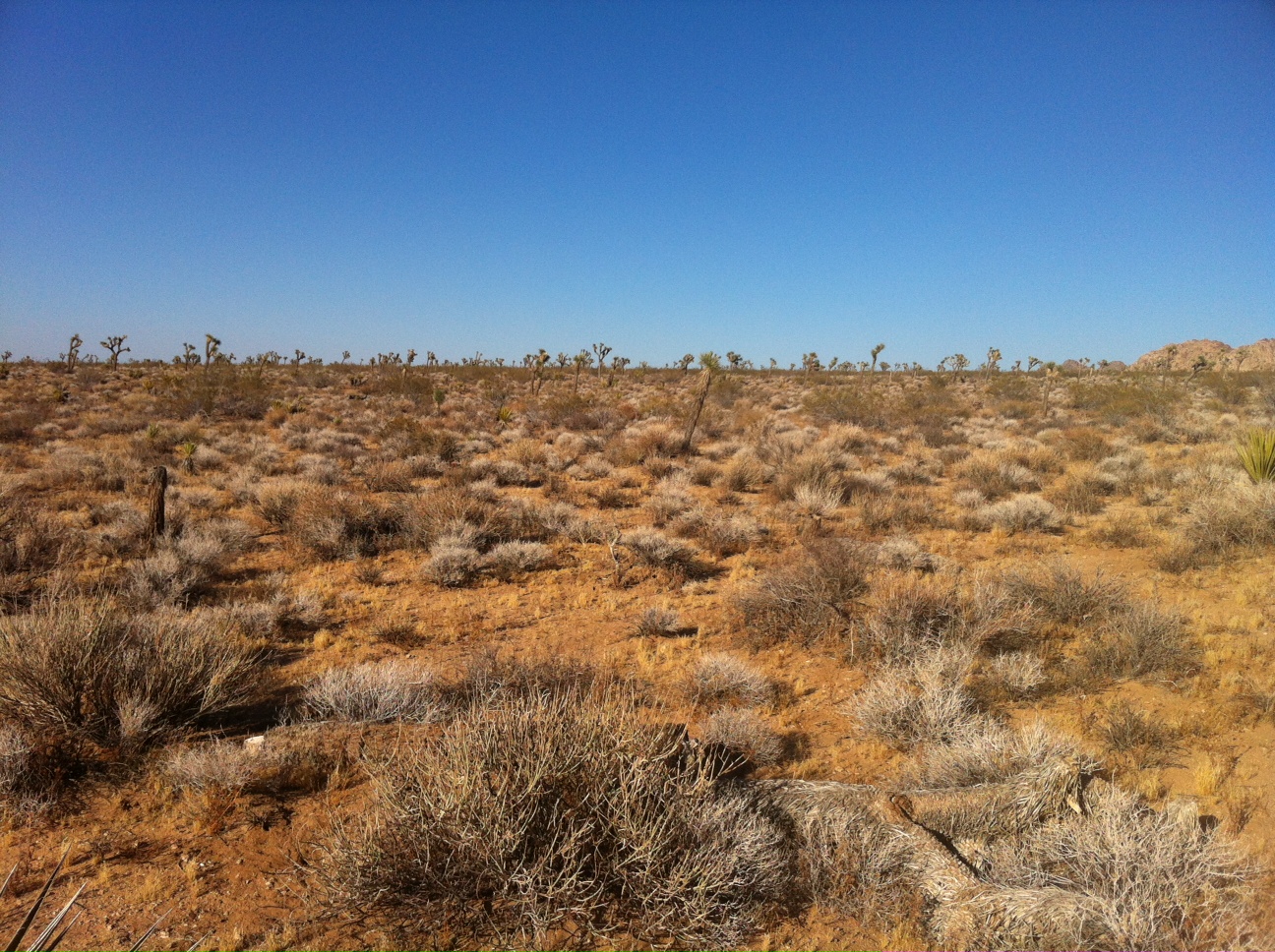
I was in the gym after work on Thursday and realized I’d rather be hiking. I decided to find the minute-microconfluence nearest the entrance of Joshua Tree National Park, which turns out to be N34 6′ x W116 15′ or 34.10 x -116.25. (Altimeter seems to be broken most of the time these days, so I downloaded DMS converter between DMS and decimal coordinates.)

It looked about a mile from the park entrance parking lot, so I parked and headed northeast through open desert from there–an area I’d never walked through.

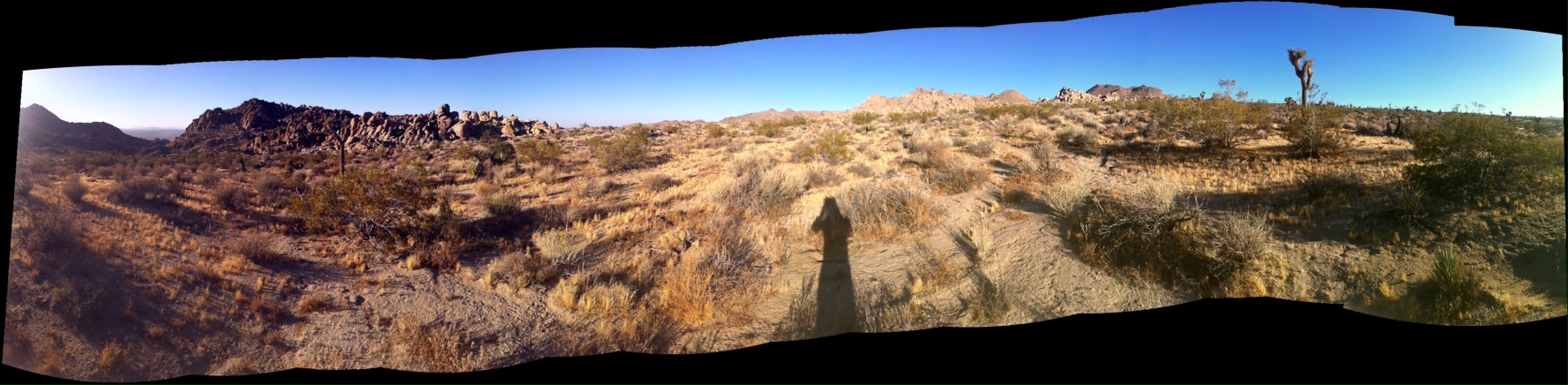
I got some great vistas on the way.

Sunfair dry lake through a notch

I was impressed with how every patch of soft sand was filled with tracks.

photo 3

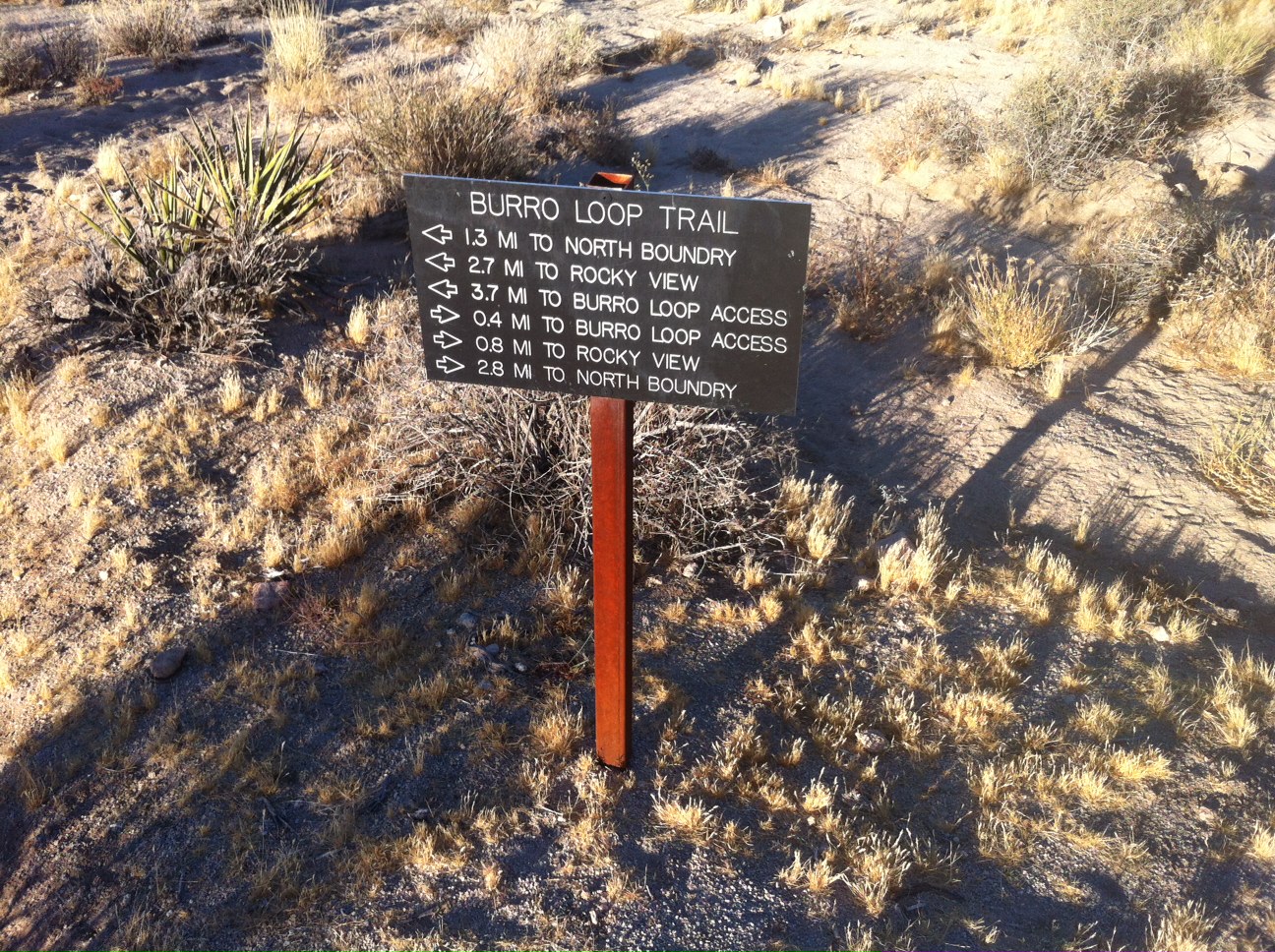
I thought this trek was taking me over ground people don’t really go, which may be true. The spot, though, turned out to be a few feet from Burro Loop Trail, which I would definitely take over the through-the-desert approach next time.

The area

The area

The spot

The spot

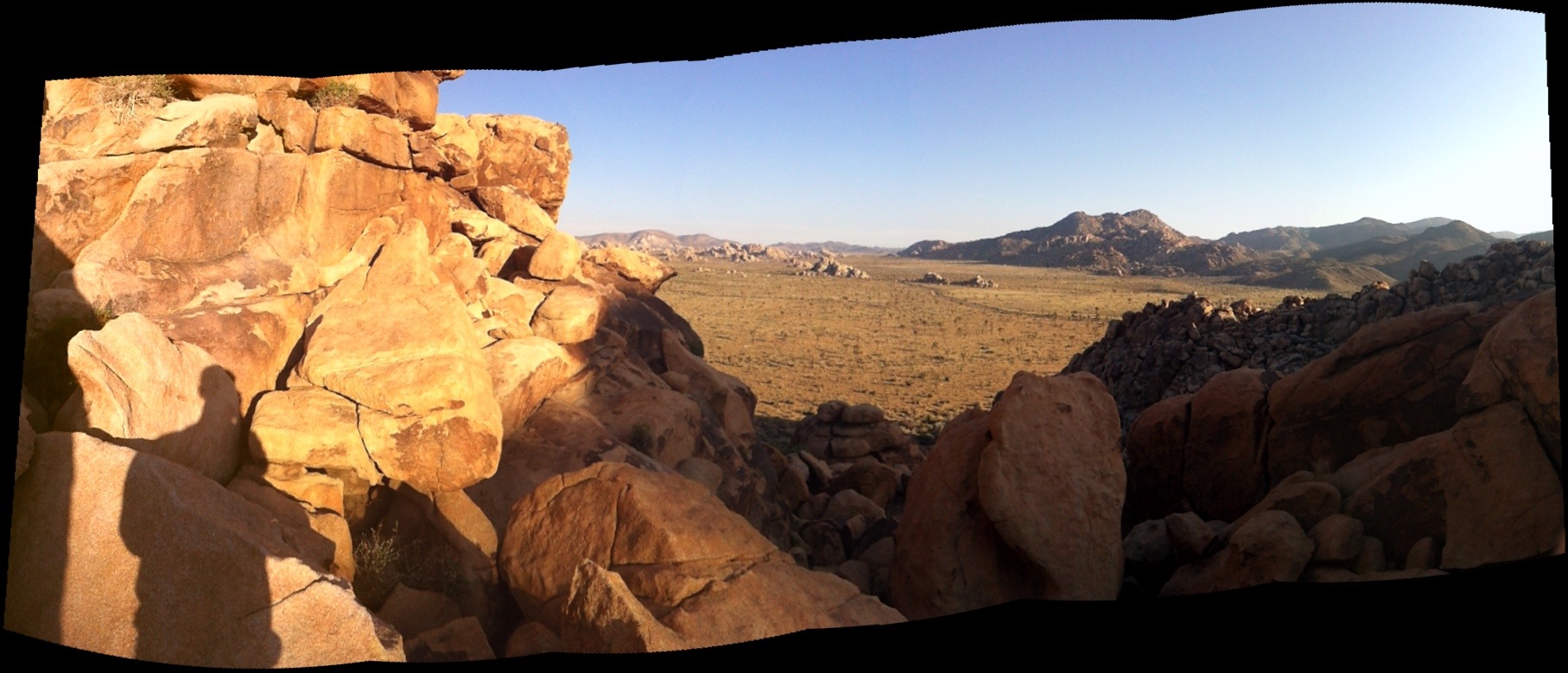
Panorama from the spot

Panorama from the spot

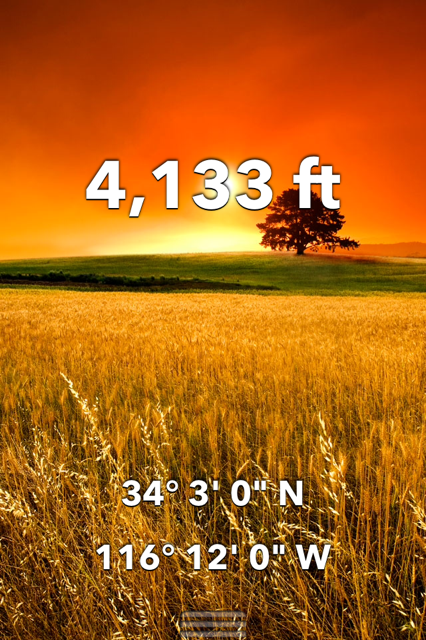
The coordinates on Maps With Me

The coordinates on Maps With Me*

And a couple hundred feet down the trail right next to the spot:


On Maps With Me I found I could put a bookmark on the coordinates I was looking for and then get a direction and distance indicator that led me eventually to the spot. It was good enough to be useful.

I hate wind. It’s a natural and deep hate that comes with growing up in the desert. So many swim practices on sunny days rendered freezing, so many treasured but aerodynamic objects disappeared to the next county, so many teenage hairstyles ruined. Wind is the Voldemort of Joshua Tree, the weather-that-shall-not-be-named: “Hey, have you noticed we haven’t had much doubleyou eye en-dee lately? Gotta love it!”

So since I’ve moved back to the desert, I’ve been thinking about what I could do to change my relationship with wind. I’d so much rather be happy than depressed when it blows, but it’s been a tough one. There’s just not much to like. I could get into kites, I guess, but I don’t feel excited about that idea. Desert kiteboarding (boarding starts at 1:00) looks like it could be fun but I’d need to get into much better shape. I’ll have to wait for my sprained wrist to heal, at least.

The obvious answer is energy-generating windmills, and I got excited about them for a while, but really we don’t need more electricity here. Thanks to a great investment by my dad, we have solar panels that generate about as much electricity as we can use.

The last idea I got excited about was a kind of wind-based CO2 scrubber. I imagined a funnel that directed air over a scrubber of some kind that was powered by an attached windmill. The scrubber would poop carbon dust (or bricks, even better) that I could bury somewhere on my property. Or whatever the hippest thing to do with carbon dust is–I never got that far. Genius, I thought. I could be happy about wind that was doing some small part to undo my pollution.

I never got that far because there are only prototypes of machines kind of like it at this point, and it is apparently not clear how well they will work. As I understand it, scrubbing CO2 out of air is difficult to do because there is so little CO2 in air. It’s much easier to do where the pollution is thick, like industrial smoke stacks. The takeaway from my several hours of looking into it was that it was probably more ethical to use whatever extra money I could scrape together to buy and install more solar panels to connect to the grid.  Not as satisfying as sucking my own pollution out of the air, but donating clean energy to power other people’s lives could mean less pollution produced in the first place.

Thinking about carbon sequestration shifted my thinking a bit in an unexpected direction. The millions and millions of stick frame houses in the US are made of sequestered carbon, for example. And landfills: All the junk mail and cardboard boxes in landfills are made of sequestered carbon.  All the plastic crap in landfills is made of sequestered carbon. I still think that forest conservation, sustainable forest management, and reforestation are some of the very most important things we can do, but I no longer cringe as much when I see forest products heading for landfills, stick frame houses in deserts, or wood siding when it should have been plaster. Even all that tragic plastic crap–at least we’re not burning it.


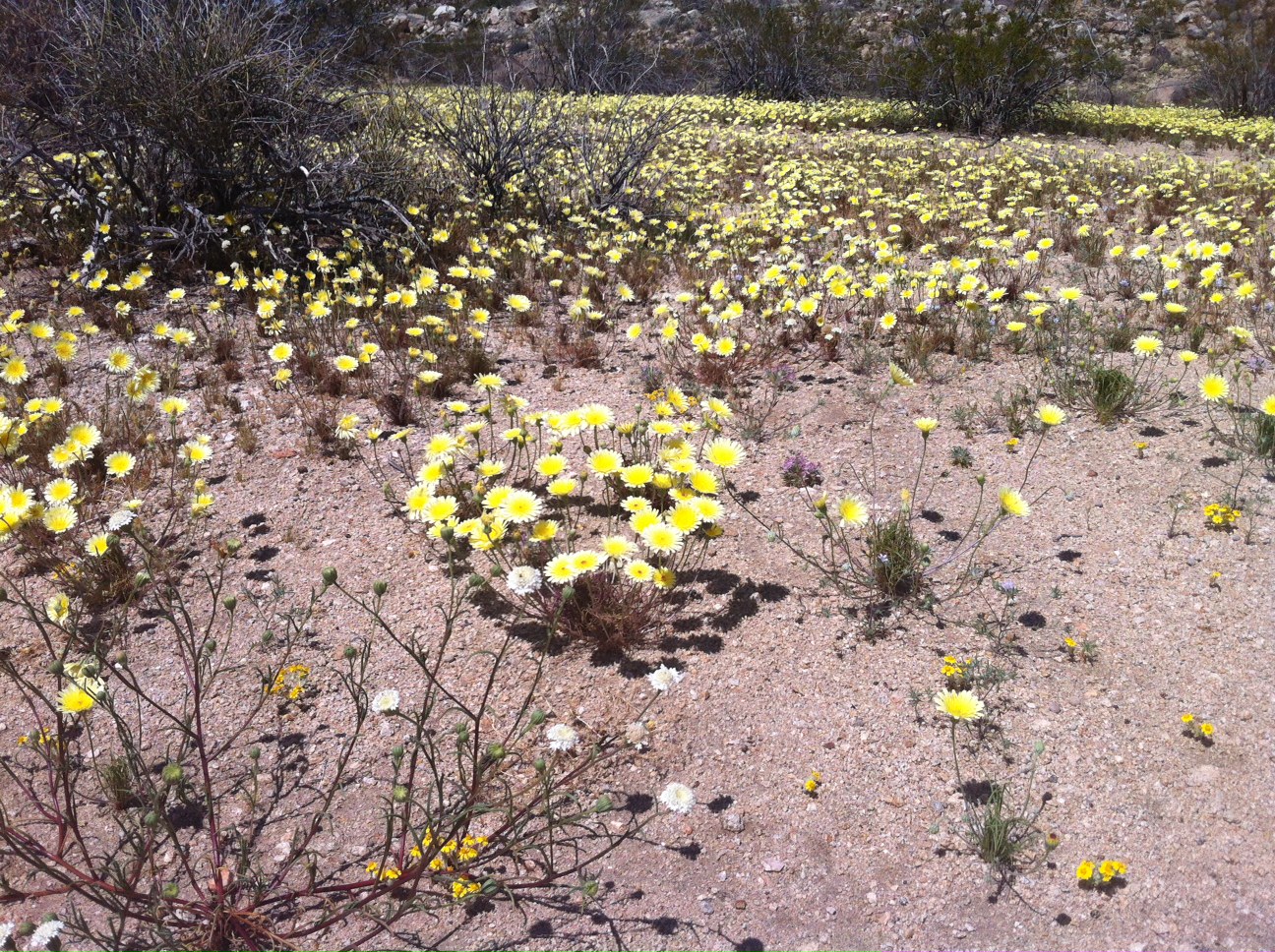
Reanna and I took a drive into JT National Park after work today, to see the wildflowers before she leaves for a natural building workshop at Quail Springs Permaculture. We parked along the road and hiked a few minutes south to see a microconfluence. It ended up being a fair scramble, too, 3/4 of the way up the pile of rocks behind Reanna here:

pano

It was a bigger challenge to find the exact spot up on steep rocks than in previous, flat spots (here, here, here & here), because of the climbing and being a bit out of breath, but more fun, too. Here’s the spot:

microconfluenceAnd the view from the spot:

pano from microconfluence

And the proof according to Altimeter and Maps With Me:

photo 3

photo 4


I drove to a nearby microconfluence today, on my lunch break. (Others here, here, and here.) It was beautiful. It’s just north of Rincon and east of Quail Springs in Joshua Tree:

photophoto (1)

photo (4)

The area

photo (3)

The spot

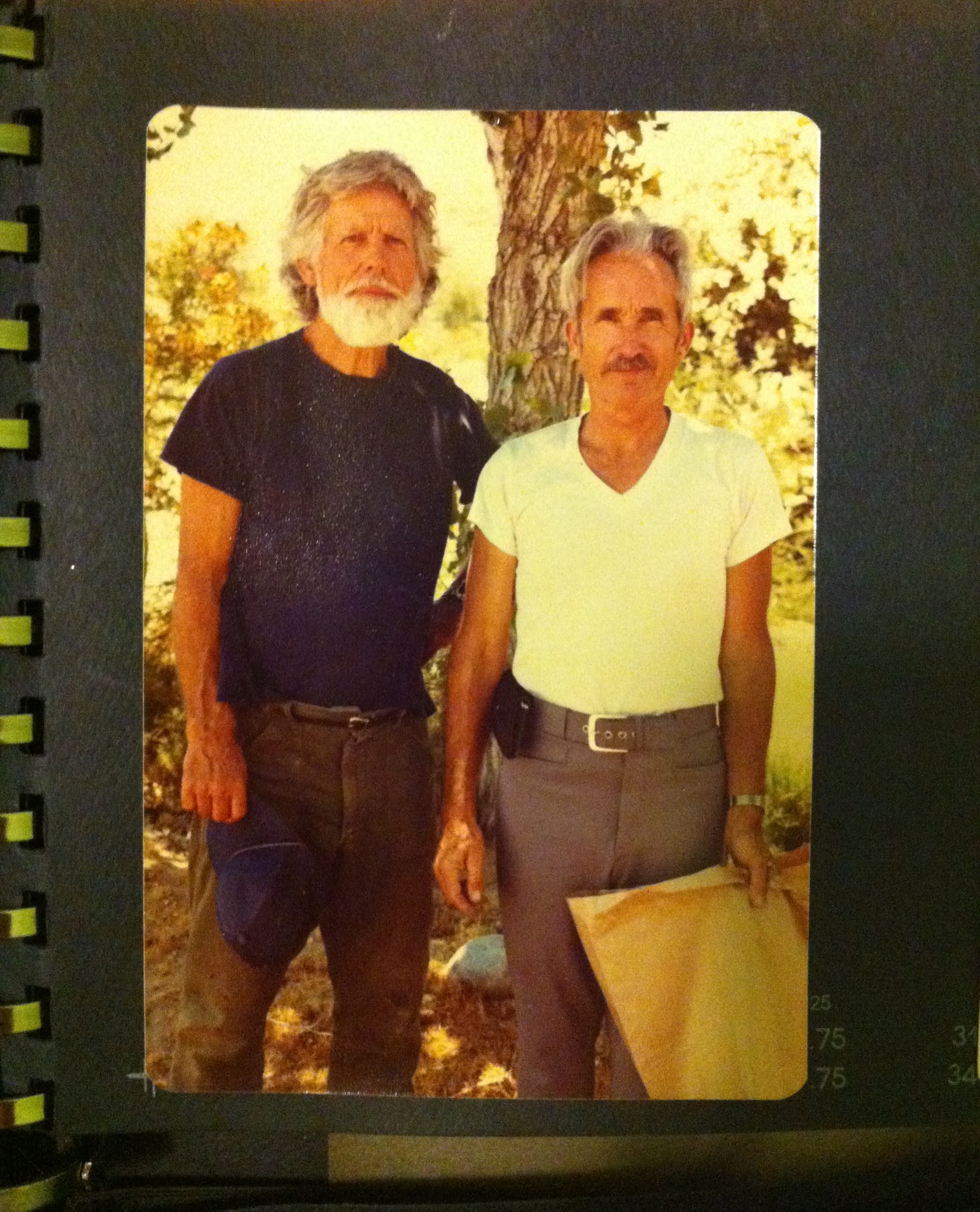
My friend Rollie has died. He had an amazing life and taught me a lot. I am not the right person to describe his life and I’d decided not to describe any of his adventures here, but a quick look shows that there is really nothing online about him. So here’s a very short version of one of his typical adventures: In his mid-70s, he climbed K2. The sherpa didn’t want to let him come because he was too old, “But I was not the one who held us up… Not once.” On that trip to Nepal, he caught amoebic dysentery, which he cured himself of with a gruesome regimen involving coffee, hydrogen peroxide, bifidus, and enemas.  “That was not fun, let me tell you, but I got rid of that bug. I went back to the doctors and they said it was completely gone.”

Right now I’m thinking most about what he taught me about getting old. He was still on an intellectual and spiritual mission when I last saw him, a week before he died. (In fact, the moment I learned he’d died, I was on my way to his house with the King James Bible on an Excel file–something he’d asked me to find to help with a scheme he had for decoding the Bible.) His memory and his mind were still strong, though his body was failing. Almost a hundred years old and he would tell me to “google” stuff, like, “Oh, just google ‘swansons’–they’ve got good deals on B12.” You can continue to learn and grow for almost a hundred years. I’ve seen it in Rollie. And you can keep your body going, too, but it’s work. He would say, “Nature is basically on your side until your 70s. In your 70s, you’ve got to work at, get it down to a science. In your 80s, it’s full-time. It’s an art and a science to keep going. In your 90s, it’s between you and God.”

He’s got me thinking about isolation in old age. He had a lot of friends in the community, but he spent most of his time alone and he told me several times that the loneliness was hardest part of his life. He had no family left in the time of his life when he needed pretty constant companionship, someone to notice when he fell. I suppose there is only so much planning you can do to head yourself towards an old age full of care and companionship. There’s a lot of luck involved. But I am thinking about it. It makes a big difference

Rollie was also one of my grandfather’s best friends over the last 60-some years, and the most poignant part of a poignant funeral for me was seeing my grandfather cry. He doesn’t generally cry, and never like that, sobbing. I felt the power of that moment and realized I haven’t known anyone for 60-some years, and I don’t know what that’s like, the depth of a 60-year relationship, the kind of hole that would leave in your life. But that’s how you want it to be, right? You want to have good enough, long enough, deep enough friendships that leave you heartbroken when they die. But you also want to have a lot of other dear relationships around you to take up the slack. My grandfather has that, and I want that, too.

Thanks for everything, Rollie.

Rollie (left) with Grandpa Bob, mid-1980s

Rollie (left) with Grandpa Bob, mid-1980s

I propose that there are four basic categories that all theoretical knowledge* eventually ends up in:

1) Wrong: These facts are shown to be straightforwardly incorrect.

2) Forgotten: We used to “know” these facts to be true, now we don’t remember them well enough to check.

3) Irrelevant: We might still think these facts are true, or maybe not, but no one cares enough to check.

4) Quaint: These facts were on to something that led somewhere, but reality turns out to be so vastly more complicated that the original ideas seem simpleminded, funny, or even cute.


*By this I technically mean all a posteriori propositional knowledge, though it may turn out to be true in a broader sense. I suppose, however, that the best I can hope for in the long run is that this proposal is true in a “quaint” sense.

Dr. Renato Guzman

Dr. Renato Guzman

On June 23, 1994, this man saved my mom’s life by performing emergency surgery. I got to meet him when my mom was in the hospital two weeks ago for a repeat of the same ailment. He was ready to save her life again, but it turned out that she didn’t need it this time. He didn’t strike me as a person who would enjoy this kind of accolade, but I feel compelled.

At the time of the surgery, I was 22 old and appropriately egocentric. I remember being scared that my mom was in the hospital, had a tube coming out of her nose, and seemed suddenly so helpless. (As far as I know, the only other time she’d been in the hospital was for my delivery.) It did not occur to me to seek out and thank Dr. Guzman. I never felt much gratitude towards him in the years since, either, possibly because of how long and arduous her recovery was.

This time around I was much more involved and met Dr. Guzman several times. This time it became very clear: This man allowed my mom to live twenty more years, and hopefully a lot more, than she otherwise would have. He allowed my mom to see my brothers grow up, meet their wives and children, meet my wife, and take part in all of our lives as fully as she has. He made it possible for my mom to do all the wonderful things she has done, with and for our family and community, for the last twenty years. I am grateful for him, his skill, and all the choices he made that brought him to be a surgeon in Joshua Tree. Thank you, Dr. Guzman!

(Read my mom’s account of her recent hospital stay here.)

My wife Reanna was ambivalent about owning her first car, largely for reasons of environmental ethics. So when she got one she started reading about “hypermilers,” a group of people developing driving techniques to increase gas mileage in their vehicles.

I’ve been interested, of course–this is right up my alley–but have little time for reading these days. Here is the only hypermiling post I’ve read,which is quite good. Mr. Money Mustache, a financial blogger, monitors his miles per gallon, gallons per hour, and other information like engine temperature in real time while he drives. He uses a bunch of driving techniques, and averages 44 MPG in his Scion (rated at 27 MPG) in city driving. Some highlights from the article:

“‘If you have to brake, you’ve made a mistake’…. [P]retend [your brakes] are hooked up to a speaker on your dashboard which blares out my voice saying ‘MEEEEEEEHHHHHHHHHH!!!’ at you for the duration of your brake application….”

When you decide to drive 75 MPH, sing this song in your head: “I am Mister Fancy, I am in a hurry, my time is so valuable that I am wasting gas. Wasting gas, wasting gas, look out world I’m wasting gas. Tomorrow I will save some gas, but today I’m wasting gas”.

On the use of air conditioning: “Is it dollar-an-hour hot in here today, or not?”

Reanna started tracking her by-the-tank gas mileage right away, using Gas Cubby, so we have a record of the MPG for every tank of gas we’ve put in. Lately I’ve been driving it the most, so I decided on an experiment based on Saul Griffith’s (which I wrote a bit about and linked to here):  I drove a full tank with an self-imposed speed limit of 60 MPH and then a tank at 55 MPH max. There are 65 and 60 MPH speed limits posted for parts of my normal commutes, so these new limits affected a significant amount of my driving–maybe a third? So to be clear, I drove normally for me (which does not include hypermiling techniques, for the most part) unless the posted limit was above my imposed new limit, when I would drive at that speed.

Hack display of 29 tanks in our 2-door Toyota Yaris. The X axis is MPG.

Sorry about the hack display, but I think it gets the point across. Each dot is a tank and bigger dots mean more tanks at that MPG. The tank with a 55 MPH speed limit was the least efficient driving, at 32.5 MPG and the tank with a 60 MPH speed limit was the most efficient, at 40.8 MPG. I really did not expect this. I expected 55 to be more efficient than 60 and I did not expect a limit of 60 to make much of a difference.

Some complications to consider: 1) It is winter right now, and we are not using air conditioning, while many of these tanks supplied energy for significant AC use. And colder engines are less efficient. 2) I was not perfect and exceeded by self-imposed speed limits accidentally, off and on. Also, I drove 10-15 minutes of my 55 MPH tank at posted speed limits of 60 and 65 because I had something time-sensitive to deal with while my mom was in the hospital. 3) Reanna drove the Yaris 25-30% of these tanks, and she is a congenitally slow driver, rarely exceeding 55 MPH.

And a note about the psychology of driving slower than a posted speed limit: I was surprised at how embarrassed and defensive I felt while driving slowly on the highway. It breaks a social norm that I didn’t often notice: Driving slower than a posted speed limit is deviant. You will drive as fast as you are allowed, if not faster. It reminded me of when, because of a back injury while a student at the University of Oregon, I started standing in the back of the class during lectures. I realized that no one stands during lectures or meetings, and it really sticks out when someone does, regardless of how harmful sitting is.

You might argue that the amount of time community mental health therapists spend writing paperwork is unethical, and you would be right in at least two ways: (1) It is an unethical use of tax payer money, paper, and storage space, as much of it is redundant, and (2) it squanders a valuable resource, attention from therapists, on writing, which we are not particularly good or efficient at.

But the worst part for me is that I consider myself a writer of sorts and really care about the quality of my writing, but now spend a large part of my full time week practicing how to write badly. I groan inwardly each time I write something like, “Clinician used psychoeducation about anchoring and adjustment and introduced perspective taking exercises. Client showed understanding of psychoeducation and participated in perspective taking exercises.” And there is no time or economic incentive to make it better.

At least, I tell myself, I did not “utilize” psychoeducation like many of my dear colleagues, but that is small comfort.

It reminds me of why I got out of the small-time freelance record production business. There I was, a songwriter, and the grist for my creative mill was whatever songs someone who could afford my hourly rate brought to me. And those over, and over, and over. Don’t get me wrong–I loved the work and most of what my client’s brought me was good, I just needed to curate what went into my ears more carefully.

The analogy is not perfect, but close. Therapist paperwork writing is not only bad, but emphasizes the least important parts of therapy. A good document of therapy would be more like one of Irvin Yalom’s novels, narrative, interesting, a document of confusion, exploration, courage, inspiration, a document of the development of a mutually beneficial relationship. But this is not what gets you paid. “Clinician challenged cognitive distortions” gets you paid.

And the writing of notes does intrude into therapy occasionally. Occasionally, in session, I have the thought, “How am I going to write this up?” Not a therapeutic thought. Brush it aside, suppress shudder, return attention to client.

One of my supervisors likes to say, “You need to own your charts, you need to love your charts. Your documentation is the only record of what you do.” In an economic and bureaucratic sense, she is exactly right. And I am committed to this career, so I know what I need to do: Fully master the paperwork. Spend as much time as necessary now so that the future me will have perfect case notes, perfect assessments, perfect charts, with no more than the minimal time, stress, and effort spent.  And hope that the bad writing I am practicing makes the minimal impression on my creative brain.